
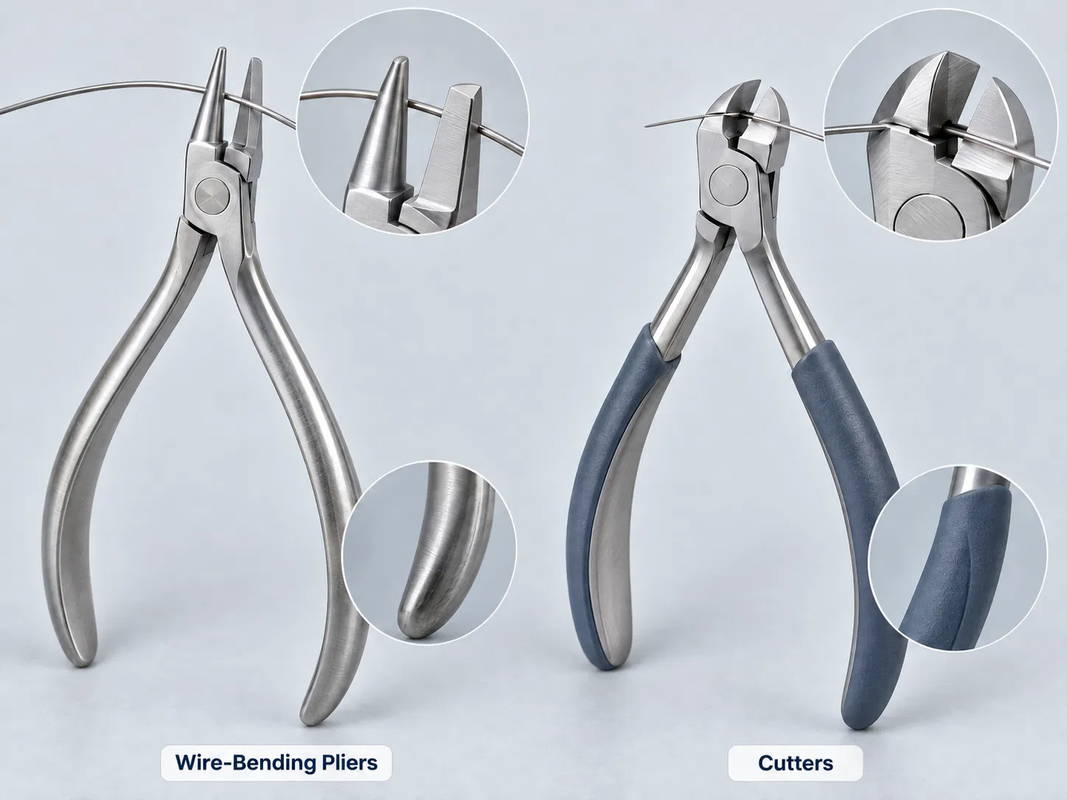
Orthodontic treatment depends heavily on precision wire adjustments. From forming loops to trimming excess archwire, clinicians rely on two essential instrument categories: wire bending pliers and orthodontic cutters.
Although they may appear similar at first glance, their beak structure, cutting mechanisms, and grip design are fundamentally different. Understanding these structural features helps clinicians select the right instrument, improve efficiency, and prevent wire distortion or instrument damage.
Understanding Wire Bending Pliers
Wire bending pliers are designed to shape, contour, and adjust orthodontic wires without cutting them. They allow controlled manipulation of stainless steel, NiTi, and other orthodontic alloys.
1. Beak Structure in Wire Bending Pliers
The beak (working end) is the most critical structural element.
Common design variations include:
- Tapered beaks for precision loop formation
- Round and flat beak combinations for torque and right-angle bends
- Smooth inner surfaces to prevent wire scoring
- Fine tip alignment for delicate adjustments
The length and taper of the beak determine access in posterior areas and influence bending accuracy.
2. Mechanical Function
Wire bending pliers function through:
- Controlled compressive force
- Balanced pivot alignment
- Stable hinge construction
They are not sharpened and should never be used for cutting, as this can misalign the beaks and damage the hinge.
3. Grip Design
Orthodontic pliers typically feature:
- Ergonomic handle curvature
- Non-slip surface finishing
- Box joint or lap joint construction
- Optional spring-loaded mechanisms
A well-balanced grip reduces hand fatigue during long procedures.
Understanding Orthodontic Cutters
Orthodontic cutters are specifically engineered to cut archwires, ligature wires, and pins with precision and minimal distortion.
1. Cutting Mechanism & Edge Geometry
Unlike pliers, cutters feature:
- Sharp cutting edges
- Carbide inserts for increased hardness
- Angled cutting heads for distal access
- Flush-cut or safety-hold designs to prevent wire projection
The geometry of the cutting edge determines whether the instrument produces:
- A flush end (close to bracket)
- A safety-hold cut (retains wire segment)
- A hard-wire cut (for stainless steel wires)
2. Beak Structure in Cutters
The beaks of cutters are:
- Shorter and stronger
- Reinforced at the cutting zone
- Precisely aligned for edge-to-edge contact
High-quality cutters maintain edge integrity even after repeated autoclave cycles.
3. Grip & Control
Cutters often include:
- Double-leaf spring mechanisms
- Cushion grips for shock absorption
- Anti-slip handle texture
- Heavy-duty box joint design
These features provide stability when cutting high-tensile wires.
Key Differences Between Wire Bending Pliers and Cutters
| Feature | Wire Bending Pliers | Orthodontic Cutters |
|---|---|---|
| Primary Function | Bending & shaping | Cutting & trimming |
| Beak Design | Tapered, smooth | Short, reinforced |
| Cutting Edges | None | Sharp, carbide-tipped |
| Force Type | Compression & torque | Shearing force |
| Risk if Misused | Wire distortion | Edge chipping |
Using the wrong instrument can result in:
- Damaged cutting edges
- Misaligned beaks
- Inaccurate wire adjustments
- Reduced instrument lifespan
Material & Manufacturing Considerations
High-quality orthodontic instruments should be manufactured from:
- Medical-grade stainless steel
- Tungsten carbide inserts (for cutters)
- Corrosion-resistant alloys
- Precision-machined hinges
Additional finishing features may include:
- Satin or matte anti-glare surface
- Polished working ends
- Laser-marked identification
All instruments must be fully autoclavable and compliant with international sterilization standards.
Clinical Application Scenarios
Wire Bending Pliers are ideal for:
- Loop formation
- Step bends
- Torque adjustments
- Rectangular wire contouring
Orthodontic Cutters are essential for:
- Distal archwire trimming
- Ligature wire cutting
- Pin and spring trimming
- Hard-wire cutting procedures
How to Choose the Right Instrument
When selecting orthodontic pliers or cutters, consider:
- Wire material compatibility
- Beak size and access requirement
- Cutting capacity rating
- Handle ergonomics
- Clinical frequency of use
Investing in correctly designed instruments improves precision, safety, and overall treatment efficiency.
Final Thoughts
Wire bending pliers and orthodontic cutters may look similar, but their beak structure, cutting mechanism, and grip design define completely different clinical functions.
Choosing the right instrument not only enhances accuracy but also protects both the wire and the tool itself. For orthodontic practices, understanding these structural differences is essential for long-term performance and predictable treatment outcomes.