
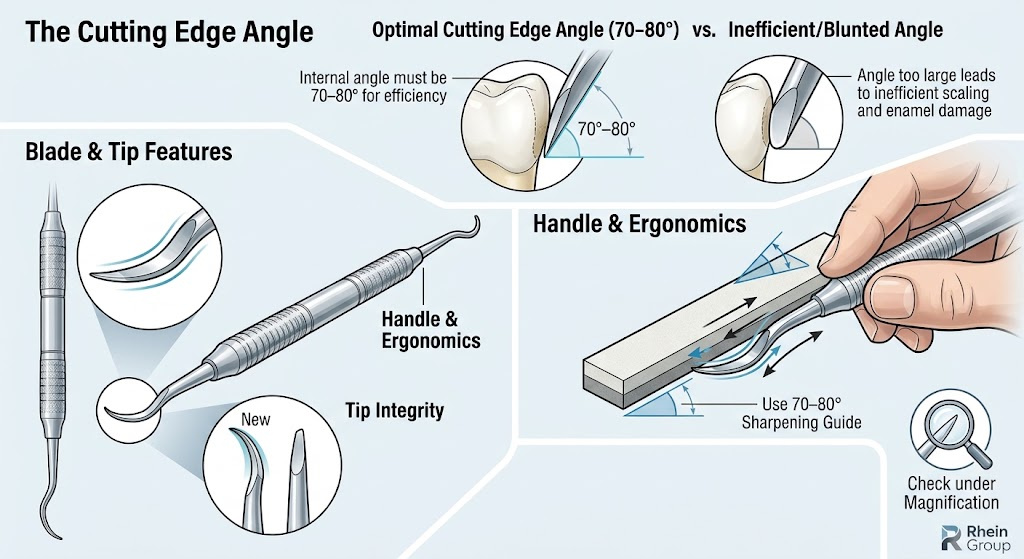
Dental scalers are essential instruments for effective plaque and calculus removal in dental practice. Maintaining their sharpness not only improves clinical efficiency but also ensures patient comfort and clinician safety. One of the most critical aspects of scaler maintenance is preserving the 70–80° cutting edge angle, alongside attention to the blade, tip, and handle features (Dental Scaler Sharpening).
Understanding the Cutting Edge Angle
The cutting edge angle of a dental scaler directly impacts its efficiency. A 70–80° angle is ideal for:
- Effective calculus removal without excessive force
- Minimizing damage to tooth enamel and soft tissues
- Reducing hand fatigue during prolonged procedures
Using an incorrect angle can blunt the instrument quickly or cause inefficient scaling, leading to longer treatment times and patient discomfort (Dental Scaler Sharpening).
Structural Features to Consider While Sharpening
1. Blade Shape and Design
The blade of a scaler determines how it contacts the tooth surface. Key points to remember:
- Maintain the original curvature of the blade
- Avoid over-sharpening the sides, which can alter the blade profile
- Use fine-grit sharpening stones or devices suited for dental instruments
2. Tip Integrity
The tip is the point of contact for subgingival and interproximal scaling. Maintaining its shape is essential:
- Ensure the tip is symmetrical and retains its original contour
- Avoid rounding or flattening during sharpening
- Check under magnification for precision
3. Handle and Ergonomics
Although the handle doesn’t directly contact teeth, its design affects sharpening and handling:
- A well-balanced handle allows precise control while sharpening
- Textured or ergonomic handles reduce slipping and improve comfort
- Consider lightweight materials to minimize clinician fatigue
Sharpening Techniques for Optimal Performance
- Use the Correct Stone – Ceramic or fine-grit diamond stones are recommended.
- Maintain the 70–80° Angle – Use angle guides or sharpening jigs to stay consistent.
- Stroke Method – Use light, controlled strokes along the blade’s lateral surfaces.
- Regular Inspection – Check sharpness under magnification before each procedure.
- Cleaning After Sharpening – Remove debris and polish the blade to prevent corrosion.
Benefits of Properly Sharpened Scalers
- Efficient plaque and calculus removal
- Reduced hand strain for clinicians
- Minimized patient discomfort
- Extended lifespan of dental instruments
Conclusion
Maintaining dental scalers at the proper 70–80° cutting edge angle while respecting the blade, tip, and handle features ensures optimal performance and safety. Regular sharpening, inspection, and careful handling are essential practices for every dental professional aiming to provide precise and comfortable care (Dental Scaler Sharpening).