
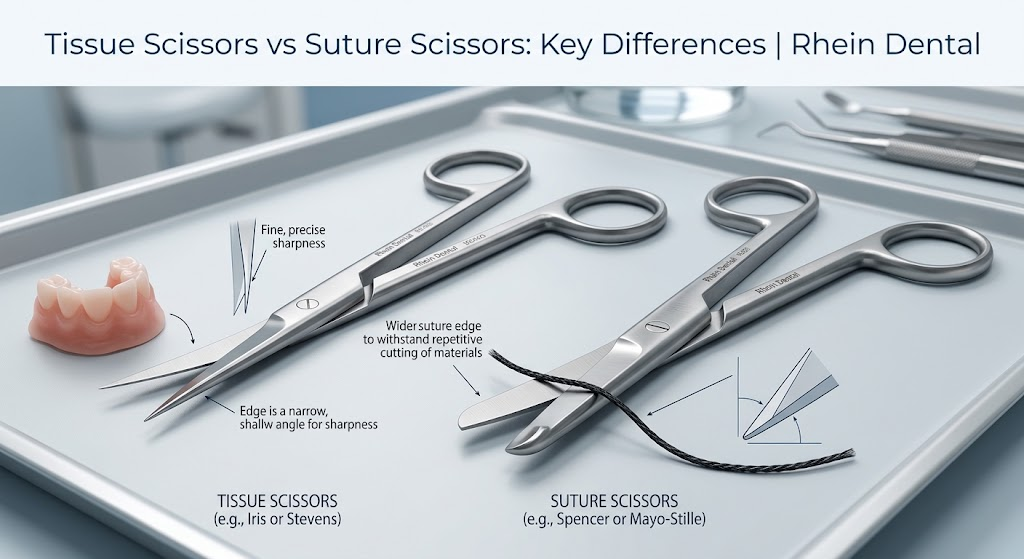
Tissue scissors and suture scissors differ mainly in blade sharpness and edge angle. Tissue scissors carry an ultra-sharp, finely honed blade. Surgeons use them for precise dissection of delicate tissue. Suture scissors carry a sturdier, less sharp edge. This design lets them cut suture material again and again without dulling quickly.
These two instruments often sit side by side on the same tray. They can look nearly identical at a glance. Yet each one solves a completely different clinical problem. Surgeons, scrub nurses, and procurement teams all benefit from knowing the difference. The right choice protects both patient outcomes and instrument lifespan.
Why the Difference Between Tissue Scissors and Suture Scissors Matters
Tissue scissors vs suture scissors are two instruments up might seem harmless at first. In practice, though, using the wrong scissor creates real clinical risk. Cutting sutures with a delicate tissue scissor dulls its razor-sharp edge almost instantly. This weakens its dissection performance for the rest of the procedure. Using a suture scissor for fine tissue work causes the opposite problem. Its blunter edge can crush tissue instead of cutting it cleanly. This slows healing and raises the risk of scarring.
Most OR training programs treat scissor selection as a core skill. It’s never just a minor detail. Getting it right protects instrument longevity. It also protects the patient.
A well-known review of surgical scissors on ScienceDirect’s clinical instrument reference confirms this distinction across major scissor types. The review notes that Metzenbaum scissors stay thin and delicate for tissue dissection, while Mayo-style scissors are built heavier and often serve as the “suture” or “material” scissor on the tray. High-quality Metzenbaum blades should never handle rougher materials like sutures or mesh, since that quickly damages their fine edge.
Tissue Scissors: Design, Function, and Uses
What Are Tissue Scissors?
Tissue scissors are precision instruments. Surgeons use them to cut and dissect delicate structures like skin, fascia, muscle, and internal organs. Their defining trait is an extremely sharp cutting edge. Many models also feature fine, tapered tips. This gives surgeons better control in tight or sensitive areas.
Key Design Features
- Acute blade angle produces a cleaner cut with less tissue trauma
- Thin, lightweight blades reduce drag and allow smooth, delicate movement
- Sharp or fine tips Metzenbaum-style scissors use long, thin blades with rounded tips for both cutting and blunt dissection
- Curved or straight designs curved blades reach deeper and improve visibility, while straight blades handle surface-level cuts
Common Clinical Uses
- Fascia and muscle dissection in general surgery
- Delicate tissue separation in plastic and reconstructive procedures
- Fine dissection in ophthalmic and microsurgical settings
- Blunt dissection to spread tissue planes before cutting
Maintenance Consideration
This sharpness comes at a cost. Tissue scissors need careful handling and regular upkeep. Cutting tougher, non-biological materials sutures, gauze, or drapes dulls the blade fast. That shortens the instrument’s useful life considerably.
Suture Scissors: Design, Function, and Uses
What Are Suture Scissors?
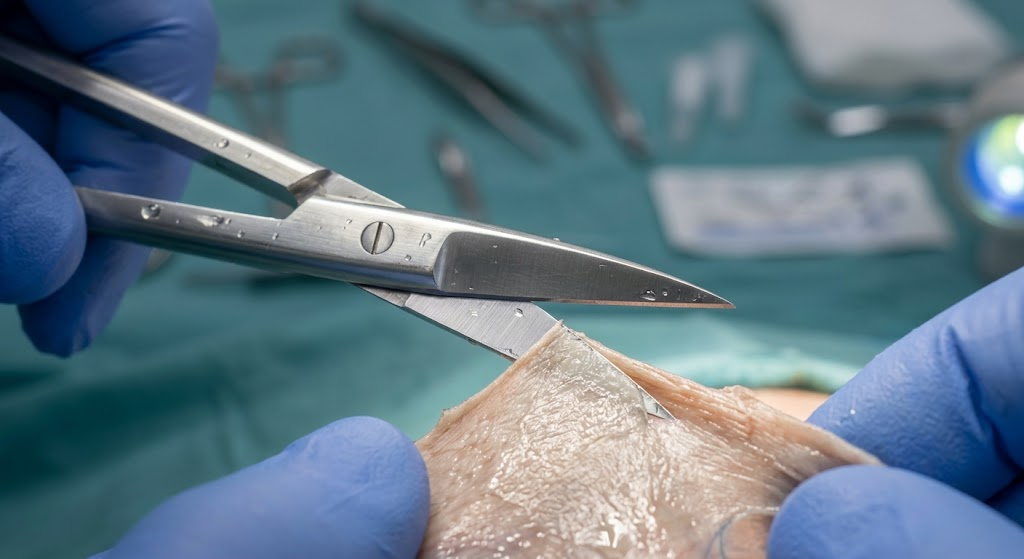
Suture scissors go by other names too, like stitch scissors or suture-cutting scissors. Surgeons and clinicians use them to cut suture material cleanly during wound closure or suture removal. Unlike tissue scissors, they favor durability over razor sharpness.
Key Design Features
- Less acute blade angle trades some sharpness for durability and consistent performance
- Sturdier blade construction often reinforced or serrated near the edge to grip suture material before cutting
- Blunt or semi-blunt tips lowers the risk of nicking skin or tissue during suture removal
- Hook-tip variants some suture-removal scissors add a small hook on one blade. This hook slides under the suture and lifts it away from the skin. It prevents slippage before the cut
Common Clinical Uses
- Cutting sutures during wound closure
- Removing sutures in clinics and outpatient settings
- Trimming suture ends after knot-tying, across silk, nylon, and polypropylene
- General cutting of ligatures and other non-tissue surgical materials
Some combination instruments take this a step further. They build a scissor edge directly into a needle holder. This design cuts down on hand exchanges during suturing. It’s a related but different approach to saving time in the OR.
Why Durability Matters More Here in tissue scissors vs suture scissors
Suture scissors regularly touch tougher synthetic and natural fibers. A razor-sharp edge would dull fast and lose consistency. Instead, a slightly blunter, sturdier edge holds up across hundreds of uses. For busy clinics and surgical settings, that reliability saves both time and money.
The product guidance from World Precision Instruments’ surgical scissors overview supports this point well. It explains that stitch scissors use small blades with sharp tips built specifically for suture cutting and removal, while heavier Mayo-style scissors handle tougher dissection tasks like cutting fascia or muscle.
Tissue Scissors vs Suture Scissors: Side-by-Side Comparison
| Feature | Tissue Scissors | Suture Scissors |
|---|---|---|
| Primary purpose | Cutting and dissecting tissue | Cutting sutures and ligatures |
| Blade sharpness | Extremely sharp, finely honed | Moderately sharp, more durable |
| Blade angle | Acute, precision-focused | Less acute, built for repeated cutting |
| Tip style | Sharp or fine-tapered | Blunt or semi-blunt for safety |
| Common materials cut | Skin, fascia, muscle | Silk, nylon, polypropylene sutures |
| Durability on non-tissue use | Dulls quickly if misused | Holds edge well over time |
| Typical settings | Dissection-heavy procedures | OR closures, outpatient removal |
| Handle style | Ring-handle, various lengths | Ring-handle, often shorter |
How to Choose the Right Scissor for Your Procedure
Match the instrument to the task. Don’t choose based on habit or convenience alone. Use this quick checklist before you set up your tray in tissue scissors vs suture scissors:
Choose tissue scissors when you need to:
- Dissect fascia, muscle, or delicate internal structures
- Perform blunt dissection to separate tissue planes
- Get the cleanest possible cut with minimal trauma
Choose suture scissors when you need to:
- Cut suture material during or after wound closure
- Remove sutures in a clinic or outpatient setting
- Trim ligatures repeatedly without dulling a precision instrument
Quick tip: Never swap one for the other out of convenience. Keep both instruments stocked and clearly labeled on your tray. This simple habit prevents misuse and protects your pricier tissue scissors from early wear.
The insights guide from CIA Medical on surgical scissor types adds a useful detail here. It notes that straight-bladed Mayo scissors handle surface-level tissue and sutures — earning them the nickname “suture scissors” while curved Mayo scissors reach deeper tissue like the uterus, muscle, or breast.
Pros and Cons at a Glance
Tissue Scissors
Pros:
- Exceptional precision for delicate dissection
- Less tissue trauma, which supports faster healing
- Available in multiple curves for different surgical access
Cons:
- Dulls fast if used on non-tissue materials
- Needs careful handling and frequent sharpening
- Costs more due to precision manufacturing
Suture Scissors
Pros:
- Strong durability across repeated cutting tasks
- Lower injury risk thanks to blunter tips
- Cost-effective for high-frequency, routine use
Cons:
- Not built for fine tissue dissection
- Less precise than tissue-specific scissors
- Can crush delicate tissue if misused
Final Thoughts
Tissue scissors and suture scissors solve two different problems, even though they share a tray. Tissue scissors bring the sharpness and precision needed for clean dissection. Suture scissors bring the durability and safety needed for reliable, repeated cutting. Know the difference, stock both correctly, and your OR or clinic runs smoother with better outcomes for every patient.
FAQ
What is the main difference between tissue scissors and suture scissors?
The main difference is blade sharpness and edge angle. Tissue scissors carry a sharp, acute-angled blade for precise dissection. Suture scissors carry a sturdier, less sharp edge built for repeated suture cutting.
Can I use tissue scissors to cut sutures?
You can, but it’s not a good idea. Cutting sutures dulls a tissue scissor’s fine edge fast. This shortens its usable precision. Keep tissue scissors for dissection only, and use suture scissors for cutting suture material.
Are Mayo scissors the same as suture scissors?
Not exactly. Mayo scissors often serve as suture or material scissors because of their heavier, semi-blunt design. But “suture scissors” is a broader category. Mayo scissors are just one specific style within it.
Why do suture scissors have a blunt or hooked tip?
The blunt or hooked tip lowers the risk of nicking the patient’s skin. The hook design slides under the suture and lifts it safely away from the skin before the cut. This reduces slippage and injury risk.
How often should surgical scissors be sharpened or replaced?
It depends on usage and instrument type. Tissue scissors need more frequent sharpening or earlier replacement due to their fine edge. Suture scissors hold their edge longer, even with heavier repeated use.
What materials are surgical scissors typically made from?
Most surgical scissors use surgical-grade stainless steel. Higher-end instruments often add tungsten carbide inserts on the cutting edge. This boosts durability and extends the time between sharpenings.