
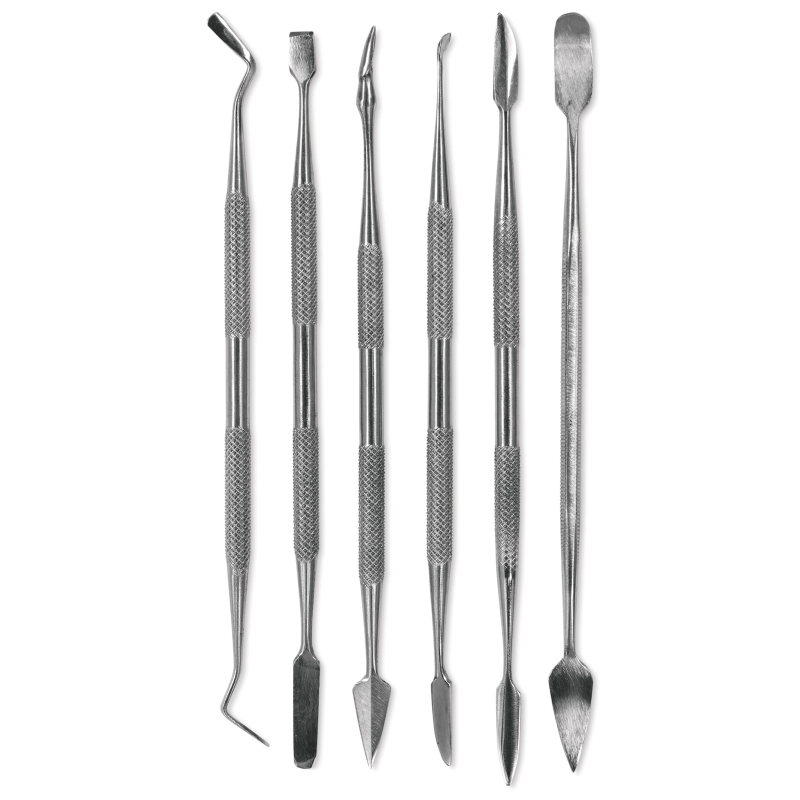
Creating a precise and lifelike anatomical wax-up is both an art and a science. Whether you’re working in prosthodontics, restorative dentistry, or lab-based crown and bridge work, the wax carving tools you choose and more importantly, their blade shapes play a crucial role in achieving accuracy, symmetry, and natural tooth morphology (Wax Carving Tool Blade Shapes).
In this guide, we’ll break down the different blade shapes used in wax carving tools and how each contributes to a flawless anatomical wax-up.
Why Blade Shape Matters in Anatomical Wax-Up
Anatomical wax-up requires careful replication of natural tooth contours, including cusps, fissures, ridges, and embrasures. Each of these features demands a specific carving approach. Using the right blade shape allows for:
- Greater precision and control
- Smooth contouring of surfaces
- Efficient wax removal and addition
- Reduced finishing time
Common Wax Carving Tool Blade Shapes and Their Uses
1. Straight Blade (Flat Carvers)
Straight blades are ideal for bulk wax removal and flattening surfaces. They provide excellent control when defining axial walls and occlusal planes.
Best for:
- Initial wax reduction
- Creating flat planes
- Shaping proximal surfaces
2. Curved Blade (Spoon or Crescent Shape)
Curved blades are designed to mimic the natural curvature of teeth. They are perfect for carving concave and convex surfaces.
Best for:
- Forming cuspal inclines
- Shaping fossae and grooves
- Refining occlusal anatomy
3. Pointed Blade (Knife or Spear Tip)
These blades are sharp and narrow, allowing for detailed carving in tight areas.
Best for:
- Defining fissures and pits
- Creating marginal ridges
- Fine detailing in interproximal areas
4. Discoid Blade
A circular, flat-edged blade used for carving and smoothing. Often paired with a cleoid end in combination tools.
Best for:
- Carving occlusal surfaces
- Smoothing wax
- Removing excess material
5. Cleoid Blade
A claw-like or pointed curved blade that complements the discoid end.
Best for:
- Carving developmental grooves
- Detailing occlusal anatomy
- Accessing deep fissures
6. Spatula Blade
Flat and broad, spatula blades are used for wax addition and contouring rather than removal.
Best for:
- Applying molten wax
- Blending and smoothing surfaces
- Building up contours
Choosing the Right Tool Combination
No single tool can achieve a complete anatomical wax-up. Dental professionals often use a combination of blade shapes to move from gross shaping to fine detailing. A typical workflow might include:
- Spatula for wax addition
- Straight blade for bulk reduction
- Curved blade for contouring
- Discoid/Cleoid for occlusal anatomy
- Pointed blade for final detailing
Tips for बेहतर Wax Carving Results
- Maintain sharpness: Dull blades reduce precision and can distort wax
- Use controlled الحرارة (heat): Slight warming improves carving efficiency
- Work in مراحل (stages): From rough shaping to fine detailing
- Observe natural teeth: Study morphology for realistic results
- Practice symmetry: Especially for bilateral restorations
Conclusion
Understanding the function of different blade shapes in wax carving tools is essential for achieving high-quality anatomical wax-ups. Each blade serves a unique purpose, and mastering their use can significantly enhance your efficiency and outcomes in dental restorations.
Investing time in learning these tools not only improves your technical skills but also elevates the overall quality of your prosthetic work.