
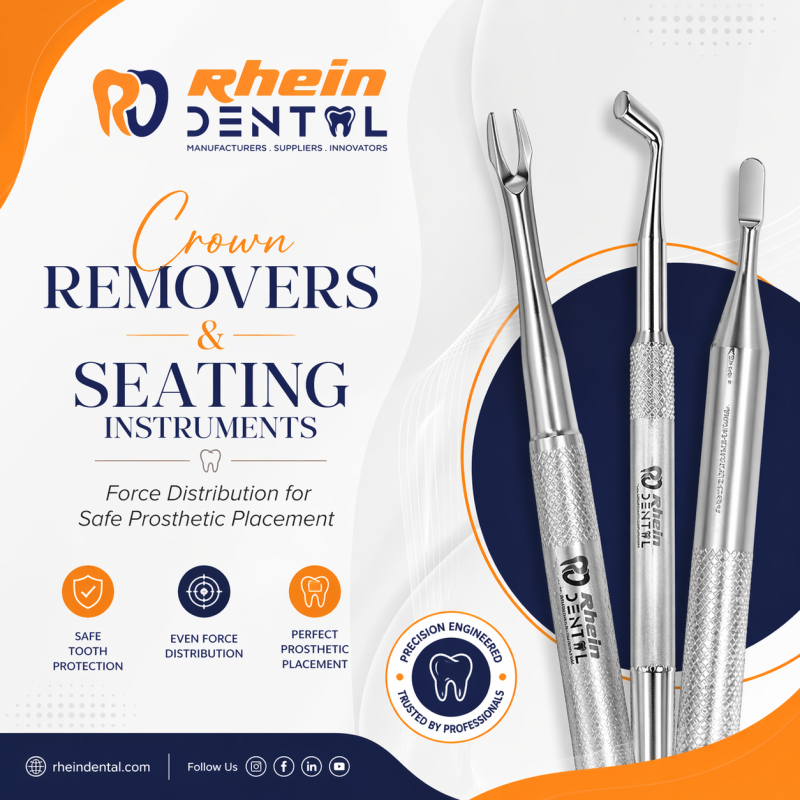
In prosthodontic practice and dental laboratory workflows, achieving a perfectly seated crown is only half the challenge. The real precision lies in how restorations are placed and, when necessary, removed without damaging the tooth structure, prosthesis, or surrounding tissues. This is where crown removers and seating instruments become essential.
Why Force Distribution Matters in Prosthetic Dentistry
Every crown or bridge relies on a precise fit between the restoration and the prepared tooth. When force is uneven or uncontrolled, it can cause:
- Marginal distortion or open margins
- Fracture of ceramic or porcelain restorations
- Trauma to the tooth or supporting structures
- Cement failure or improper seating
- Patient discomfort during adjustment
Properly designed instruments help spread force evenly, ensuring controlled movement rather than sudden stress concentration.
Crown Removers: Controlled Force for Safe Retrieval
Crown removers are designed to disengage restorations that are either temporarily or permanently cemented. Their goal is not brute force, but controlled, directional force application.
How Crown Removers Work
Crown removers typically use a combination of:
- Mechanical leverage
- Spring-loaded impact
- Hook or grip engagement on crown margins
The force is delivered in short, controlled impulses rather than continuous pressure, which helps prevent damage.
Force Distribution in Crown Removal
Effective crown removers distribute force by:
- Focusing energy at specific retention points
- Avoiding direct pressure on fragile ceramic surfaces
- Using shock-based dislodgement instead of pulling force
This reduces the risk of cracking porcelain or damaging abutment teeth.
Best Use Cases
- Temporary crown removal
- Retrieving cemented metal crowns
- Adjusting ill-fitting prostheses
- Removing trial restorations during fit checks
Seating Instruments: Precision Placement Through Even Pressure
Seating instruments are used to ensure crowns, bridges, or inlays are fully and correctly seated onto the tooth preparation. Unlike removal tools, their function is to apply uniform downward pressure.
How Seating Instruments Work
These instruments may include:
- Crown seating pluggers
- Occlusal presses
- Rubber-ended seating tools
- Handheld pressure applicators
They help guide the restoration into its final position while maintaining alignment.
Force Distribution in Crown Seating
The key principle here is even pressure across the occlusal surface:
- Prevents tilting of the crown during placement
- Ensures uniform cement flow and escape
- Reduces voids or trapped air bubbles
- Helps achieve complete marginal seating
Uneven force may cause one side to seat while the opposite remains lifted, resulting in a poor fit.
Best Use Cases
- Cementation of final crowns and bridges
- Seating temporary restorations
- Adjusting inlays and onlays
- Ensuring complete marginal adaptation
Crown Removers vs Seating Instruments: A Functional Comparison
| Feature | Crown Removers | Seating Instruments |
|---|---|---|
| Primary Purpose | Removal of restorations | Placement of restorations |
| Type of Force | Impact or traction-based | Steady, controlled pressure |
| Force Distribution | Localized, targeted release | Even, uniform distribution |
| Risk Factor | Potential fracture if misused | Mis-seating if uneven pressure |
| Clinical Goal | Safe retrieval | Accurate seating |
The Science Behind Safe Force Application
The success of both instruments depends on understanding how force behaves:
- Concentrated force can exceed material limits and cause fractures
- Distributed force spreads stress evenly, reducing risk
- Controlled magnitude ensures safety without compromising efficiency
In dental prosthetics, the goal is always to balance enough force to achieve movement, but not enough to cause deformation.
Practical Tips for Safe Prosthetic Placement
- Always inspect restoration fit before applying force
- Use gradual pressure instead of sudden force application
- Ensure cement is evenly distributed before seating
- Confirm occlusal alignment during placement
- Re-check margins after seating to avoid open edges
Common Mistakes to Avoid
- Using excessive force during crown removal
- Applying uneven pressure during seating
- Ignoring manufacturer recommendations for fragile restorations
- Attempting removal without proper instrument engagement
- Rushing cementation without trial seating
Conclusion
Crown removers and seating instruments are essential tools in prosthodontics, but their true effectiveness lies in how well they manage and distribute force. Crown removers focus on controlled, localized force to safely retrieve restorations, while seating instruments ensure even pressure for precise placement.