
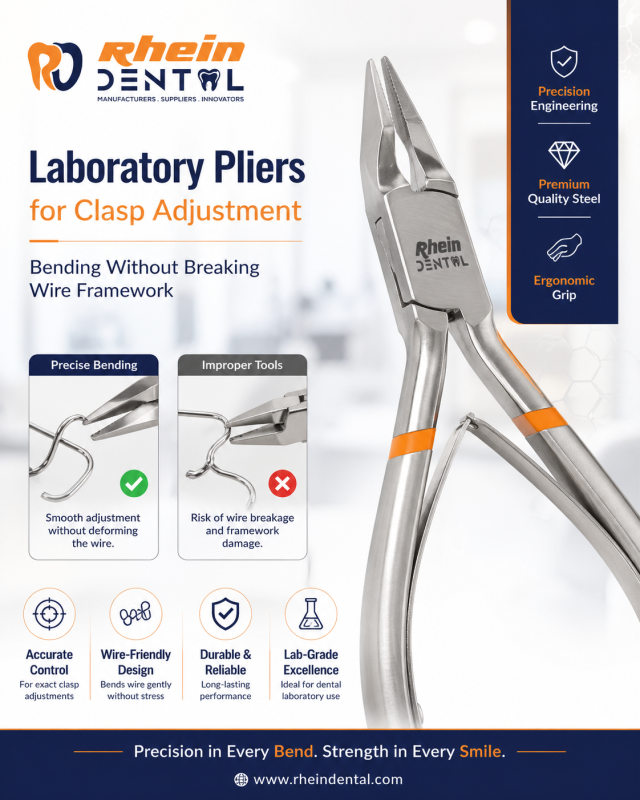
In removable prosthodontics, precision isn’t optional it’s everything. One small misstep while adjusting a clasp can compromise retention, distort the framework, or even fracture the wire entirely. That’s where laboratory pliers step in. The right technique, paired with the right instrument, ensures controlled bending without weakening the metal structure (Clasp adjustment pliers).
Why Clasp Adjustment Matters
Clasps are designed to provide retention, stability, and support. Over time—or due to minor inaccuracies during fabrication—they may require adjustment to:
- Improve fit and retention
- Reduce patient discomfort
- Prevent excessive pressure on abutment teeth
However, clasp wires are delicate. Improper bending can cause metal fatigue, leading to cracks or complete failure.
Understanding Wire Behavior
Before picking up pliers, it’s important to understand how clasp materials behave:
- Elastic range: The wire returns to its original shape after bending
- Plastic range: Permanent deformation occurs
- Fatigue zone: Repeated bending weakens the structure
The goal is to achieve controlled movement within safe limits—without repeatedly stressing the same area.
Types of Laboratory Pliers for Clasp Adjustment
Different pliers are designed for specific movements. Using the correct type prevents unnecessary stress on the wire.
1. Bird Beak Pliers
- Ideal for creating loops and gentle curves
- Provide precise control with round and flat beaks
2. Three-Prong Pliers
- Excellent for adjusting clasp arms symmetrically
- Helps distribute force evenly across the wire
3. Flat Nose (Parallel) Pliers
- Used for holding and stabilizing the wire
- Prevents slipping during bending
4. Adams Pliers
- Common in orthodontics but useful for clasp adjustments
- Good for sharp bends and fine tuning
Key Principles for Safe Clasp Adjustment
1. Support Before You Bend
Always stabilize the wire with one plier while applying force with another. Unsupported bending concentrates stress and increases fracture risk.
2. Make Small, Controlled Movements
Avoid large bends in one go. Gradual adjustments maintain the integrity of the metal.
3. Avoid Repeated Bending
Each bend weakens the wire. If you keep adjusting the same spot, it will eventually break.
4. Bend at the Right Location
Target the middle of the clasp arm, not the terminal end. This distributes stress more evenly.
5. Use the Correct Tool for the Task
Improvising with the wrong plier can flatten, nick, or overstress the wire.
Step-by-Step Clasp Adjustment Technique
- Evaluate the Fit
Identify whether the clasp is too tight or too loose. - Mark the Adjustment Area
Focus on the section that needs modification. - Stabilize the Framework
Use flat nose pliers to hold the wire firmly. - Apply Controlled Force
Use a second plier (e.g., bird beak) to gently bend. - Check Frequently
Reinsert and test after each small adjustment. - Finish and Polish if Needed
Ensure no rough edges remain.
Common Mistakes to Avoid
- ❌ Bending the clasp repeatedly in the same spot
- ❌ Using excessive force
- ❌ Holding the wire too close to the bending point
- ❌ Using damaged or worn-out pliers
- ❌ Ignoring signs of metal fatigue (whitening or micro-cracks)
Pro Tip: Heat Treatment? Think Twice
Unlike some metals, most clasp wires used in dentistry are not meant for chairside heat treatment. Applying heat incorrectly can alter their mechanical properties and reduce resilience.
Maintaining Your Laboratory Pliers
Your tools directly affect your results. Keep them in top condition:
- Clean and disinfect after use
- Check for alignment regularly
- Avoid dropping (this misaligns beaks)
- Lubricate joints periodically
Final Thoughts
Clasp adjustment is a skill that blends technique, material knowledge, and the right instrumentation. With proper handling, laboratory pliers allow you to fine-tune retention without compromising the structural integrity of the wire framework.
Mastering these small adjustments leads to better patient comfort, longer-lasting prostheses, and more predictable outcomes—hallmarks of high-quality dental work.