
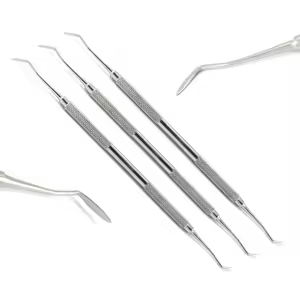
In restorative dentistry, achieving a functional restoration is only part of the goal. The real challenge lies in recreating natural tooth anatomy the subtle grooves, cusps, ridges, and contours that define both aesthetics and occlusion. This is where carvers and sculptors become essential instruments in clinical practice. These tools are not just used to remove excess material; they are designed to shape, refine, and replicate anatomical form, and their effectiveness depends heavily on one critical factor: blade angle design (Carvers and Sculptors in Dentistry).
The Role of Carvers and Sculptors in Dentistry
Carvers and sculptors are hand instruments used primarily in amalgam and composite restorations to:
- Remove excess restorative material
- Define anatomical features
- Create occlusal morphology
- Refine marginal ridges and fossae
While often used interchangeably, their efficiency depends greatly on the geometry of the working end, particularly the blade angle.
Why Blade Angle Matters in Tooth Anatomy Replication
Natural teeth are not flat structures. They have complex three-dimensional morphology that includes:
- Cuspal inclines
- Developmental grooves
- Marginal ridges
- Occlusal pits and fossae
To replicate this complexity, carvers must interact with restorative material at precise angles. The blade angle determines:
- Depth of carving
- Smoothness of contouring
- Control over material displacement
- Accuracy of anatomical replication
Even a slight variation in blade angulation can significantly alter the final restoration outcome.
Types of Blade Angles in Carvers and Sculptors
1. Acute Blade Angles (Sharp Angulation)
Acute angles are designed for precise detailing and deep carving.
Clinical Use:
- Defining fissures and grooves
- Sculpting occlusal anatomy
- Creating sharp marginal ridges
Advantage:
Provides excellent control for fine anatomical detailing without excessive material removal.
2. Moderate Blade Angles (Balanced Design)
Moderate angles offer a balance between precision and adaptability.
Clinical Use:
- General contouring of occlusal surfaces
- Shaping cuspal inclines
- Refining transitional anatomy
Advantage:
Allows controlled carving with reduced risk of overcutting.
3. Obtuse Blade Angles (Broad Contouring)
Obtuse angles are designed for smooth surface shaping and blending.
Clinical Use:
- Final smoothing of restoration surfaces
- Blending anatomical transitions
- Reducing surface irregularities
Advantage:
Ensures natural curvature and smooth finish, closely mimicking enamel contours.
Carvers vs Sculptors: Functional Differences
Although often grouped together, they serve slightly different purposes:
Carvers
- Focus on material removal
- Define primary anatomy
- Work best in early to mid stages of restoration
Sculptors
- Focus on refining and finishing
- Enhance surface texture and fine anatomy
- Used in final shaping stages
Together, they ensure both structure and detail are achieved.
Clinical Applications in Different Restorations
1. Amalgam Restorations
- Carvers define bulk anatomy
- Sculptors refine occlusal grooves and marginal ridges
- Blade angles ensure proper condensation and contouring
2. Composite Restorations
- Gentle sculpting is required to avoid disrupting resin polymerization
- Acute angles help in precise anatomical reproduction
3. Posterior Restorations
- Emphasis on occlusal anatomy replication
- Balanced blade angles ensure proper load distribution and function
How Blade Design Impacts Natural Tooth Replication
Accurate replication of tooth anatomy depends on three key factors:
1. Direction of Force
Blade angle controls how restorative material is displaced.
2. Depth of Cut
Sharper angles allow deeper anatomical definition, while broader angles smooth transitions.
3. Surface Adaptation
Proper angulation ensures seamless blending with surrounding tooth structure.
Together, these factors determine whether a restoration looks artificial or naturally integrated.
Clinical Tips for Better Anatomical Sculpting
- Use acute angles for initial anatomical definition
- Switch to moderate angles for contouring stability
- Finish with obtuse angles for polishing and blending
- Always work under proper lighting to visualize anatomy clearly
- Use minimal pressure to avoid material distortion
Conclusion
Carvers and sculptors are more than finishing instruments—they are anatomical replication tools. Their blade angles directly influence how accurately natural tooth structure can be recreated in restorative dentistry.
By understanding and mastering blade angulation, clinicians can move beyond simple restorations and achieve outcomes that are not only functional but biomimetically precise.
The difference between an average restoration and an exceptional one often lies in how well the instrument replicates nature—and blade angles make that difference.