
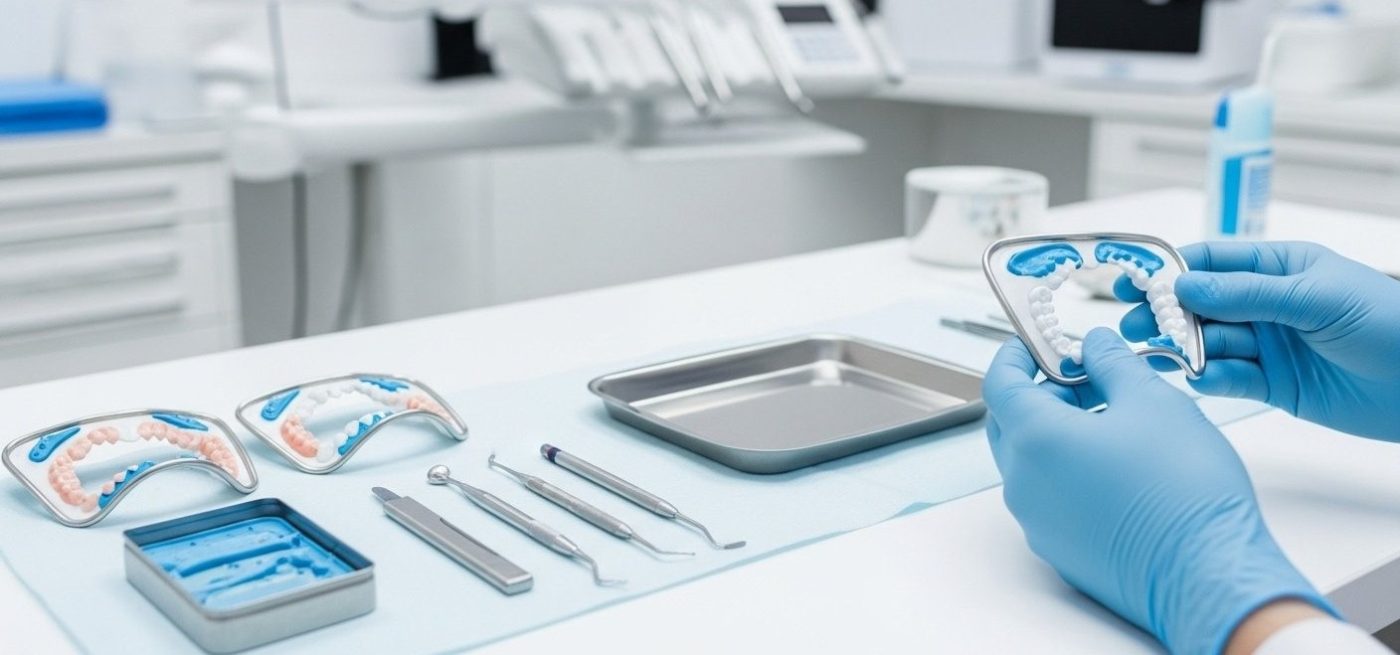
In restorative and prosthodontic dentistry, impression accuracy is everything. However, even the best impression materials can fail if they do not properly adhere to the tray. That is where impression tray adhesives come into play. More importantly, tray design itself plays a critical role in how effectively these adhesives perform. Understanding this relationship can significantly improve clinical outcomes.
What Is an Impression Tray Adhesive?
An impression tray adhesive is a specially formulated bonding agent. It ensures that the impression material firmly attaches to the tray during placement and removal. Without proper adhesion, materials may distort, detach, or shrink, leading to inaccurate impressions and compromised restorations.
Why Adhesive Application Matters
Proper adhesive application is essential for several reasons. First, it prevents separation between the tray and impression material. As a result, dimensional stability is maintained. Second, it reduces the risk of voids and distortions. Furthermore, it ensures consistent results across multiple procedures.
However, adhesive performance does not depend only on the product itself. Instead, tray design directly influences how well the adhesive can function.
Types of Impression Trays and Their Influence
1. Stock Trays
Stock trays are pre-manufactured and come in standard sizes. They are widely used due to convenience and cost-effectiveness.
However, their design presents certain challenges. Because they are not customized, gaps may exist between the tray and oral tissues. Consequently, uneven adhesive distribution can occur. In addition, stock trays often rely on perforations for mechanical retention, which may reduce the dependence on adhesives but can also lead to inconsistent bonding.
2. Custom Trays
Custom trays are fabricated specifically for an individual patient. As a result, they offer a uniform space for impression material.
This design enhances adhesive performance in several ways. First, the even spacing allows consistent adhesive coating. Moreover, the close adaptation minimizes material movement. Therefore, custom trays provide superior bonding and more accurate impressions.
3. Perforated Trays
Perforated trays include multiple holes that allow impression material to flow through and lock mechanically.
While this design improves retention, it can sometimes reduce the role of adhesives. Nevertheless, adhesive application is still necessary. It adds a chemical bond that complements mechanical retention. Without it, material tearing may occur during removal.
4. Non-Perforated (Solid) Trays
Solid trays rely entirely on adhesive bonding. Therefore, correct adhesive selection and application become critical.
If the adhesive layer is uneven or insufficient, the impression material may detach. For this reason, clinicians must apply a uniform, thin coat and allow adequate drying time.
Key Factors in Adhesive Performance
Tray design influences several aspects of adhesive effectiveness:
- Surface Texture: Rough surfaces enhance mechanical interlocking, while smooth surfaces depend more on chemical adhesion.
- Tray Material: Plastic and metal trays interact differently with adhesives. Therefore, using a compatible adhesive is essential.
- Spacing and Fit: Uniform spacing ensures even adhesive distribution.
- Presence of Retentive Features: Rims, perforations, and rims affect how stress is distributed during removal.
Best Practices for Adhesive Application
To maximize bonding effectiveness, clinicians should follow these steps:
- Clean the Tray Thoroughly
Remove debris, oils, or moisture before applying adhesive. - Apply a Thin, Even Layer
Avoid pooling, as it can weaken the bond. - Extend Adhesive Beyond the Borders
This prevents edge lifting and distortion. - Allow Proper Drying Time
Most adhesives require 5–10 minutes to become tacky. - Use Material-Specific Adhesives
Different impression materials require compatible adhesives for optimal bonding.
Common Mistakes to Avoid
Many bonding failures occur due to simple errors. For example, applying adhesive too thickly can reduce effectiveness. Similarly, insufficient drying time can compromise adhesion. In addition, using the wrong adhesive for the material can lead to separation.
Conclusion
Impression tray adhesives are essential for achieving accurate and reliable dental impressions. However, their effectiveness is closely linked to tray design. While stock and perforated trays offer convenience, custom and well-adapted trays provide superior bonding conditions.
Ultimately, understanding how tray design affects adhesive performance allows clinicians to make better choices. By combining the right tray with proper adhesive application techniques, dental professionals can ensure consistent, high-quality results.