
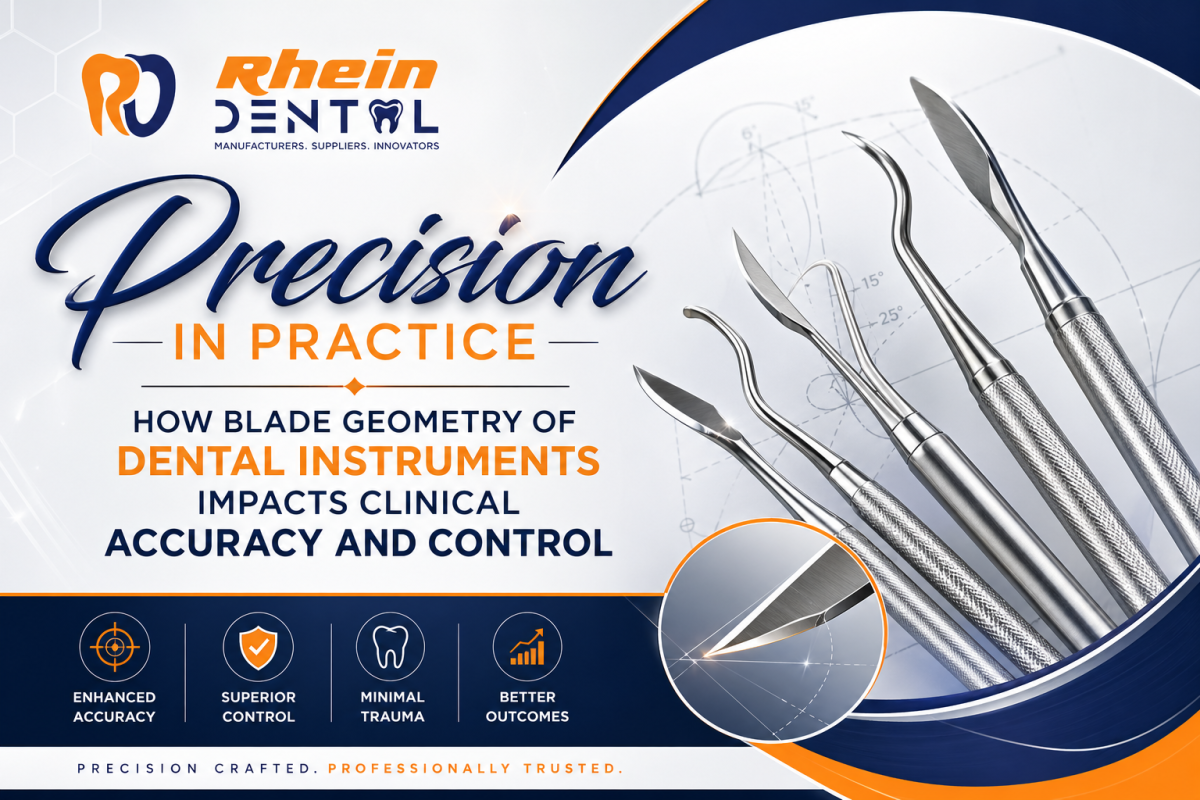
In modern dentistry, precision defines success. Every clinical movement depends not only on skill but also on the engineering behind the instruments being used. Among all design factors, blade geometry plays a decisive role in ensuring accuracy, efficiency, and control during dental procedures.
Moreover, understanding blade design helps clinicians select instruments that enhance performance and reduce procedural errors.
1. Understanding Blade Geometry in Dental Instruments
Blade geometry refers to the structural design of the working end of a dental instrument, including its angle, edge sharpness, thickness, and curvature.
In particular, it determines:
- How effectively the instrument engages with tooth or tissue surfaces
- The level of force required during clinical procedures
- The precision of cutting, scaling, or carving actions
- Accessibility in confined oral regions
Furthermore, even minor variations in blade design can significantly influence clinical outcomes.
2. Why Blade Geometry Is Clinically Important
Blade design is not merely a manufacturing detail—it directly impacts daily dental practice.
- Firstly, it enhances procedural accuracy by guiding controlled movements
- Secondly, it reduces physical strain on the clinician’s hand and wrist
- In addition, it improves access to deep or narrow oral cavities
- Consequently, it minimizes the risk of damaging surrounding healthy tissue
- Finally, it improves overall treatment predictability
3. Key Elements That Define Blade Geometry
• Blade Angle
The angle determines how the blade enters and interacts with surfaces.
As a result, optimal angles allow smoother and more controlled clinical strokes.
• Blade Thickness
Thin blades offer precision, whereas thicker designs provide strength.
Therefore, selection depends on whether the procedure is delicate or force-intensive.
• Edge Sharpness
A sharper edge reduces pressure requirements during use.
Notably, it also enhances tactile sensitivity and procedural smoothness.
• Curvature Design
Curved blades follow natural tooth anatomy more effectively.
Moreover, they improve access to posterior and interproximal areas.
• Bevel Orientation
Bevel positioning controls the direction of cutting force.
In turn, this improves safety and accuracy during manipulation.
4. Impact Across Different Dental Instruments
Carving and Restorative Instruments
Carvers require precise blade geometry to replicate natural tooth anatomy.
Additionally, well-balanced edges ensure smoother restorative shaping.
Scalers and Curettes
These instruments rely heavily on curved blade designs.
As a result, they provide better subgingival access and efficient calculus removal.
Surgical Instruments
Surgical blades are engineered for strength and stability.
Furthermore, their geometry ensures controlled incision depth and direction.
Diagnostic Instruments
Explorers depend on fine, sensitive tips.
Consequently, they enhance detection of caries and surface irregularities.
5. How Blade Geometry Improves Clinical Control
Effective blade design significantly enhances procedural control:
- It stabilizes hand movements during intricate procedures
- It ensures directional precision along targeted surfaces
- It reduces unintended tissue trauma
- It improves consistency across repeated clinical tasks
Moreover, better control directly translates into improved patient comfort and safety.
6. Manufacturing Precision Behind Blade Performance
Blade geometry is deeply influenced by manufacturing quality and processes:
- Forging techniques enhance structural strength and durability
- Precision grinding ensures consistent angles and sharpness
- Heat treatment improves hardness without compromising flexibility
- Hand finishing refines edges for optimal clinical smoothness
In addition, these processes collectively ensure long-term instrument reliability.
7. Clinical Benefits for Dental Professionals
When clinicians understand blade geometry, they can:
- Select instruments more effectively for each procedure
- Improve procedural speed without compromising accuracy
- Reduce operator fatigue during long treatments
- Achieve more predictable and consistent results
- Enhance patient safety and comfort
Therefore, blade geometry knowledge is essential for both practitioners and procurement specialists.
Conclusion
Blade geometry is far more than a design feature—it is the foundation of clinical precision. Every angle, edge, and curve contributes to how effectively a dental instrument performs in real-world procedures.
Ultimately, optimized blade design ensures greater accuracy, improved control, and superior clinical outcomes, making it a critical consideration in modern dental instrumentation.on begins at the blade.