
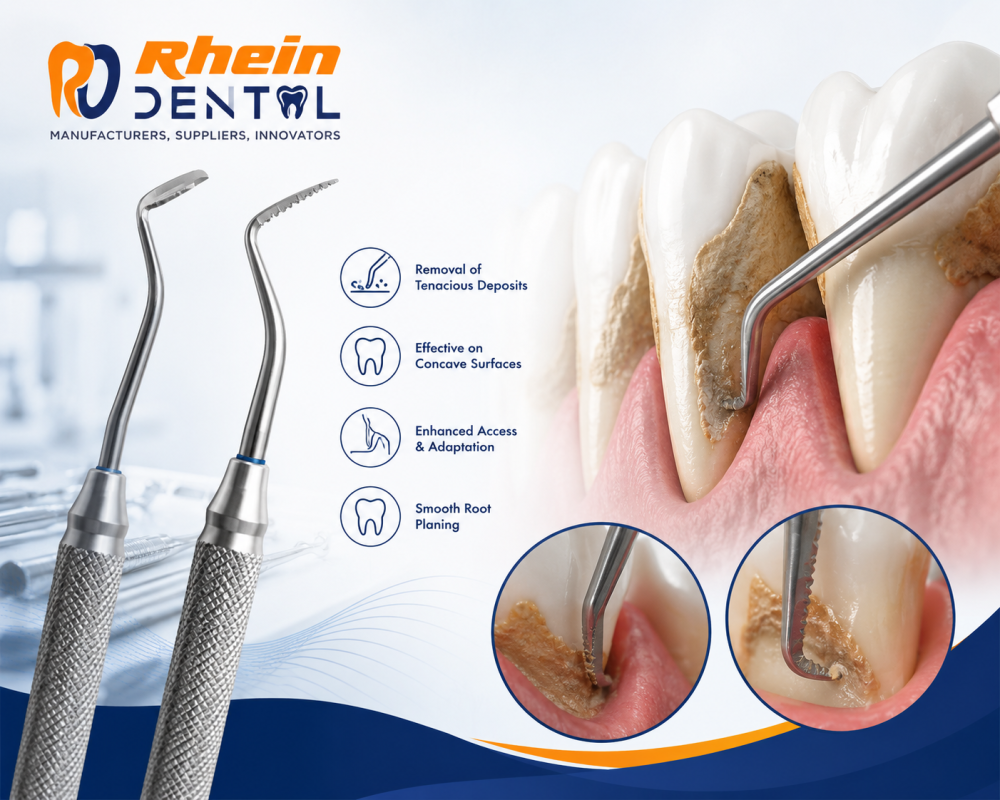
In modern periodontal therapy, clinicians often rely on ultrasonic systems and universal curettes for routine debridement. However, certain clinical situations still demand the precision and mechanical efficiency of specialized hand instruments. Among these, hoe scalers and file scalers continue to play a valuable role in managing tenacious calculus deposits and difficult root anatomies where standard instruments may lose effectiveness (Hoe and File Scalers).
Although considered niche instruments today, their unique blade geometry and working mechanics make them highly effective for specific periodontal applications — especially in areas involving ledges of heavy calculus, burnished deposits, and concave root surfaces (Hoe and File Scalers).
Understanding Hoe Scalers
A hoe scaler is a periodontal hand instrument designed with a single straight cutting edge positioned at approximately a 99-degree angle to the shank. Unlike curettes that adapt through sweeping motions, hoe scalers function primarily through a pull stroke that engages and fractures large calculus deposits.
The blade is slightly bowed and beveled, allowing the instrument to maintain contact with the tooth surface while generating strong lateral pressure during activation (Hoe and File Scalers).
Primary Design Features
- Single cutting edge
- Blade bent at an angle to the shank
- Strong pull-stroke mechanics
- Heavy-duty working end for dense deposits
- Available in multiple angulations for anterior and posterior access
Because of their rigid structure, hoe scalers are particularly useful where heavy ledges or rings of calculus resist ultrasonic instrumentation.
Clinical Applications of Hoe Scalers
1. Removal of Heavy Supragingival and Subgingival Calculus
Hoe scalers excel in breaking away large, tenacious calculus deposits that are firmly attached to root surfaces. Their rigid blade permits powerful controlled strokes capable of fracturing dense mineralized accumulations.
These instruments are especially beneficial in:
- Long-standing periodontal cases
- Smokers with dense calculus formation
- Lingual surfaces of mandibular anterior teeth
- Posterior interproximal ledges
2. Accessing Concave Root Morphology
Root concavities present a major challenge during periodontal instrumentation. Standard curettes may skip over deep depressions, leaving residual deposits behind. Hoe scalers can engage certain concave areas more aggressively due to their direct pull-stroke action and extended blade design.
3. Initial Gross Debridement
Many clinicians use hoe scalers during the first phase of periodontal therapy to reduce bulky deposits before transitioning to finer root planing instruments.
This staged approach:
- Improves tactile sensitivity later in treatment
- Reduces operator fatigue
- Enhances efficiency during final root smoothing
Understanding File Scalers
File scalers differ significantly from conventional scalers. Instead of a sharpened blade edge, they contain a series of small, blunt cutting projections arranged on a base. These projections crush, fracture, and roughen heavy calculus deposits through a push-pull filing motion.
Rather than slicing deposits away cleanly, file scalers mechanically disrupt the attachment of calculus to the tooth surface.
Structural Characteristics
- Multiple miniature cutting ridges
- Heavy reinforced working end
- Filing stroke activation
- Strong pressure tolerance
- Designed for crushing calculus deposits
Because of their abrasive mechanical action, file scalers are rarely used for routine scaling but remain highly valuable in advanced periodontal cases.
Niche Applications of File Scalers
1. Crushing Burnished Calculus
Burnished calculus is particularly difficult to detect and remove because it becomes smooth and tightly adapted to the root surface. File scalers help roughen and fracture these deposits, making subsequent curette instrumentation more effective.
2. Managing Extremely Tenacious Deposits
In cases involving:
- Long-term periodontal neglect
- Deep periodontal pockets
- Heavy mineralization
- Furcation involvement
file scalers can provide the initial disruption needed before finer instrumentation begins.
3. Root Surface Preparation Before Curettes
Some clinicians use file scalers to create micro-fractures within dense calculus layers. Once weakened, the deposits become easier to remove with Gracey or universal curettes.
Root Planing on Concave Surfaces
Concave root anatomy remains one of the most difficult aspects of periodontal debridement. Developmental grooves, furcations, and root depressions can harbor biofilm and calculus beyond the reach of many instruments.
Hoe scalers and file scalers contribute to root planing in these situations by:
- Increasing mechanical engagement with irregular surfaces
- Dislodging deeply embedded deposits
- Improving access to developmental concavities
- Preparing surfaces for finishing curettes
However, these instruments require excellent tactile sensitivity and careful pressure control to avoid unnecessary root surface trauma.
Advantages of Hoe and File Scalers
Efficient Heavy Deposit Removal
Both instruments perform exceptionally well against thick and stubborn calculus accumulations.
Strong Mechanical Action
Their rigid construction allows greater pressure application compared to flexible curettes.
Useful in Advanced Periodontal Cases
They remain valuable in difficult clinical scenarios where ultrasonic tips or curettes may be insufficient alone.
Improved Debridement Efficiency
When used strategically, they reduce overall instrumentation time during severe periodontal therapy.
Limitations and Clinical Considerations
Despite their strengths, hoe and file scalers are not universally suitable for all periodontal procedures.
Potential Root Surface Trauma
Aggressive instrumentation can gouge or excessively roughen cementum if used improperly.
Limited Adaptation
Compared to Gracey curettes, adaptation around complex root anatomy may still be challenging.
Technique Sensitivity
Proper angulation, pressure control, and stroke direction are essential for predictable outcomes.
Reduced Use in Modern Practice
The rise of advanced ultrasonic technology has reduced dependence on these instruments in routine care.
Instrument Selection in Contemporary Periodontics
Today, periodontal instrumentation often combines:
- Ultrasonic scalers for biofilm disruption
- Curettes for fine root planing
- Specialized hand instruments for difficult deposits
Hoe scalers and file scalers remain important adjunctive tools rather than primary instruments. Their role is highly selective but clinically valuable when confronting:
- Dense calculus ledges
- Burnished deposits
- Root concavities
- Furcation involvement
- Advanced chronic periodontitis cases
Experienced clinicians recognize that successful periodontal therapy depends not only on technology but also on choosing the correct instrument for the specific root morphology and deposit characteristics encountered.
Conclusion
Hoe scalers and file scalers continue to hold a specialized place in periodontal instrumentation despite the evolution of ultrasonic systems and advanced curettes. Their unique mechanical design enables effective disruption of tenacious calculus deposits and improved management of concave root surfaces that are otherwise difficult to instrument thoroughly.
When used with proper technique and clinical judgment, these instruments enhance debridement efficiency, improve root surface access, and support comprehensive periodontal therapy in complex cases. Their continued relevance demonstrates that even niche hand instruments remain essential components of advanced periodontal care.