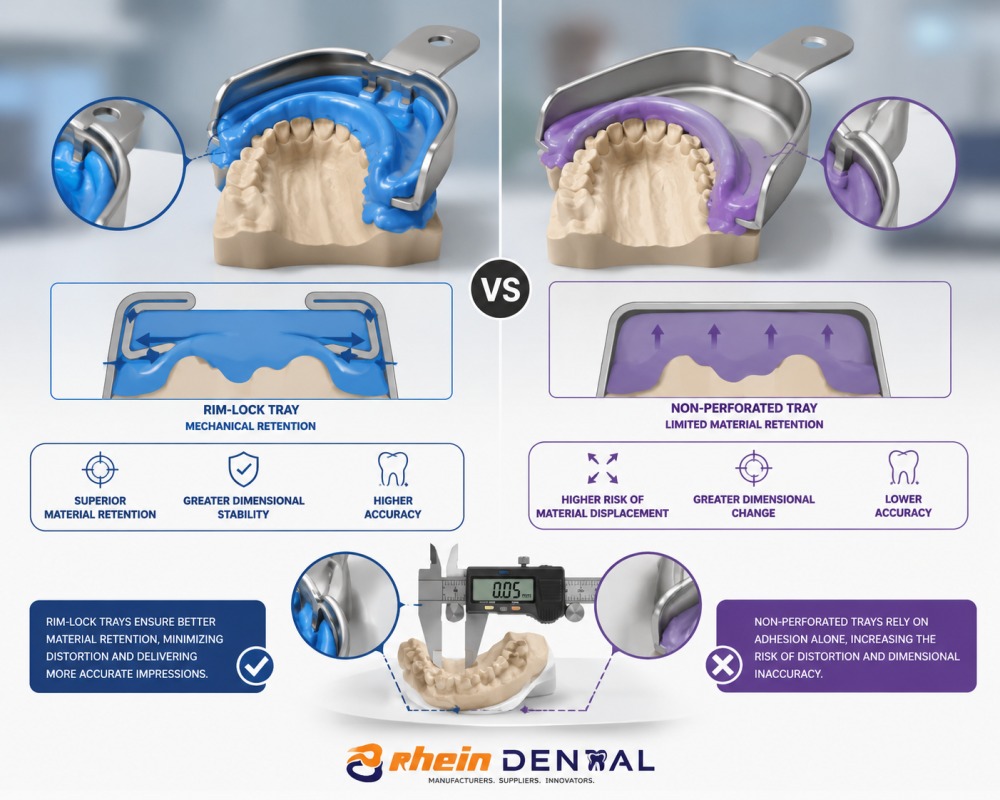
Accurate dental impressions are fundamental to successful restorative, prosthodontic, orthodontic, and implant procedures. Even small dimensional distortions during impression taking can affect the fit, function, and longevity of the final restoration. While impression materials often receive the most attention, the design of the impression tray itself plays an equally important role in maintaining dimensional stability (Rim-Lock vs Non-Perforated Impression Trays).
Among the most commonly discussed tray designs are rim-lock impression trays and non-perforated impression trays. Both are intended to support impression materials during procedures, but they use different retention mechanisms that directly influence material stability, distortion resistance, and overall impression accuracy (Rim-Lock vs Non-Perforated Impression Trays).
Understanding how these tray systems work helps clinicians select the most appropriate option for predictable and clinically accurate results.
The Importance of Impression Tray Retention
An impression tray serves as the structural foundation that carries and stabilizes impression material during insertion, setting, and removal from the oral cavity.
If the impression material loses adhesion or shifts within the tray, several issues may occur:
- Dimensional distortion
- Marginal inaccuracies
- Voids or pulls in the impression
- Poor restoration fit
- Occlusal discrepancies
- Need for impression retakes
Effective material retention mechanisms help minimize movement and maintain the relationship between oral structures and the impression material throughout the procedure.
What Are Rim-Lock Impression Trays?
Rim-lock impression trays are metal trays designed with raised peripheral edges or locking rims around the tray borders. These rims mechanically secure the impression material within the tray during impression taking and removal.
Unlike perforated trays that rely on holes for retention, rim-lock trays use border engagement to stabilize the material.
Key Characteristics of Rim-Lock Trays
- Metallic reusable construction
- Raised retention edges along borders
- Strong mechanical locking effect
- High rigidity during impression procedures
- Commonly used with elastomeric materials
Their durable structure makes them especially popular in prosthodontic and crown-and-bridge procedures where dimensional precision is critical.
What Are Non-Perforated Impression Trays?
Non-perforated trays feature smooth tray walls without perforations or rim-lock borders. Retention of the impression material depends primarily on tray adhesives rather than mechanical locking features.
These trays are often manufactured in:
- Stainless steel
- Aluminum
- Disposable plastic materials
They are commonly used when clinicians prefer simplified tray designs or when adhesive systems provide adequate material bonding.
How Material Retention Mechanisms Differ
The primary distinction between these tray types lies in how they prevent impression material displacement.
Rim-Lock Retention Mechanism
Rim-lock trays rely on mechanical retention. As the impression material sets, it engages around the tray borders and becomes physically locked into place.
This design helps resist:
- Material pull-away
- Distortion during removal
- Peripheral separation
- Compression displacement
Non-Perforated Tray Retention Mechanism
Non-perforated trays rely almost entirely on chemical adhesion through tray adhesives.
The adhesive forms a bonding layer between the tray surface and impression material to prevent separation during removal.
The effectiveness depends heavily on:
- Proper adhesive application
- Adequate drying time
- Material compatibility
- Surface cleanliness
The Relationship Between Tray Design and Dimensional Accuracy
Dimensional accuracy is one of the most critical factors in impression success. Even minimal distortion can compromise the fit of crowns, bridges, aligners, dentures, or implant restorations.
Tray rigidity and retention stability directly affect dimensional outcomes.
Why Rim-Lock Trays Often Provide Higher Stability
Rim-lock trays offer enhanced mechanical stabilization, particularly during removal from undercut areas where impression materials experience significant stress.
Benefits include:
- Reduced material flexing
- Better resistance to detachment
- Lower distortion risk
- Improved peripheral stability
- More consistent impression accuracy
Because the material remains mechanically secured, there is less chance of micro-movement during removal from the mouth.
Challenges Associated with Non-Perforated Trays
Non-perforated trays can still produce highly accurate impressions when used correctly, but they are more technique-sensitive.
Potential issues include:
- Adhesive failure
- Uneven bonding
- Material separation from tray walls
- Increased distortion risk during removal
- Reduced stability in high-stress areas
Clinical success depends heavily on proper adhesive protocol and material compatibility.
Impression Materials and Tray Compatibility
Different impression materials behave differently inside impression trays.
Common Impression Materials Used with These Trays
| Impression Material | Rim-Lock Compatibility | Non-Perforated Compatibility |
|---|---|---|
| Polyvinyl Siloxane (PVS) | Excellent | Excellent with adhesive |
| Polyether | Excellent | Good with proper bonding |
| Alginate | Moderate | Commonly used |
| Condensation Silicone | Good | Good |
| Zinc Oxide Eugenol | Good | Moderate |
Elastomeric materials often benefit from the enhanced stability provided by rigid rim-lock tray systems.
Tray Rigidity and Its Effect on Accuracy
Tray flexure is another major factor influencing dimensional precision.
Metal rim-lock trays generally provide:
- Higher rigidity
- Lower deformation under pressure
- Better dimensional stability
- Consistent seating during impression taking
Disposable non-perforated trays, especially plastic variants, may flex slightly during insertion or removal, potentially affecting accuracy.
Clinical Situations Favoring Rim-Lock Trays
Rim-lock trays are commonly preferred for:
- Crown and bridge impressions
- Implant prosthetics
- Full-arch precision impressions
- Complex prosthodontic cases
- Situations requiring maximum dimensional stability
Their mechanical retention design supports high-detail reproduction and predictable laboratory results.
Clinical Situations Favoring Non-Perforated Trays
Non-perforated trays may be preferred for:
- Routine impressions
- Preliminary impressions
- Shorter procedures
- Disposable tray applications
- Situations prioritizing convenience and efficiency
When combined with high-quality adhesives and proper technique, they can still achieve reliable clinical results.
Infection Control and Reusability Considerations
Reusable metal rim-lock trays offer durability and long-term cost efficiency but require strict sterilization protocols.
Disposable non-perforated trays provide advantages such as:
- Reduced cross-contamination risk
- Faster turnaround between patients
- Simplified inventory management
- Elimination of repeated sterilization cycles
The choice often depends on practice workflow and procedural requirements.
Choosing the Right Impression Tray
Selecting the ideal tray depends on several clinical factors:
- Required dimensional precision
- Type of restoration
- Impression material used
- Patient anatomy
- Infection control preferences
- Tray rigidity requirements
- Procedural complexity
No single tray design is universally superior for every case. Instead, clinicians should evaluate which retention mechanism best supports the intended procedure.
The Future of Impression Tray Design
As dentistry continues to prioritize precision and efficiency, impression tray manufacturers are developing increasingly advanced retention systems and ergonomic designs.
Modern innovations focus on:
- Enhanced rigidity with lightweight materials
- Improved adhesive compatibility
- Better patient comfort
- Digital workflow integration
- Optimized retention geometry
Despite advances in intraoral scanning technology, conventional impressions remain widely used across many clinical applications. As a result, tray design continues to play a critical role in maintaining impression accuracy and restorative success.