
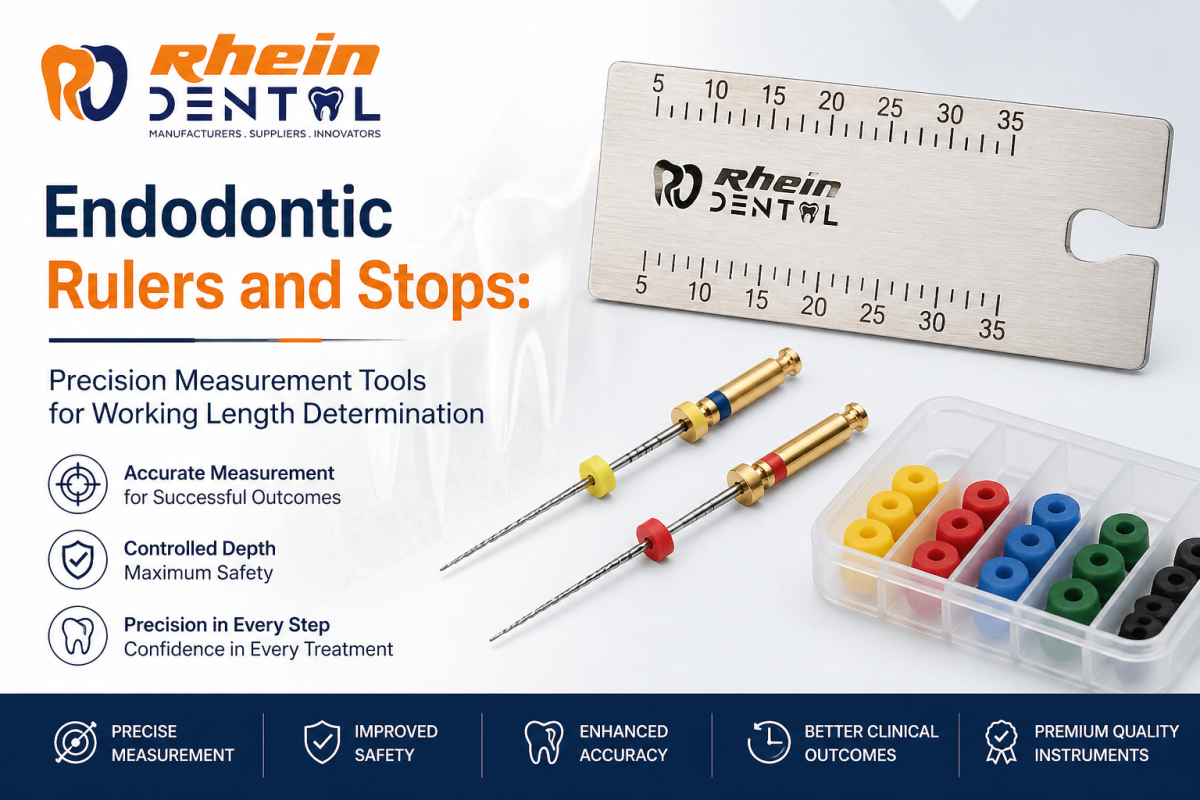
In endodontic treatment, precision is everything. The success of root canal therapy depends heavily on accurate working length determination, as even a small miscalculation can lead to underfilling, over-instrumentation, or treatment failure. This is where endodontic rulers and stops become essential—they provide reliable measurement control that ensures predictable and safe outcomes (Endodontic rulers and stops).
1. What Are Endodontic Rulers and Stops?
Endodontic rulers and stops are measurement and calibration tools used during root canal procedures to determine and maintain the correct working length of endodontic files and instruments.
- Endodontic ruler: A precision-marked measuring device used to measure file length accurately
- Endodontic stop: A small rubber or silicone marker placed on the file shaft to control insertion depth
Together, they ensure that instruments reach the correct anatomical position inside the root canal system.
2. Why Working Length Determination Is Critical
Accurate working length is the foundation of successful root canal therapy.
- Firstly, it ensures complete removal of infected pulp tissue
- Secondly, it prevents damage to periapical tissues beyond the root apex
- In addition, it improves the accuracy of cleaning, shaping, and obturation
- Consequently, it reduces the risk of post-treatment complications
- Ultimately, it increases long-term treatment success rates
Even a 0.5 mm error can significantly affect clinical outcomes.
3. Function of Endodontic Rulers in Clinical Practice
Endodontic rulers provide a stable and precise measurement platform for clinicians.
They help in:
- Measuring file length before insertion
- Standardizing instrument calibration
- Verifying pre-measured working lengths
- Ensuring consistency across multiple files
Moreover, high-quality rulers offer clear markings that improve readability and reduce measurement errors.
4. Role of Endodontic Stops in Depth Control
Endodontic stops act as physical depth indicators on the instrument shaft.
They are used to:
- Mark the exact working length on endodontic files
- Prevent over-insertion into the canal
- Maintain consistent penetration depth during repeated use
- Improve operator control during instrumentation
In addition, adjustable stops allow quick repositioning for different canal lengths.
5. Key Features of High-Quality Measurement Tools
When selecting endodontic rulers and stops, several features are important:
• High Measurement Accuracy
Precise calibration ensures reliable working length determination.
• Durable Material Construction
Stainless steel rulers and heat-resistant stops enhance longevity.
• Clear Visibility Markings
High-contrast scales reduce reading errors under clinical lighting.
• Smooth Adjustment Mechanism
Stops should move easily but remain firmly in place during use.
• Sterilization Compatibility
Tools must withstand repeated autoclave cycles without deformation.
6. Clinical Benefits of Using Precision Measurement Tools
Using endodontic rulers and stops improves clinical performance in multiple ways:

- Enhances accuracy during root canal instrumentation
- Reduces procedural errors and re-treatment cases
- Improves efficiency by minimizing measurement guesswork
- Supports predictable obturation outcomes
- Increases clinician confidence during complex cases
Furthermore, standardized measurements improve workflow consistency across treatments.
7. Common Mistakes Avoided with Proper Use
Proper use of these tools helps prevent:
- Over-instrumentation beyond the apex
- Under-preparation of the canal system
- Incorrect obturation length
- Post-operative pain caused by tissue damage
- Instrument separation due to excessive insertion
Therefore, they play a preventive role as much as a measuring one.
8. Importance in Modern Endodontics
With advancements in rotary systems and imaging technology, precision has become even more critical. However, mechanical measurement tools like rulers and stops remain indispensable.
In fact, they serve as:
- A reliable backup to electronic apex locators
- A verification system for radiographic measurements
- A fundamental tool in training and clinical practice
Thus, they continue to hold a key position in endodontic workflows.
Conclusion
Endodontic rulers and stops may appear simple, but they are essential precision instruments in root canal therapy. By ensuring accurate working length determination, they directly contribute to treatment success, patient safety, and procedural efficiency.
Ultimately, in endodontics, precision is not optional—it is the standard, and these tools help achieve it consistently.