
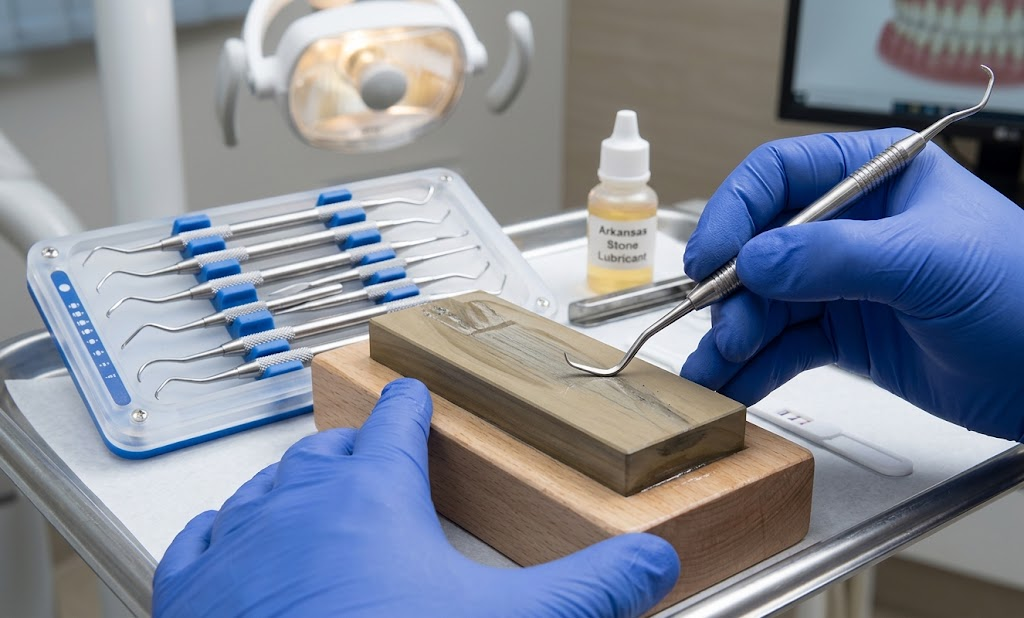
In periodontal therapy, precision matters at every stage of treatment. Even the most advanced curettes and scalers lose effectiveness when their cutting edges become dull. Instrument sharpening is not just a maintenance task it is a critical clinical procedure that directly affects treatment efficiency, clinician comfort, and patient outcomes (Instrument Sharpening Technique).
Properly sharpened periodontal instruments improve tactile sensitivity, reduce operator fatigue, and ensure efficient calculus removal with minimal tissue trauma. For dental professionals performing scaling and root planing procedures daily, mastering sharpening techniques is essential for maintaining consistent therapeutic performance.
Why Instrument Sharpening Matters in Periodontal Therapy
Periodontal curettes and scalers are designed with fine cutting edges that gradually wear down through repeated use and sterilization cycles. A dull instrument requires greater lateral pressure, leading to:
- Incomplete calculus removal
- Increased hand fatigue
- Reduced tactile sensitivity
- Longer treatment times
- Greater patient discomfort
- Higher risk of tissue trauma
Sharp instruments, on the other hand, provide smooth and controlled strokes that improve both clinician efficiency and patient experience. Consistent edge maintenance also extends the life of expensive periodontal instruments.
Understanding the Cutting Edge Anatomy
Before sharpening, clinicians must understand the anatomy of periodontal instruments.
Curettes
Gracey and universal curettes typically have:
- A rounded toe
- A rounded back
- One or two cutting edges depending on the design
Scalers
Sickle scalers feature:
- A pointed tip
- Triangular cross-section
- Two sharp cutting edges for supragingival calculus removal
The cutting edge is formed where the face of the instrument meets the lateral surface. Maintaining this precise angle is crucial during sharpening.
Signs That a Curette or Scaler Needs Sharpening
Several indicators suggest that sharpening is required:
- Instrument slips over calculus deposits
- Increased pressure is needed during scaling
- Burnished calculus remains after instrumentation
- Reduced tactile sensation
- Visible reflection from the cutting edge under light
A sharp edge does not reflect light, while a dull edge creates a shiny reflective line.
Common Sharpening Methods
There are two primary sharpening approaches used in dental practice.
Stationary Stone Technique
In this method, the instrument remains stationary while the sharpening stone moves against the blade. This is the most widely taught technique because it offers better control and preserves instrument contours effectively.
Advantages include:
- Greater precision
- Better angle maintenance
- Reduced metal removal
- Suitable for Gracey curettes
Moving Stone Technique
Here, the sharpening stone remains stationary while the instrument moves. Although faster, it requires more experience and may increase the risk of altering instrument anatomy.
Essential Sharpening Equipment
High-quality sharpening tools contribute significantly to edge consistency.
Sharpening Stones
Common options include:
- Arkansas stones
- Ceramic stones
- Diamond-coated stones
Fine-grit stones are preferred for periodontal instruments because they produce smoother cutting edges.
Lubricants
Lubrication minimizes heat generation and metal debris accumulation. Depending on the stone type, water or oil may be used.
Magnification and Lighting
Loupes and adequate lighting improve visibility and help maintain correct angulation during sharpening.
Step-by-Step Sharpening Technique
1. Stabilize the Instrument
Hold the curette or scaler securely with a modified pen grasp while resting your hand on a stable surface.
2. Identify the Correct Angle
Maintain the original factory angle, usually between 70° and 80° between the face and lateral surface.
3. Adapt the Stone Properly
Position the sharpening stone against the lateral surface while preserving the correct internal angle.
4. Use Controlled Strokes
Apply light, even strokes from heel to toe while following the instrument’s contour.
5. Preserve Instrument Shape
Avoid excessive sharpening that alters blade width, toe shape, or curvature.
6. Remove the Wire Edge
After sharpening, lightly pass the stone along the face to eliminate any residual metal fragments.
7. Test Sharpness
Use a plastic test stick to verify cutting efficiency. A sharp instrument should engage the surface without slipping.
Maintaining Gracey Curette Design Integrity
Gracey curettes are area-specific instruments with complex blade angulations. Improper sharpening can destroy their design characteristics and compromise clinical effectiveness.
Key considerations include:
- Maintain the original lower shank alignment
- Preserve the rounded toe
- Avoid flattening the curved blade surface
- Sharpen only the functional cutting edge
Because Gracey curettes are precision instruments, careful sharpening is especially important for maintaining adaptation in deep periodontal pockets and furcation areas.
How Often Should Instruments Be Sharpened?
Sharpening frequency depends on:
- Clinical workload
- Type of deposits encountered
- Instrument material quality
- Sterilization cycles
Many clinicians inspect instrument sharpness after every procedure and sharpen as needed rather than waiting for significant dullness.
Routine maintenance sharpening removes minimal metal and helps preserve instrument longevity.
Common Sharpening Mistakes
Several errors can negatively affect periodontal instrumentation performance:
Incorrect Angulation
Altering the cutting angle reduces scaling efficiency and may damage root surfaces.
Excessive Pressure
Heavy force removes unnecessary metal and shortens instrument lifespan.
Over-Sharpening
Repeated aggressive sharpening changes blade anatomy and compromises adaptation.
Ignoring Instrument Design
Different instruments require different sharpening approaches. Universal curettes, Gracey curettes, and sickle scalers should not all be sharpened identically.
Infection Control Considerations
Sharpening should be performed in a clean, organized environment following standard infection prevention protocols.
Best practices include:
- Cleaning instruments before sharpening
- Wearing protective eyewear and gloves
- Disinfecting sharpening stones regularly
- Inspecting instruments for corrosion or damage
Proper maintenance supports both clinical safety and regulatory compliance.
Benefits of Properly Sharpened Periodontal Instruments
Consistent sharpening delivers measurable advantages:
- Improved calculus removal efficiency
- Reduced clinician fatigue
- Enhanced tactile sensitivity
- Shorter appointment durations
- Better patient comfort
- More predictable periodontal outcomes
For dental hygienists and periodontists, instrument sharpness directly influences procedural quality and long-term treatment success.
Final Thoughts
Instrument sharpening is a foundational skill in periodontal therapy that directly affects treatment precision, ergonomics, and patient care. Maintaining curette and scaler cutting edges ensures efficient calculus removal while preserving delicate periodontal tissues.
By using proper sharpening techniques, preserving instrument anatomy, and implementing regular maintenance routines, dental professionals can achieve more consistent clinical outcomes and extend the lifespan of their periodontal instruments.
In modern periodontal practice, sharp instruments are not optional—they are essential for delivering predictable, high-quality therapy.