
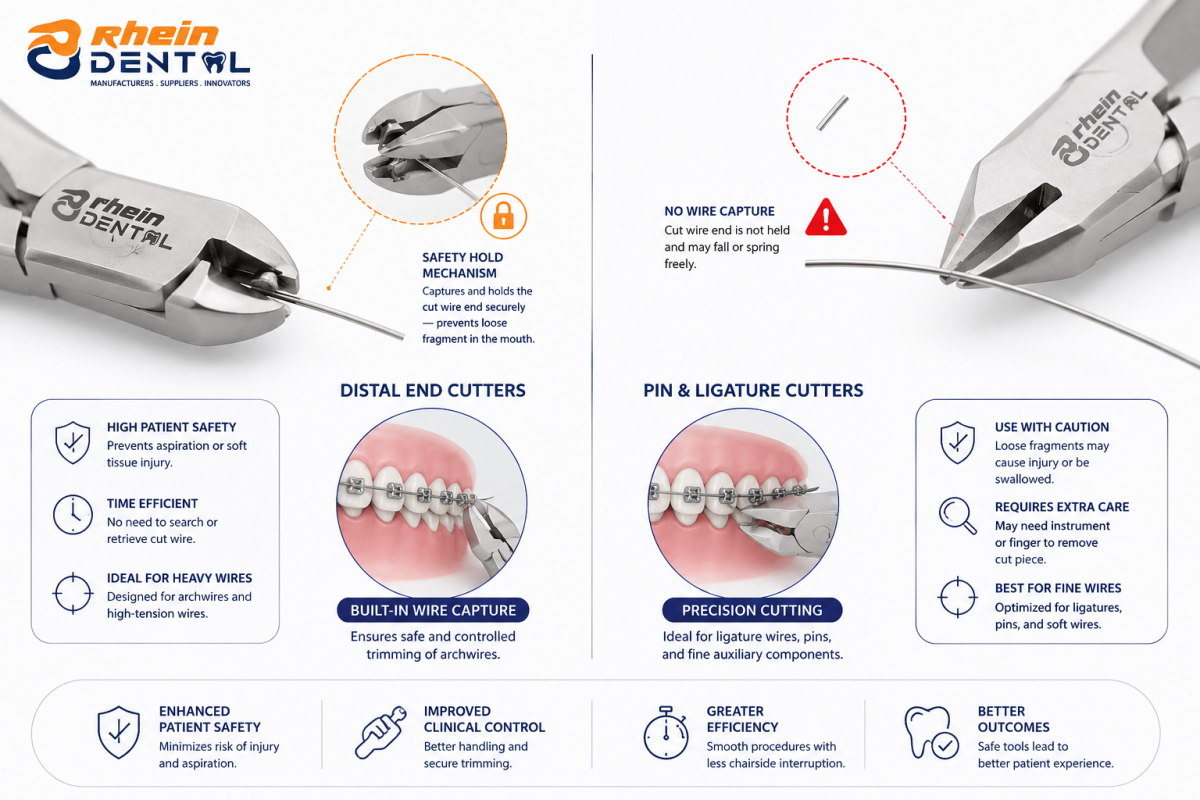
In orthodontic procedures, wire trimming is a routine but highly sensitive task. Whether adjusting archwires at the distal end or cutting ligature wires during appliance placement, clinicians must maintain complete control over trimmed wire segments to protect both patient comfort and procedural efficiency.
Two commonly used instruments for wire cutting are distal end cutters and pin and ligature cutters. While both serve essential functions in orthodontics, their safety mechanism designs differ significantly — especially in how they manage and capture wire ends during trimming.
Understanding these differences helps clinicians choose the correct instrument for each procedure while minimizing risks such as soft tissue injury, accidental wire ingestion, and chairside inefficiency.
Why Wire-End Control Matters in Orthodontics
Orthodontic wires are small, resilient, and often under tension inside the oral cavity. During cutting procedures, detached wire fragments can become hazardous if not properly controlled.
Uncaptured wire ends may:
- Injure oral soft tissues
- Cause patient discomfort
- Create aspiration or ingestion risks
- Damage appliances
- Increase chairside retrieval time
- Reduce procedural efficiency
Modern orthodontic instruments increasingly incorporate safety-focused designs that capture or stabilize wire segments immediately after cutting.
What Are Distal End Cutters?
Distal end cutters are specialized orthodontic pliers designed to trim the distal ends of archwires after placement into molar tubes or brackets.
Their defining feature is the ability to hold the cut wire segment securely after trimming.
Primary Uses of Distal End Cutters
- Trimming excess archwire length
- Cutting stainless steel wires
- Cutting nickel-titanium wires
- Finishing archwire placement
- Preventing loose wire fragments in the oral cavity
Distal end cutters are commonly used during active treatment adjustments and wire changes.
The Built-In Safety Hold Mechanism
The major advantage of distal end cutters is their integrated safety hold feature.
After the cutting blades sever the wire, a holding mechanism retains the trimmed segment instead of allowing it to spring freely inside the mouth.
This mechanism typically works through:
- Tungsten carbide insert alignment
- Spring-loaded retention pressure
- Precision jaw closure geometry
- Controlled gripping force after cutting
The retained wire can then be safely removed from the oral cavity without risk of projection or accidental swallowing.
Benefits of Distal End Cutter Safety Designs
Improved Patient Safety
Capturing the wire segment significantly reduces the risk of aspiration or ingestion during procedures.
Better Soft Tissue Protection
Loose wire fragments can puncture cheeks, gingiva, or lips. Retention systems help prevent these injuries.
Increased Clinical Efficiency
Clinicians spend less time retrieving detached wire pieces during treatment.
Enhanced Procedural Confidence
Controlled cutting improves handling during difficult posterior access cases.
Reduced Patient Anxiety
Patients often feel more comfortable knowing wire fragments are safely controlled during trimming.
What Are Pin and Ligature Cutters?
Pin and ligature cutters are orthodontic cutting instruments designed primarily for thinner wires and small pins.
Unlike distal end cutters, they are optimized for precision cutting rather than wire-end retention.
Common Applications
- Cutting ligature wires
- Trimming soft stainless steel wires
- Removing elastic pins
- Fine intraoral wire adjustments
- Cutting auxiliary components
Their smaller beak profile allows excellent access in tight clinical areas.
Key Design Differences Between the Two Instruments
Although both instruments cut orthodontic wires, their engineering objectives differ substantially.
| Feature | Distal End Cutters | Pin & Ligature Cutters |
|---|---|---|
| Primary Function | Archwire trimming | Fine wire cutting |
| Safety Hold Feature | Yes | Usually No |
| Wire Retention After Cut | Captures wire segment | Wire segment may release freely |
| Cutting Strength | High | Moderate |
| Typical Wire Type | Heavy archwires | Thin ligatures and auxiliaries |
| Posterior Access | Excellent | Good |
| Risk Reduction | High fragment control | Requires additional handling care |
Why Distal End Cutters Require Greater Force Control
Orthodontic archwires — particularly stainless steel and rectangular wires — require significant cutting force. Without a controlled mechanism, released wire tension may cause the cut segment to spring unpredictably.
Distal end cutters are engineered to manage:
- High cutting pressure
- Wire recoil energy
- Controlled blade alignment
- Safe fragment capture
This makes them essential for handling heavier orthodontic wires safely.
Material Engineering in Modern Cutting Instruments
High-quality orthodontic cutters often use tungsten carbide inserts for improved cutting efficiency and durability.
Advantages of Tungsten Carbide Inserts
- Higher hardness than stainless steel
- Longer cutting edge lifespan
- Cleaner wire cuts
- Reduced instrument wear
- Improved resistance to deformation
In distal end cutters, insert precision is especially important because improper alignment may compromise the wire-holding mechanism.
Safety Considerations During Wire Cutting
Even with advanced instrument designs, proper clinical technique remains critical.
Recommended Safety Practices
Stabilize the Wire Before Cutting
Always maintain control of the wire to minimize recoil.
Inspect Cutting Edges Regularly
Damaged or dull blades can cause incomplete cuts or slipping.
Avoid Overloading the Instrument
Using cutters beyond their intended wire capacity may damage the jaws or compromise safety performance.
Use the Correct Instrument for Each Task
Pin and ligature cutters should not replace distal end cutters for heavy archwire trimming.
Maintain Sterilization Protocols
Proper cleaning and sterilization preserve alignment and cutting efficiency.
Ergonomics and Clinical Comfort
Orthodontists perform repetitive cutting procedures daily. Instrument ergonomics directly influence comfort, hand fatigue, and procedural precision.
Modern cutter designs often include:
- Lightweight construction
- Balanced force distribution
- Ergonomic handle contours
- Smooth hinge movement
- Reduced hand strain during repeated use
Comfortable instruments improve procedural consistency during long clinical sessions.
Choosing Between Distal End Cutters and Pin & Ligature Cutters
The ideal choice depends on the clinical application.
Distal End Cutters Are Best For:
- Heavy archwire trimming
- Posterior wire cutting
- Situations requiring wire-end capture
- Safety-focused procedures
- High-tension wire adjustments
Pin and Ligature Cutters Are Best For:
- Fine wire trimming
- Ligature adjustments
- Auxiliary wire cutting
- Delicate intraoral access
- Precision detailing tasks
Most orthodontic practices require both instruments as part of a complete orthodontic setup.
The Growing Importance of Safety-Focused Instrument Design
As orthodontic treatment standards continue to evolve, instrument manufacturers increasingly focus on safety-centered engineering. Capturing wire ends during trimming is no longer considered a luxury feature — it has become an essential part of efficient and patient-focused orthodontic care.
Distal end cutters demonstrate how intelligent safety mechanisms can significantly reduce procedural risks while improving workflow efficiency. Meanwhile, pin and ligature cutters continue to provide unmatched precision for fine wire management tasks.
Selecting high-quality orthodontic cutters designed for specific clinical functions helps practitioners maintain safer procedures, better instrument longevity, and more predictable treatment outcomes.