
In complete denture prosthodontics, the precision of an edentulous impression determines everything that follows retention, stability, comfort, phonetics, and ultimately patient confidence. Even the most meticulously fabricated denture will fail clinically if the foundational impression is inaccurate.
Among the most critical decisions during this stage is the selection between stock and custom edentulous impression trays. While both serve the same fundamental purpose, their influence on tissue capture, peripheral extension, and border accuracy differs significantly. Equally important is the role of border molding instruments and techniques, which define the final seal and functional adaptation of the prosthesis.
This distinction is not merely technical — it is the difference between a denture that passively rests and one that physiologically integrates with the oral environment.
Understanding Edentulous Impression Trays
Edentulous impression trays are designed specifically for patients who have lost all natural teeth. Their purpose is to carry impression material evenly while accurately recording the supporting tissues and vestibular anatomy of the maxillary or mandibular arch.
The tray must achieve three objectives simultaneously:
- Maintain uniform impression material thickness
- Support functional tissue recording
- Permit accurate border extension
Failure in any one of these areas compromises denture retention and long-term patient satisfaction.
Stock Edentulous Impression Trays
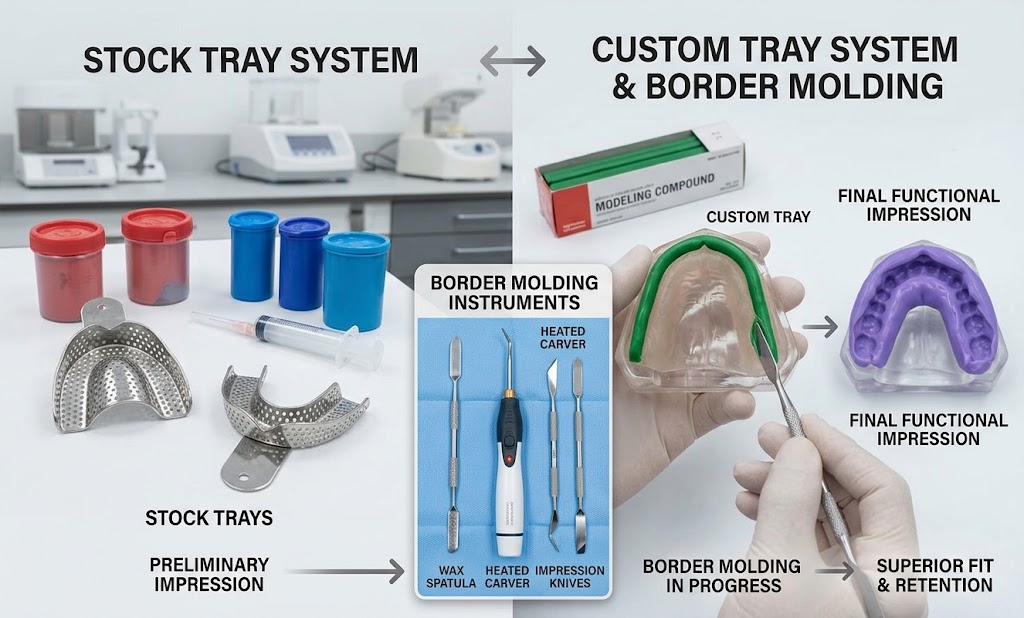
Stock trays are pre-manufactured trays available in standardized sizes and shapes. They are commonly used for preliminary impressions and diagnostic procedures.
Advantages of Stock Trays
1. Immediate Availability
Stock trays eliminate laboratory fabrication time and allow rapid chairside workflow.
2. Cost Efficiency
They are economical for routine preliminary impressions and high-volume clinical environments.
3. Simplicity in Initial Records
For diagnostic casts and treatment planning, stock trays provide sufficient anatomical detail.
4. Versatility
Available in multiple arch sizes and perforation designs, they can accommodate a broad range of edentulous anatomies.
Limitations of Stock Trays
Despite their convenience, stock trays inherently lack individualized adaptation.
1. Inconsistent Material Thickness
Excessive spacing in some regions and insufficient space in others can distort impression accuracy.
2. Poor Peripheral Adaptation
Standardized borders rarely correspond precisely to a patient’s vestibular anatomy.
3. Reduced Functional Accuracy
Movable tissue areas may not be captured under functional conditions.
4. Compromised Retention
An inaccurate border seal directly affects denture suction and stability.
For these reasons, stock trays are generally considered transitional tools rather than definitive impression carriers.
Custom Impression Trays
Custom trays are fabricated on preliminary casts specifically for the individual patient. They are designed to produce highly controlled and uniform final impressions.
Advantages of Custom Trays
1. Uniform Impression Material Thickness
Consistent spacing minimizes polymerization distortion and improves dimensional stability.
2. Precise Border Control
Tray extensions can be tailored accurately to the patient’s vestibular anatomy.
3. Improved Tissue Accuracy
Selective pressure techniques become possible, allowing clinicians to control tissue displacement.
4. Superior Final Denture Retention
A well-constructed custom tray significantly improves peripheral seal formation and denture stability.
5. Greater Patient Comfort
Reduced bulk and better adaptation enhance tolerance during impression procedures.
Why Border Molding Determines the Final Fit
Even a perfectly fabricated custom tray remains incomplete until border molding is performed accurately.
Border molding records the functional depth and width of the vestibule by shaping the tray borders dynamically during muscle movement. This step establishes the future denture’s peripheral seal.
Without proper border molding:
- Air leakage increases
- Denture movement occurs during speech and mastication
- Overextension causes soreness
- Underextension reduces retention
Border molding transforms a static tray into a functionally accurate impression system.
Border Molding Instruments and Their Clinical Role
The precision of border molding depends heavily on the instruments used to manipulate materials and define anatomical contours.
1. Wax Spatulas and Heated Carvers
These instruments soften and contour modeling compound evenly along tray borders. Controlled heating prevents irregular thickness and void formation.
2. Border Molding Compound Carriers
Specialized carriers ensure smooth material placement without contamination or premature cooling.
3. Impression Knives and Trimming Instruments
Used to refine overextended regions after functional testing, these instruments prevent impingement on movable tissues.
4. Tissue Manipulation Instruments
Mirror handles, burnishers, and contouring tools assist in shaping borders while maintaining vestibular integrity.
5. Silicone Syringe Systems
In modern prosthodontics, elastomeric border molding materials are often injected precisely around critical vestibular areas for greater accuracy.
The clinician’s ability to control these instruments directly influences the denture’s eventual retention and comfort.
Functional Anatomy and Border Accuracy
Successful border molding must account for dynamic muscular activity.
Maxillary Considerations
Critical structures include:
- Labial frenum
- Buccal frenum
- Hamular notch
- Posterior palatal seal region
Mandibular Considerations
The mandibular arch presents greater challenges due to muscular activity involving:
- Buccinator
- Mylohyoid
- Retromylohyoid space
- Masseteric notch
Inadequate border shaping in these areas commonly leads to denture instability.
Stock vs. Custom Trays: Clinical Comparison
| Feature | Stock Tray | Custom Tray |
|---|---|---|
| Adaptation Accuracy | Moderate | Excellent |
| Material Thickness Control | Inconsistent | Uniform |
| Border Precision | Limited | Highly Accurate |
| Final Denture Retention | Variable | Superior |
| Clinical Efficiency | Faster Initial Use | Better Definitive Outcome |
| Patient Comfort | Moderate | Improved |
| Best Use | Preliminary Impressions | Final Impressions |
Modern Prosthodontic Trends
Digital workflows are influencing tray fabrication through CAD/CAM custom trays and digitally designed impression systems. However, despite technological advancement, the biological principles remain unchanged:
- Accurate tissue recording
- Controlled border extension
- Functional peripheral seal
No digital innovation can compensate for poor border molding fundamentals.
Conclusion
In edentulous prosthodontics, impression accuracy is not achieved by material selection alone — it is engineered through tray design, border control, and meticulous instrumentation.
Stock trays provide speed and practicality for preliminary procedures, but custom trays remain the clinical standard for definitive impressions where precision and retention are paramount.
Most importantly, border molding instruments and techniques determine whether the final prosthesis merely occupies space or truly functions as an extension of the patient’s oral anatomy. In complete denture therapy, the border is not a margin — it is the foundation of fit itself.