
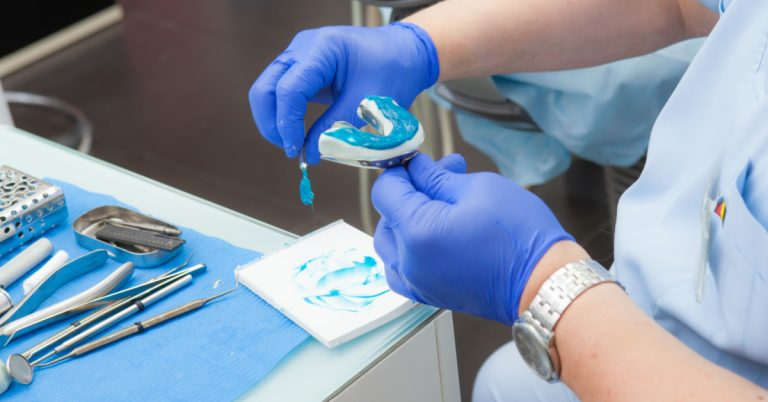
In restorative dentistry, precision and efficiency often go hand in hand. One of the tools that brings both together is the triple tray system. Designed to capture upper and lower impressions simultaneously along with the interocclusal record, this technique has become a valuable approach in crown and bridge preparations.
What Is a Triple Tray System?
A triple tray is a dual-arch impression tray that records the maxillary and mandibular arches at the same time while also capturing the bite relationship. It is typically used in single-unit crown cases or short-span restorations where accuracy and time efficiency are essential.
Unlike traditional methods that require multiple steps, the triple tray simplifies the process into one coordinated impression.
Why Triple Tray Systems Are Used in Crown Preparations
Crown preparations demand high precision. Even minor discrepancies in occlusion or fit can lead to restoration failure. The triple tray system offers several advantages in this context:
- It captures opposing arches simultaneously
- It records the interocclusal relationship in the same step
- It reduces chair time for both clinician and patient
- It minimizes material distortion caused by multiple impressions
As a result, clinicians can achieve more predictable outcomes with fewer procedural steps.
How the Triple Tray Technique Works
The procedure involves placing a specialized dual-arch tray loaded with impression material into the patient’s mouth while they bite down in centric occlusion. The material flows around both the prepared tooth and opposing dentition, as well as between the arches to record bite alignment.
Once set, the impression provides three critical records:
- Upper arch detail
- Lower arch detail
- Occlusal relationship
This single-step capture is what makes the system so efficient.
Materials Used with Triple Trays
The success of a triple tray impression depends heavily on material selection. Commonly used materials include:
- Addition silicone (PVS): Preferred for its accuracy and dimensional stability
- Polyether: Known for excellent flow and hydrophilicity
- Fast-setting elastomers: Useful to reduce patient discomfort and movement errors
Each material must balance working time, flow, and rigidity to ensure clean removal without distortion.
Advantages of Triple Tray Systems
Triple tray systems offer multiple clinical benefits, especially in crown preparations:
1. Time Efficiency
By combining multiple steps into one, overall chair time is significantly reduced.
2. Improved Patient Comfort
Fewer impression procedures mean less discomfort and gag reflex activation.
3. Reduced Material Usage
Less impression material is required compared to full-arch techniques.
4. Accurate Occlusal Record
Because the bite is recorded simultaneously, occlusal discrepancies are minimized.
Limitations to Consider
Despite their advantages, triple trays are not suitable for every case. Some limitations include:
- Not ideal for multiple-unit or full-arch restorations
- Requires stable occlusion during setting time
- Limited visibility of posterior detail in complex cases
- Potential distortion if patient movement occurs
Therefore, proper case selection is essential for success.
Best Practices for Clinical Success
To maximize accuracy with triple tray systems, clinicians should follow these guidelines:
- Ensure proper tray size selection for full coverage
- Use high-quality elastomeric impression materials
- Instruct patients to maintain a steady bite during setting
- Avoid overloading the tray with material
- Disinfect and dry the preparation area before impression taking
These steps help reduce errors and improve final restoration fit.
Conclusion
Triple tray systems have transformed crown preparation workflows by combining efficiency with accuracy. When used in the right clinical situations, they reduce chair time, improve patient comfort, and deliver reliable impressions for restorations.
However, their success depends on proper case selection, correct material choice, and careful technique. When these factors align, the triple tray becomes a powerful tool in modern restorative dentistry.