
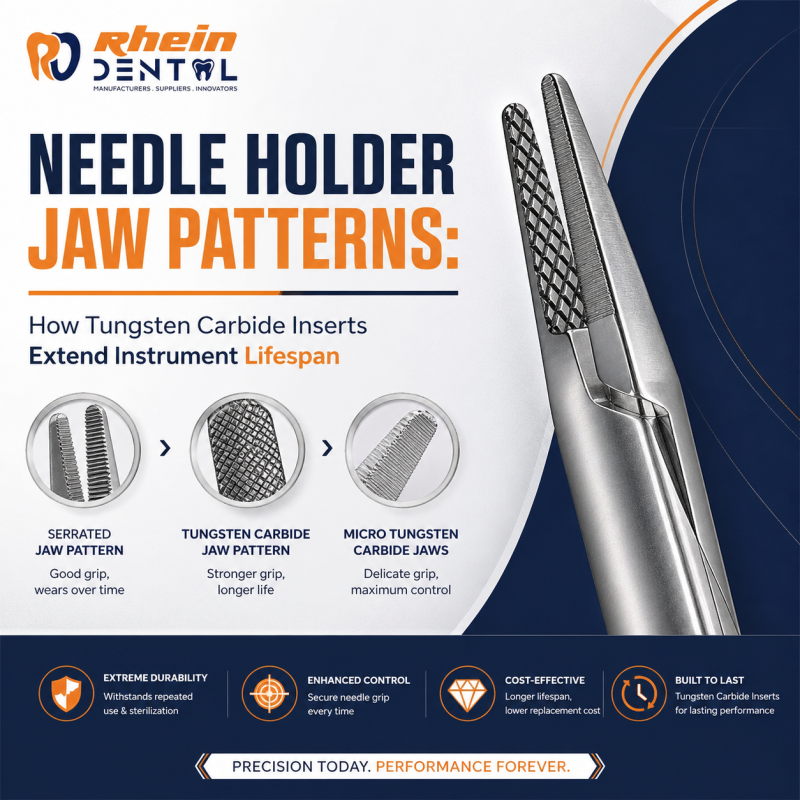
In surgical and dental procedures, needle holders play a crucial role in ensuring accurate and controlled suturing. One of the most important yet often overlooked factors is the jaw pattern design, especially when combined with tungsten carbide (TC) inserts (Needle Holder Jaw Patterns).
Why Jaw Patterns Matter
The jaw of a needle holder determines how securely it grips the suture needle. A strong and stable grip helps:
- Prevent needle slippage
- Improve suturing precision
- Reduce hand fatigue
However, over time, standard stainless steel jaws wear down and lose grip strength.
Common Jaw Patterns
- Standard Serrated Jaws: Basic grip but wear out faster with repeated use.
- Tungsten Carbide Jaws: Reinforced with TC inserts for stronger, longer-lasting grip.
- Micro TC Jaws: Designed for delicate procedures with controlled, gentle handling.
How Tungsten Carbide Inserts Help
Tungsten carbide is extremely hard and wear-resistant, making it ideal for surgical instruments.
Key benefits:
- Maintains sharp grip pattern for longer use
- Reduces needle slippage during suturing
- Extends overall instrument lifespan
- Performs consistently even after repeated sterilization
Clinical Advantage
Needle holders with TC inserts provide:
- Better control during suturing
- Less fatigue during long procedures
- More reliable performance in high-precision work
Final Takeaway
Jaw pattern design combined with tungsten carbide inserts significantly improves both performance and durability. While the initial cost may be higher, TC needle holders offer long-term reliability, precision, and cost savings in clinical practice.