
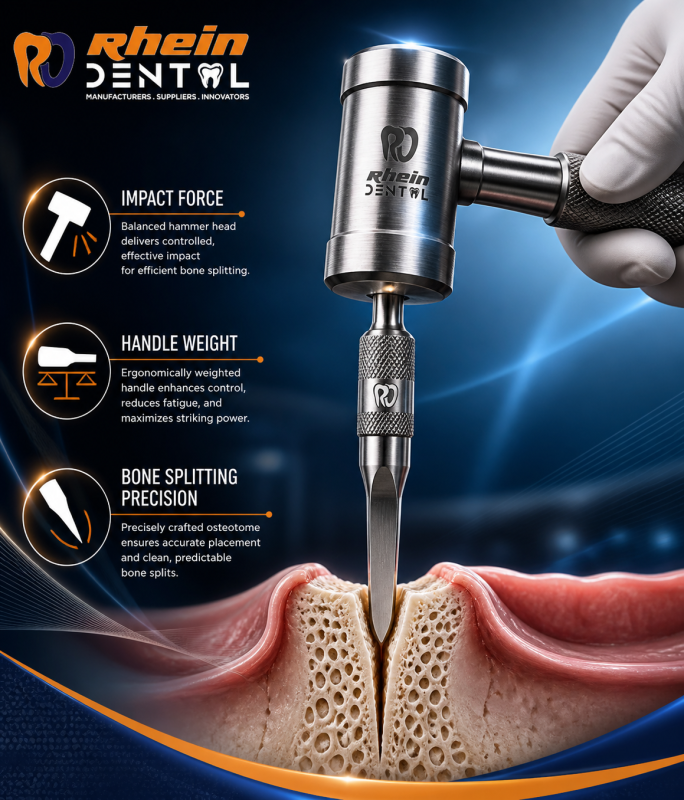
In oral and maxillofacial surgery, precision is everything—but when it comes to bone splitting and controlled osteotomy, precision must be paired with controlled force. This is where the surgical hammer and osteotome combination becomes indispensable. Together, they form a mechanical system that allows surgeons to shape bone with accuracy, efficiency, and minimal trauma.
Understanding how impact force, handle weight, and instrument design interact can significantly improve surgical outcomes and reduce procedural complications.
The Surgical Hammer: Controlled Power Delivery
The surgical hammer is not about brute force—it is about controlled impact energy.
Key Features:
- Balanced head for predictable strike force
- Ergonomic handle for controlled swings
- Available in lightweight and heavier variants
- Designed for repetitive, precise tapping rather than heavy blows
Clinical Role:
In oral surgery, the hammer is used to deliver measured force to the osteotome, allowing the surgeon to:
- Split cortical bone safely
- Expand narrow ridges
- Perform atraumatic bone removal
- Assist in implant site preparation
The effectiveness of the hammer depends heavily on how efficiently energy is transferred through the handle into the osteotome blade.
The Osteotome: Precision Bone Shaping Tool
The osteotome is a chisel-like instrument designed to cut or compress bone rather than remove it aggressively.
Key Features:
- Sharp, beveled working end
- Available in straight and curved designs
- Varying widths for different surgical applications
- High-grade stainless steel for durability and sharpness
Clinical Role:
Osteotomes are used in:
- Ridge expansion procedures
- Sinus floor elevation (internal sinus lift)
- Controlled bone splitting
- Implant site preparation in low-density bone
Unlike rotary instruments, osteotomes preserve bone vitality by compressing rather than cutting away tissue.
Impact Force: The Science Behind Bone Splitting
The success of this pairing depends largely on impact force dynamics.
Too much force can lead to:
- Microfractures
- Uncontrolled bone splitting
- Soft tissue trauma
Too little force results in:
- Inefficient bone penetration
- Increased surgical time
- Fatigue for the operator
The ideal technique involves light, rhythmic tapping, allowing gradual advancement of the osteotome through bone layers.
Handle Weight: Balance Over Power
The weight of the surgical hammer plays a critical role in precision control.
Lightweight Hammers:
- Offer better control and finesse
- Preferred for delicate maxillary procedures
- Reduce surgeon fatigue
Heavier Hammers:
- Generate stronger impact with less effort
- Useful in dense mandibular bone
- Require more experience for controlled use
The key is balance—an optimally weighted hammer allows the surgeon to maintain accuracy without excessive effort.
Surgical Precision in Bone Splitting
When the hammer and osteotome are used together correctly, they enable highly controlled bone manipulation.
Benefits of Proper Pairing:
- Minimal heat generation compared to rotary tools
- Preserved bone vitality and blood supply
- Reduced risk of bone necrosis
- Improved implant success rates
- Greater control in narrow anatomical spaces
This technique is especially valuable in implant dentistry, where bone preservation is essential for long-term stability.
Technique Matters More Than Force
Even the best instruments cannot compensate for poor technique. Successful outcomes depend on:
- Proper angulation of the osteotome
- Controlled tapping rhythm
- Understanding bone density variations
- Gradual force application rather than abrupt impact
Experienced surgeons rely on tactile feedback—feeling the resistance of bone through the instrument—to guide each step.
Conclusion
The surgical hammer and osteotome form a powerful yet delicate partnership in oral surgery. When used correctly, they transform controlled impact into precise bone shaping, offering a minimally invasive alternative to rotary techniques.
By balancing impact force, handle weight, and surgical technique, clinicians can achieve superior bone splitting precision, improved healing outcomes, and enhanced procedural safety.
In modern oral surgery, it is not just about applying force—it is about applying it intelligently.