
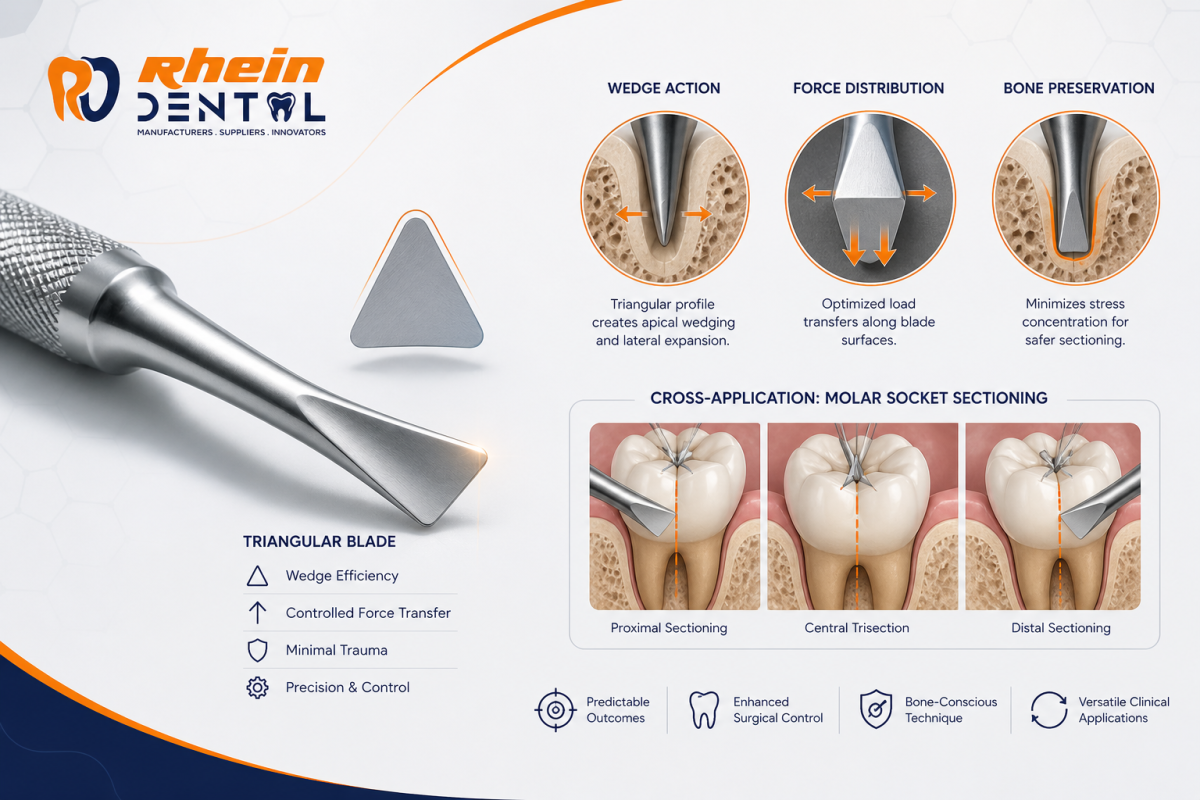
In oral surgery, precision isn’t just a preference—it’s a necessity. Among the instruments designed for controlled tooth elevation, the Cryer elevator holds a special place. Its unique geometry, especially the triangular blade design, transforms rotational force into effective leverage, making it indispensable in challenging molar extractions and root retrieval cases (Cryer elevator working principle).
Understanding how this instrument works—beyond simple “levering”—reveals a fascinating blend of biomechanics, geometry, and surgical strategy.
The Core Design: Why the Cryer Blade Is Triangular
At first glance, the Cryer elevator may look like just another surgical lever. But its power comes from a deliberately engineered triangular blade.
This shape is not cosmetic—it is functional physics in action:
- The narrow, pointed tip allows deep penetration into the periodontal ligament (PDL) space or bifurcation zones.
- The widening triangular body distributes force gradually as rotation increases.
- The asymmetrical geometry converts rotational input into lateral displacement of root structures.
In simple terms, the triangle acts like a force amplifier—small input at the handle becomes concentrated, directional force at the working end.
This is why Cryer elevators are particularly effective in retrieving fractured roots, especially in mandibular molars where access is limited.
Triangular Blade Physics: How Force Actually Works
The working principle of the Cryer elevator relies on three mechanical concepts:
1. Wedge Mechanics
The blade functions as a wedge inserted into a confined space. Once engaged, even slight rotation generates lateral separation of surrounding bone and root fragments.
2. Lever Arm Amplification
The long handle of the Cryer elevator acts as a Class I lever. The fulcrum is the bone contact point, and the load is the root fragment. This allows significant force multiplication with minimal operator effort.
3. Rotational Force Conversion
Unlike straight elevators that rely mainly on linear displacement, the Cryer system converts rotational torque into vertical and lateral root movement. This is what makes it so effective in deeply seated fragments.
Together, these principles create a controlled yet powerful extraction system—reducing the need for excessive force that could damage surrounding alveolar bone.
Cross-Application in Molar Socket Sectioning
One of the most interesting aspects of the Cryer elevator is its indirect role in molar socket sectioning strategies, especially in difficult lower molar cases.
In surgical extraction workflows, the Cryer elevator is often used after sectioning or partial separation of roots. Here’s how it integrates:
1. Assisting in Root Hemisection Retrieval
After a molar is sectioned, each root behaves as an independent structure. The Cryer elevator can be inserted into the bifurcation area to elevate one root segment while stabilizing the other.
2. Expanding the Socket Space
Its wedge action gently expands the periodontal ligament space, making it easier to mobilize remaining fragments without additional bone removal.
3. Controlled Dislodgement of Retained Roots
In cases where roots are fractured below the alveolar crest, the triangular blade can “hook” into available space and apply rotational lift, reducing the need for aggressive bone drilling.
This makes it a valuable adjunct instrument in minimally invasive molar surgery protocols.
Clinical Advantages of Cryer Elevator Mechanics
When used correctly, the Cryer elevator offers several clinical benefits:
- Reduced bone trauma due to controlled force direction
- Improved access to deeply embedded root fragments
- Less reliance on rotary instrumentation in some cases
- Higher precision in posterior molar regions
- Efficient retrieval of fractured roots without extensive flap extension
Its efficiency is not about force alone—it’s about force direction control.
Common Mistakes in Use
Despite its effectiveness, misuse can lead to complications. Some common errors include:
- Applying excessive rotational force without proper engagement
- Incorrect angulation leading to cortical plate stress
- Using it as a primary extraction tool instead of a retrieval instrument
- Poor fulcrum placement causing uncontrolled leverage
The Cryer elevator is most effective when treated as a precision instrument, not a brute-force tool.
Final Thoughts
The Cryer elevator is a clear example of how intelligent instrument design can transform surgical outcomes. Its triangular blade is not just a shape—it is a carefully engineered mechanism that translates physics into clinical efficiency.
When integrated thoughtfully into molar socket sectioning procedures, it enhances control, reduces trauma, and improves retrieval success in even the most challenging posterior cases.
In essence, it reminds us that in oral surgery, success often depends less on force—and more on how that force is designed, directed, and delivered.