
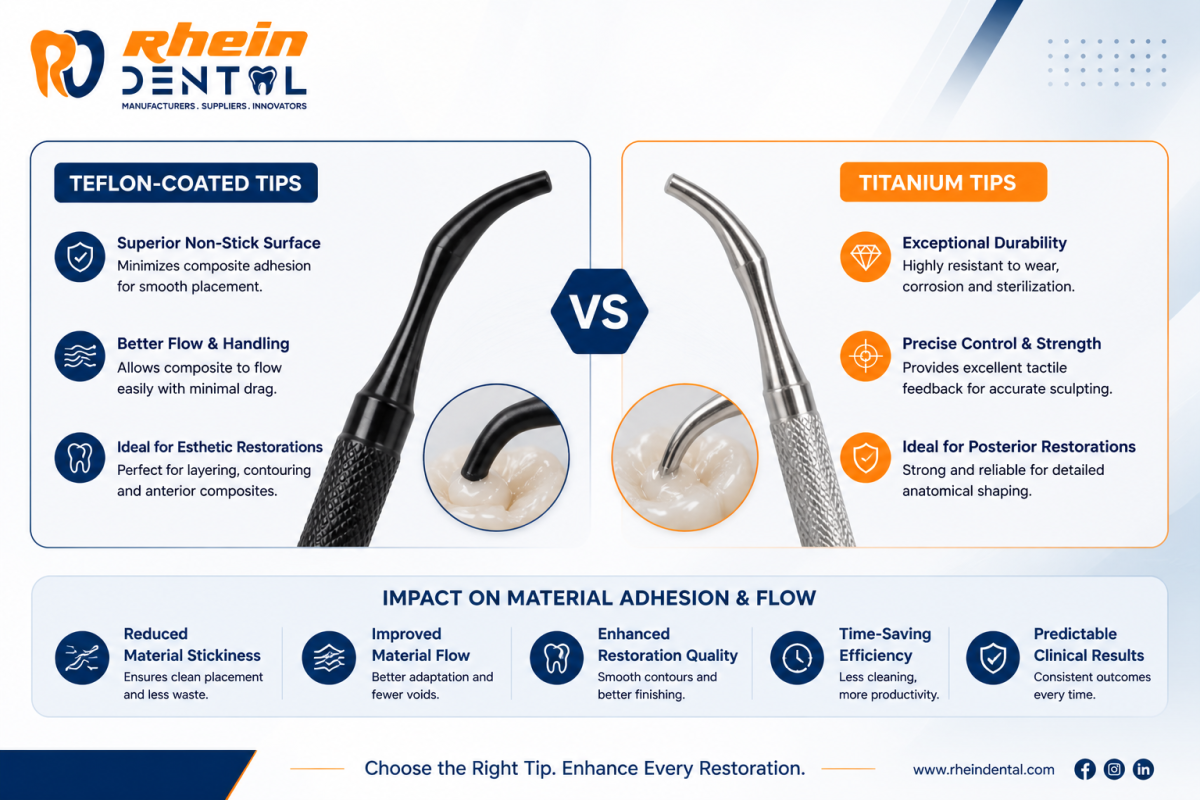
Composite restorations require precision, control, and smooth handling during placement and contouring. While restorative materials continue to evolve, the instruments used to manipulate them remain equally important in achieving predictable clinical outcomes (Composite Placement Instruments).
Among modern restorative instruments, Teflon-coated and titanium-tipped composite placement instruments are widely preferred because they minimize sticking, improve handling, and support better material adaptation. Both instrument types are designed to reduce composite adhesion during placement, but they differ significantly in surface properties, durability, tactile feedback, and clinical performance.
Understanding how these instrument tips influence material flow and adhesion helps clinicians choose the most suitable option for different restorative procedures.
Why Composite Adhesion to Instruments Matters
Composite resin materials are naturally sticky due to their viscous resin matrix. During placement, conventional stainless-steel instruments may cause the material to:
- Pull away from cavity walls
- Stick to the instrument surface
- Create voids or irregular contours
- Reduce adaptation accuracy
- Increase finishing time
Poor handling characteristics can compromise restoration quality and increase operator frustration.
Modern non-stick composite instruments aim to improve manipulation efficiency while maintaining restoration integrity.
Understanding Teflon-Coated Composite Instruments
What Are Teflon-Coated Tips?
Teflon-coated instruments feature a polytetrafluoroethylene (PTFE) surface layer applied over stainless steel or other base materials.
Teflon is known for its extremely low friction coefficient, which significantly reduces composite sticking during placement.
Advantages of Teflon-Coated Instruments
Exceptional Non-Stick Performance
One of the biggest advantages of Teflon-coated tips is their ability to resist composite adhesion.
The smooth surface allows clinicians to:
- Sculpt composite more easily
- Achieve smoother contours
- Reduce pull-back effects
- Improve marginal adaptation
- Minimize drag during layering
This is especially beneficial when working with highly viscous packable composites.
Improved Composite Flow Control
Because composite material glides more smoothly across the Teflon surface, clinicians often experience greater control during incremental placement.
This improves:
- Anatomical shaping
- Occlusal contouring
- Interproximal adaptation
- Layering precision
Better flow control also reduces the need for excessive manipulation.
Enhanced Efficiency During Restorative Procedures
Reduced sticking means fewer interruptions during placement. Clinicians spend less time cleaning instruments or correcting distorted composite layers.
This can improve efficiency in:
- Direct anterior restorations
- Posterior composites
- Veneer procedures
- Class III and IV restorations
Limitations of Teflon-Coated Instruments
Coating Wear Over Time
Although Teflon provides excellent non-stick properties, the coating may gradually wear with repeated sterilization and clinical use.
Surface damage can reduce performance and eventually expose the underlying metal.
Reduced Surface Hardness
Compared to titanium, Teflon-coated tips are generally softer and may be less resistant to scratching or mechanical wear.
Improper cleaning techniques may accelerate coating deterioration.
Understanding Titanium Composite Placement Instruments
What Are Titanium Tips?
Titanium composite instruments are manufactured using high-grade titanium alloys with naturally smooth, corrosion-resistant surfaces.
Titanium offers excellent strength, durability, and biocompatibility while maintaining relatively low composite adhesion.
Advantages of Titanium Tips
Superior Durability
Titanium instruments are highly resistant to:
- Corrosion
- Scratching
- Mechanical wear
- Repeated sterilization cycles
This makes them ideal for long-term clinical use.
Better Structural Strength
Titanium tips maintain their shape and edge integrity more effectively than coated surfaces.
This is especially useful for:
- Fine anatomical carving
- Marginal refinement
- Posterior occlusal sculpting
- High-precision restorative work
Reliable Tactile Feedback
Many clinicians prefer titanium because it provides firmer tactile sensation during composite placement.
This enhanced feedback helps improve:
- Pressure control
- Material adaptation
- Surface contour accuracy
For detailed restorative procedures, tactile precision can significantly influence final outcomes.
Limitations of Titanium Tips
Slightly Higher Composite Adhesion
Although titanium reduces sticking compared to standard stainless steel, it typically does not provide the same ultra-low adhesion as Teflon-coated surfaces.
Some highly viscous composites may still adhere slightly during manipulation.
Higher Cost
Titanium instruments are often more expensive due to material quality and manufacturing complexity.
However, their durability may offset replacement costs over time.
Comparing Teflon-Coated and Titanium Tips
Adhesion Performance
Teflon-coated instruments generally provide superior non-stick performance, particularly with sticky hybrid and packable composites.
Titanium offers moderate non-stick characteristics but prioritizes durability and control.
Material Flow Characteristics
Teflon-coated tips allow composite to flow more smoothly with reduced drag, making them ideal for layering and contouring procedures.
Titanium tips provide slightly firmer manipulation, which some clinicians prefer for controlled sculpting.
Durability Comparison
Titanium significantly outperforms Teflon coatings in terms of long-term wear resistance and sterilization durability.
Clinics with heavy restorative workloads may benefit from titanium’s longevity.
Clinical Applications of Each Instrument Type
Best Uses for Teflon-Coated Instruments
Teflon-coated tips are commonly preferred for:
- Esthetic anterior restorations
- Composite veneer placement
- Incremental layering
- Highly viscous composite materials
- Smooth contour creation
Best Uses for Titanium Instruments
Titanium tips are often favored for:
- Posterior restorations
- High-volume restorative practice
- Precise anatomical carving
- Long-term instrument durability
- Detailed occlusal sculpting
Infection Control and Maintenance
Proper maintenance directly affects the lifespan and performance of both instrument types.
Clinicians should:
- Avoid abrasive cleaning agents
- Use non-scratching sterilization procedures
- Inspect tips regularly for wear
- Store instruments carefully to prevent surface damage
Protecting the instrument surface helps preserve optimal composite handling characteristics.
The Future of Composite Placement Technology
As restorative materials become more advanced, instrument manufacturers continue improving surface engineering and ergonomic design.
Emerging technologies may include:
- Advanced nano-coatings
- Enhanced anti-stick surfaces
- Hybrid titanium-polymer designs
- Improved ergonomic grip systems
These innovations aim to further optimize composite adaptation, reduce operator fatigue, and improve restorative precision.
Conclusion
Both Teflon-coated and titanium composite placement instruments play valuable roles in restorative dentistry. Each offers distinct advantages depending on clinical priorities and restorative techniques.
Teflon-coated tips excel in minimizing composite adhesion and improving material flow, making them highly effective for smooth contouring and esthetic restorations. Titanium tips, on the other hand, provide superior durability, structural strength, and tactile control for long-term clinical performance.
Selecting the right instrument ultimately depends on the clinician’s preferred handling characteristics, restoration type, and workflow requirements. When chosen appropriately, both instrument systems contribute significantly to achieving precise, efficient, and high-quality composite restorations.