
Orthodontic treatment is built on precision, consistency, and attention to detail. While brackets, archwires, and aligners often receive the most attention, the instruments used to place, adjust, and remove these appliances play an equally important role. Every adjustment made during treatment relies on specialized orthodontic instruments that allow clinicians to work accurately while ensuring patient comfort (Types of Orthodontic Instruments).
Whether you’re an orthodontist, a general dentist providing orthodontic services, a dental student, or a clinic manager purchasing equipment, understanding the types of orthodontic instruments and their functions is essential. The right instruments improve treatment efficiency, reduce chair time, and help achieve predictable clinical outcomes. Conversely, poorly designed or worn instruments can compromise accuracy and increase the risk of appliance damage(Types of Orthodontic Instruments).
Moreover, investing in high-quality orthodontic instruments contributes to long-term cost savings. Premium instruments retain their cutting performance, resist corrosion, and withstand repeated sterilization cycles, making them a reliable choice for busy dental practices.
This comprehensive guide explains the most commonly used orthodontic instruments, their clinical applications, key features, and practical tips for selecting the best instruments for your practice.
What Are Orthodontic Instruments?
Orthodontic instruments are specialized dental tools designed to diagnose, place, adjust, maintain, and remove orthodontic appliances. Unlike general dental instruments, these tools are specifically engineered to handle delicate wires, brackets, bands, elastics, and other orthodontic components with exceptional precision.
Throughout orthodontic treatment, clinicians rely on these instruments to perform a wide range of procedures, including:
- Bonding orthodontic brackets
- Placing and adjusting archwires
- Forming wire loops and bends
- Installing ligatures and elastics
- Seating and removing orthodontic bands
- Debonding brackets at the end of treatment
- Finishing and detailing tooth alignment
Because every stage of treatment requires accuracy, orthodontic instruments are manufactured with fine working tips, ergonomic handles, and durable surgical-grade materials that provide consistent performance.
Why High-Quality Orthodontic Instruments Matter
Selecting premium orthodontic instruments is about much more than convenience. In fact, instrument quality directly influences clinical efficiency, patient safety, and treatment outcomes.
High-quality instruments offer several important advantages:
- Improved precision during appliance placement
- Better control when manipulating orthodontic wires
- Reduced chair time for both clinicians and patients
- Enhanced patient comfort during adjustments
- Greater durability under repeated sterilization
- Lower long-term replacement costs
- Reduced hand fatigue through ergonomic designs
Furthermore, premium instruments maintain proper alignment, gripping force, and cutting efficiency even after hundreds of autoclave cycles. As a result, clinicians can perform procedures confidently without worrying about inconsistent performance.
Main Categories of Different Types of Orthodontic Instruments
Orthodontic instruments can be grouped into several categories based on their primary function. Understanding these categories makes it easier to select the right instrument for each clinical procedure.
The major categories include:
- Diagnostic instruments
- Orthodontic pliers
- Wire cutting instruments
- Bracket placement instruments
- Ligature instruments
- Band placement instruments
- Bracket removal instruments
- Measuring instruments
- Finishing instruments
- Utility orthodontic tools
Each category contains instruments specifically designed to perform precise clinical tasks.
Orthodontic Pliers
Among all orthodontic instruments, orthodontic pliers are some of the most frequently used. They allow clinicians to bend wires, create loops, hold orthodontic components, and make precise adjustments throughout treatment.
Since every orthodontic procedure involves different wire types and appliance configurations, multiple types of pliers are used during various stages of treatment.
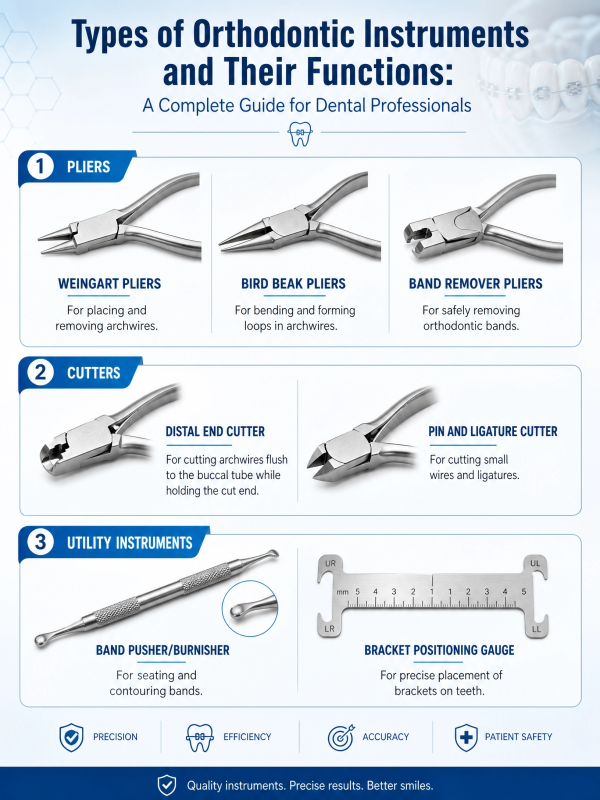
Bird Beak Pliers
Bird Beak Pliers are considered one of the most versatile orthodontic hand instruments. Their distinctive design features one round beak and one flat beak, allowing clinicians to create smooth bends without weakening the orthodontic wire.
Primary Functions
Bird Beak Pliers are commonly used to:
- Bend orthodontic wires
- Create wire loops
- Form springs
- Fabricate removable appliances
- Adjust archwires
- Customize wire configurations
Additionally, these pliers provide excellent control when working with stainless steel and nickel-titanium wires.
Clinical Applications
Orthodontists frequently use Bird Beak Pliers during:
- Loop formation
- Appliance fabrication
- Wire contouring
- Chairside appliance adjustments
- Minor wire modifications
Because of their versatility, Bird Beak Pliers are often considered an essential instrument in every orthodontic setup.
Weingart Pliers
Weingart Pliers are another indispensable instrument used throughout orthodontic treatment. Their narrow, serrated beaks provide a secure grip on orthodontic wires without causing unnecessary damage.
Primary Functions
Clinicians commonly use Weingart Pliers to:
- Insert archwires into brackets
- Remove orthodontic wires
- Guide wires through molar tubes
- Hold orthodontic components securely
- Position auxiliary appliances
Furthermore, the angled design allows easy access to posterior teeth, making wire placement more efficient.
Advantages
Some key benefits include:
- Excellent wire control
- Strong gripping force
- Improved access to difficult areas
- Reduced slipping during adjustments
- Comfortable handling
Consequently, Weingart Pliers remain one of the most frequently used orthodontic instruments in daily practice.
Three-Prong Pliers
Three-Prong Pliers are specifically designed for controlled wire adjustments. Unlike standard pliers, their three-point contact distributes pressure evenly across the wire, minimizing distortion during bending.
Primary Functions
These pliers help clinicians:
- Bend orthodontic wires
- Adjust appliance components
- Modify heavy wires
- Correct wire angulation
- Shape removable appliances
In addition, they are particularly useful when greater bending force is required.
Clinical Uses
Orthodontists often choose Three-Prong Pliers for:
- Appliance repair
- Wire customization
- Heavy wire adjustments
- Laboratory procedures
- Orthodontic finishing
Choosing the Right Orthodontic Pliers
Not every orthodontic procedure requires the same type of pliers. Instead, clinicians should select instruments based on the specific wire material, appliance design, and treatment stage.
When purchasing orthodontic pliers, consider the following factors:
- Surgical-grade stainless steel construction
- Tungsten carbide inserts where applicable
- Precision tip alignment
- Ergonomic handle design
- Corrosion resistance
- Autoclave compatibility
- Manufacturer reputation
- Long-term durability
Additionally, purchasing instruments from reputable manufacturers helps ensure consistent quality and dependable clinical performance.
Orthodontic Wire Cutting Instruments
While orthodontic pliers shape and manipulate wires, cutting instruments ensure that every wire is trimmed safely and precisely. Throughout treatment, orthodontists routinely shorten archwires, remove ligatures, and cut heavy stainless steel wires. Therefore, having the correct cutter for each task is essential.
Modern orthodontic wire cutters are engineered to deliver clean cuts with minimal effort. In addition, premium cutters maintain their sharpness even after repeated sterilization, making them a worthwhile investment for busy practices.
Distal End Cutter
Among all orthodontic cutting instruments, the Distal End Cutter is one of the most frequently used. It is specifically designed to trim the excess portion of an archwire extending beyond the last molar.
Unlike ordinary wire cutters, many distal end cutters feature a safety hold mechanism that securely grips the cut wire fragment. As a result, the wire does not fall into the patient’s mouth, significantly reducing the risk of swallowing or aspiration.
Primary Functions
The Distal End Cutter is commonly used to:
- Cut excess archwire after placement
- Hold the trimmed wire segment securely
- Improve patient safety during wire adjustments
- Prevent irritation caused by long wire ends
Clinical Benefits
Clinicians appreciate this instrument because it offers:
- Precise cutting performance
- Enhanced patient safety
- Reduced chair time
- Comfortable posterior access
- Long-lasting cutting efficiency
Consequently, the Distal End Cutter has become an indispensable instrument in every orthodontic practice.
Ligature Cutter
Although ligature wires are much thinner than archwires, they still require a dedicated cutting instrument. A Ligature Cutter allows clinicians to remove fine ligature wires without damaging surrounding brackets or soft tissues.
Because its cutting tips are smaller and more delicate, this instrument delivers exceptional precision.
Primary Functions
A Ligature Cutter is commonly used to:
- Cut stainless steel ligature wires
- Remove ligatures during adjustments
- Trim fine auxiliary wires
- Support debonding procedures
Why It Matters
Using the appropriate cutter offers several advantages:
- Cleaner cuts
- Improved visibility
- Greater precision
- Reduced tissue trauma
- Better control in confined spaces
Pin and Ligature Cutter
The Pin and Ligature Cutter combines versatility with precision. In addition to cutting ligature wires, it can also trim orthodontic pins and light auxiliary wires.
For practices performing a variety of orthodontic procedures, this instrument adds flexibility without sacrificing accuracy.
Primary Functions
Orthodontists use this cutter to:
- Cut ligature wires
- Trim orthodontic pins
- Remove light auxiliary wires
- Perform detailed finishing procedures
Bracket Placement Instruments
Accurate bracket positioning is one of the most important factors influencing orthodontic treatment outcomes. Even a slight variation in bracket height or angulation can affect tooth movement and increase treatment time. Consequently, clinicians rely on specialized instruments to position brackets with exceptional precision.
Bracket Holding Tweezers
Bracket Holding Tweezers are designed to grasp orthodontic brackets securely during bonding. Their fine serrated tips provide excellent control, allowing clinicians to position each bracket accurately before curing the adhesive.
Primary Functions
These tweezers help clinicians:
- Hold orthodontic brackets
- Transfer brackets to teeth
- Position brackets accurately
- Improve bonding efficiency
Clinical Advantages
Furthermore, Bracket Holding Tweezers offer:
- Better handling of small components
- Reduced risk of dropping brackets
- Greater placement accuracy
- Improved workflow during bonding procedures
Bracket Placement Forceps
Another valuable bonding instrument is the Bracket Placement Forceps. Unlike ordinary tweezers, these forceps are specifically designed to hold orthodontic brackets securely while allowing precise placement.
Primary Functions
Clinicians use Bracket Placement Forceps to:
- Carry orthodontic brackets
- Position attachments
- Improve placement precision
- Increase bonding efficiency
As a result, the bonding process becomes faster and more controlled.
Ligature Instruments
Ligatures secure the archwire within each bracket slot. Consequently, dedicated ligature instruments allow clinicians to install and adjust these small components efficiently while minimizing patient discomfort.
Mathieu Needle Holder
The Mathieu Needle Holder is one of the most recognizable orthodontic instruments. Thanks to its spring-loaded locking mechanism, clinicians can hold elastics securely without excessive hand pressure.
Primary Functions
This instrument is commonly used to:
- Place elastic ligatures
- Hold orthodontic elastics
- Insert power chains
- Position auxiliary attachments
Advantages
Additionally, the Mathieu Needle Holder provides:
- Secure grip
- Comfortable handling
- Excellent control
- Faster elastic placement
Ligature Director
A Ligature Director is designed to guide ligature wires safely beneath bracket wings. At the same time, it helps tuck protruding wire ends away from the cheeks and lips.
Primary Functions
Orthodontists use this instrument to:
- Direct ligature wires
- Position elastics
- Protect soft tissues
- Improve patient comfort
Because of its slim profile, the Ligature Director works especially well in crowded areas of the mouth.
Ligature Tucker
Once ligature wires have been tightened, sharp wire ends must be tucked neatly beneath the bracket. A Ligature Tucker performs this task quickly and safely.
Primary Functions
The Ligature Tucker helps clinicians:
- Push ligature wires into position
- Prevent soft tissue irritation
- Improve patient comfort
- Finish wire adjustments neatly
Consequently, patients experience fewer complaints related to wire irritation.
Orthodontic Band Instruments
Although bonded brackets are widely used today, orthodontic bands remain important for molars and specialized appliances. Therefore, orthodontists require dedicated instruments for placing and removing bands safely.
Band Pusher
The Band Pusher applies controlled pressure while seating orthodontic bands onto teeth.
Primary Functions
It is commonly used to:
- Seat orthodontic bands
- Improve band adaptation
- Apply even pressure
- Enhance band stability
Band Seater
After the band is positioned, clinicians often use a Band Seater together with a bite stick to ensure complete seating.
Benefits
Using this instrument helps achieve:
- Proper band adaptation
- Better cement distribution
- Improved retention
- Comfortable seating
Bracket Removing Instruments
Every orthodontic case eventually reaches the debonding stage. At this point, brackets must be removed carefully without damaging enamel surfaces.
Bracket Removing Pliers
Bracket Removing Pliers are specifically engineered to apply controlled force between the bracket base and adhesive.
Primary Functions
These pliers allow clinicians to:
- Remove orthodontic brackets
- Protect enamel
- Reduce bracket fractures
- Improve patient comfort during debonding
Clinical Benefits
Furthermore, using specialized debonding pliers helps:
- Preserve tooth integrity
- Reduce cleanup time
- Minimize discomfort
- Improve overall treatment completion
Measurement of Different Types of Orthodontic Instruments
Successful orthodontic treatment depends on precise measurements. Even small differences in bracket height or wire length can influence tooth movement and overall treatment results. Therefore, orthodontists use specialized measuring instruments to maintain consistency throughout every stage of care.
Unlike general measuring tools, orthodontic measuring instruments are specifically designed for accurate intraoral and laboratory applications. As a result, they help clinicians achieve predictable outcomes while minimizing unnecessary adjustments.
Bracket Height Gauge
Accurate bracket placement begins with consistent measurements. For this reason, the Bracket Height Gauge plays a vital role during the bonding process.
Rather than estimating bracket position visually, clinicians use this instrument to achieve standardized bracket heights across the dental arch.
Primary Functions
The Bracket Height Gauge helps clinicians:
- Measure bracket height
- Position brackets consistently
- Improve bonding accuracy
- Reduce bracket repositioning
Clinical Advantages
When brackets are placed accurately, clinicians can expect:
- More predictable tooth movement
- Improved finishing results
- Fewer mid-treatment corrections
- Reduced treatment time
Diagnostic and Utility of Different Types of Orthodontic Instruments
Although pliers and cutters perform most orthodontic procedures, several utility instruments support diagnosis, appliance placement, and routine adjustments. Together, these tools improve workflow and enhance clinical efficiency.
Mouth Mirror
The Mouth Mirror remains one of the most frequently used instruments in every dental practice.
Functions
Clinicians use it to:
- Obtain indirect vision
- Retract soft tissues
- Improve illumination
- Examine difficult-to-see areas
Additionally, the mirror allows orthodontists to evaluate bracket positioning from multiple angles without changing patient positioning.
Explorer
An Explorer assists clinicians in examining orthodontic appliances throughout treatment.
Primary Uses
It is commonly used to:
- Check bracket integrity
- Detect adhesive remnants
- Evaluate appliance stability
- Inspect tooth surfaces
Furthermore, the explorer helps identify loose brackets before they become larger clinical problems.
Cotton Pliers
Despite their simple design, Cotton Pliers are extremely versatile in orthodontics.
Common Functions
They are used to:
- Transfer cotton pellets
- Hold elastics
- Carry ligatures
- Handle small orthodontic components
Because they provide excellent control, Cotton Pliers improve efficiency during routine appointments.
Materials Used in Different Types of Orthodontic Instruments
The quality of an orthodontic instrument depends largely on the materials used during manufacturing. Premium materials improve durability, maintain precision, and ensure long-term performance despite repeated sterilization.
Most professional orthodontic instruments are manufactured from:
- Surgical-grade stainless steel
- German stainless steel
- Tungsten carbide inserts
- Titanium alloys
- Corrosion-resistant specialty alloys
These materials provide several important benefits, including:
- Excellent corrosion resistance
- Long-lasting cutting edges
- High tensile strength
- Reliable tip alignment
- Compatibility with repeated autoclaving
- Reduced maintenance requirements
Consequently, investing in premium instruments often results in lower replacement costs over time.
How to Choose High-Quality Orthodontic Instruments
Selecting the right orthodontic instruments requires more than comparing prices. Instead, clinicians should evaluate quality, durability, ergonomics, and long-term performance before making a purchase.
1. Material Quality
Always choose instruments manufactured from surgical-grade stainless steel or other high-quality alloys. Better materials provide superior durability and corrosion resistance.
2. Precision Manufacturing
Well-aligned tips ensure accurate wire bending, secure gripping, and clean cutting performance.
3. Ergonomic Design
Comfortable handles reduce hand fatigue during lengthy procedures. Consequently, ergonomic instruments improve both efficiency and clinician comfort.
4. Cutting Performance
High-quality cutters maintain their sharpness even after hundreds of sterilization cycles. Therefore, they continue delivering smooth, clean cuts over an extended service life.
5. Sterilization Compatibility
Orthodontic instruments should tolerate repeated autoclaving without corrosion, discoloration, or mechanical failure.
6. Manufacturer Reputation
Choosing trusted manufacturers helps ensure consistent quality, reliable warranties, and dependable customer support.
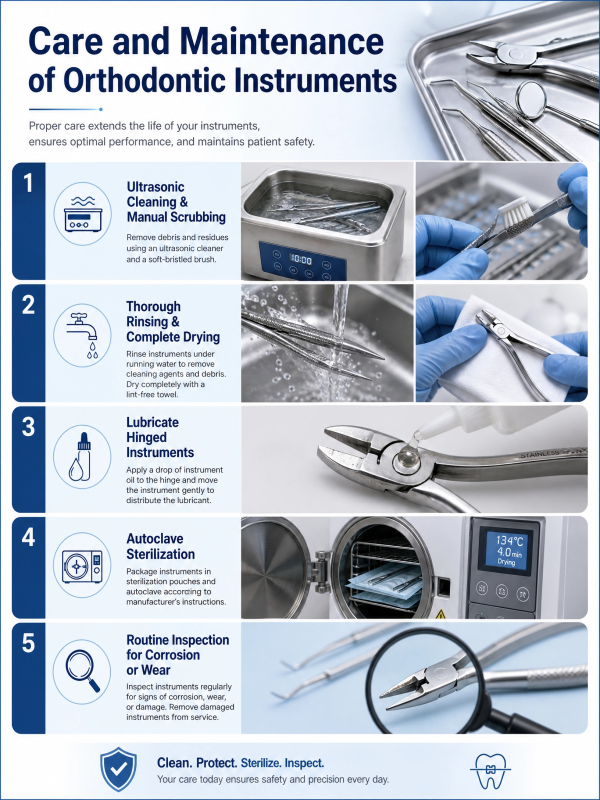
Instrument Care and Maintenance
Even the highest-quality orthodontic instruments require proper maintenance to preserve their performance.
Following these best practices will extend instrument lifespan:
- Clean instruments immediately after use.
- Remove debris before sterilization.
- Use ultrasonic cleaning whenever possible.
- Lubricate hinged instruments regularly.
- Inspect cutting edges for wear.
- Replace damaged instruments promptly.
- Store instruments in sterilization cassettes.
- Avoid mixing delicate carbide cutters with heavier instruments during processing.
Proper maintenance not only protects your investment but also supports safe and efficient patient care.
Conclusion
Orthodontic treatment relies on precision at every stage, and the right instruments make that precision possible. From wire bending and bracket placement to appliance adjustments and final debonding, each orthodontic instrument is designed for a specific clinical purpose.
Understanding the types of orthodontic instruments and their functions enables dental professionals to work more efficiently, improve treatment outcomes, and provide greater comfort for patients. Moreover, investing in high-quality, well-maintained instruments enhances long-term reliability, reduces replacement costs, and supports consistent clinical performance.
Whether you are establishing a new orthodontic practice, expanding your dental inventory, or replacing existing equipment, selecting durable, precision-engineered orthodontic instruments is an investment in both patient care and professional success.
Frequently Asked Questions (FAQs)
What are orthodontic instruments?
Orthodontic instruments are specialized dental tools used to diagnose, place, adjust, maintain, and remove orthodontic appliances such as brackets, bands, archwires, ligatures, and retainers.
Which instrument is used to bend orthodontic wires?
Bird Beak Pliers, Jarabak Pliers, Adams Pliers, and Three-Prong Pliers are commonly used to bend orthodontic wires and create customized wire configurations.
What is a Distal End Cutter used for?
A Distal End Cutter trims excess archwire extending beyond the last molar. Many modern models also hold the cut wire securely to improve patient safety.
Which orthodontic instrument removes brackets?
Bracket Removing Pliers are specifically designed to debond orthodontic brackets while protecting tooth enamel.
What are Weingart Pliers used for?
Weingart Pliers are primarily used to insert, remove, and guide archwires through orthodontic brackets and molar tubes.
Why are orthodontic instruments made from stainless steel?
Surgical-grade stainless steel provides excellent strength, corrosion resistance, and durability while remaining compatible with repeated autoclave sterilization.
How often should orthodontic instruments be replaced?
Instrument lifespan depends on usage and maintenance. However, cutters should be replaced once they lose sharpness, while damaged or misaligned instruments should be removed from service immediately.
What is the difference between Bird Beak Pliers and Three-Prong Pliers?
Bird Beak Pliers are primarily used for creating loops and smooth wire bends, whereas Three-Prong Pliers provide greater leverage for adjusting heavier wires and appliance components.
Which orthodontic instrument is used for placing elastics?
The Mathieu Needle Holder is the most commonly used instrument for placing elastic ligatures and power chains.
How do you maintain orthodontic instruments?
Routine cleaning, ultrasonic washing, lubrication, proper sterilization, and regular inspection help preserve instrument performance and extend service life.