
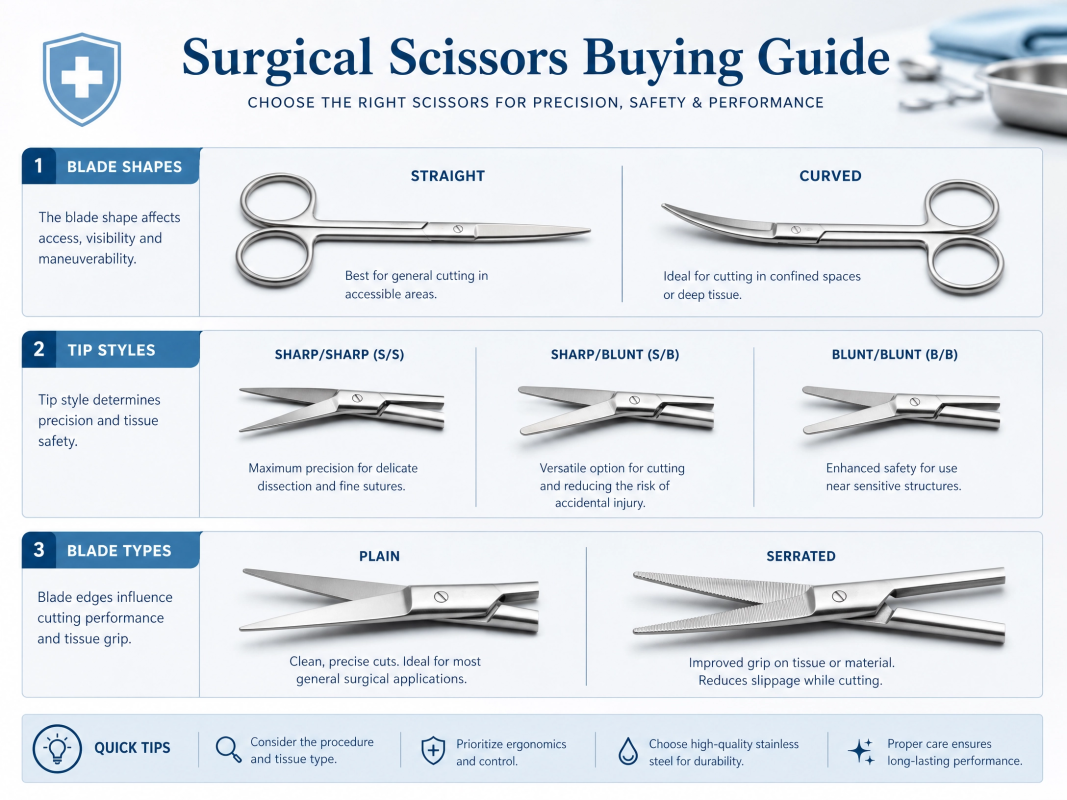
Selecting the right surgical scissors is about much more than choosing a size. Every procedure demands precision, tissue preservation, and efficiency, making blade shape, curvature, and tip configuration critical factors in instrument selection.
Whether you’re purchasing instruments for a hospital, surgical centre, dental practice, veterinary clinic, or educational institution, understanding the design differences between surgical scissors can improve procedural outcomes while extending instrument lifespan.
This comprehensive buying guide explains how to choose the ideal surgical scissors for every task, covering blade types, curved vs straight scissors, blunt and sharp tips, material quality, and common applications.
Why Choosing the Right Surgical Scissors Matters
Surgical scissors are among the most frequently used instruments in operating theatres. They are designed for controlled cutting, dissecting tissue, trimming sutures, and handling delicate anatomical structures.
Using an unsuitable scissor can lead to:
- Reduced cutting precision
- Tissue trauma
- Blade dulling
- Increased surgeon fatigue
- Shorter instrument lifespan
- Higher replacement costs
Selecting scissors based on the intended procedure ensures greater efficiency and patient safety.
Understanding Surgical Scissor Anatomy
Before choosing a model, it’s important to understand the key components that influence performance.
Blade
The blade performs the cutting action. Its length, thickness, sharpness, and shape determine what materials it can cut effectively.
Tip
The tip controls entry into tissue and determines whether the instrument is designed for blunt dissection, delicate cutting, or precise trimming.
Shank
The shank connects the blades to the finger rings. Longer shanks provide deeper reach while maintaining visibility.
Joint
Most surgical scissors use a box lock or screw joint that allows smooth opening and closing.
Finger Rings
Ergonomically designed finger rings improve comfort during prolonged procedures.
Blade Shapes: Which One Should You Choose?
Different blade designs are engineered for different surgical tasks.
Straight Blade Scissors
Straight blades provide maximum visibility during cutting.
Best suited for:
- Suture removal
- Cutting dressings
- Trimming gauze
- External tissue
- Operating room preparation
Advantages:
- Excellent visibility
- Controlled straight cuts
- Easy access on flat surfaces
Common examples include:
- Straight Mayo Scissors
- Stitch Scissors
- Operating Scissors
Curved Blade Scissors
Curved blades follow natural tissue planes.
They allow surgeons to cut beneath tissue without obstructing the surgical field.
Best for:
- Tissue dissection
- Deep surgical work
- Separating fascia
- Muscle dissection
- Internal procedures
Advantages include:
- Better visibility beneath tissue
- Reduced accidental damage
- Easier deep access
- Improved precision
Curved scissors are among the most commonly used instruments during general surgery.
Fine-Bladed Scissors
Fine blades are manufactured for precision rather than strength.
Ideal applications include:
- Plastic surgery
- Ophthalmic surgery
- ENT
- Microsurgery
- Delicate tissue
These scissors minimize trauma while maintaining exceptional control.
Heavy-Bladed Scissors
Heavy blades are intended for dense structures.
Suitable for:
- Fascia
- Tendons
- Thick connective tissue
- Surgical materials
Heavy-duty scissors maintain edge integrity under greater cutting forces.
Straight vs Curved Surgical Scissors
| Feature | Straight Scissors | Curved Scissors |
|---|---|---|
| Best For | Surface cutting | Deep tissue |
| Visibility | Excellent | Excellent underneath tissue |
| Tissue Dissection | Limited | Excellent |
| Suture Removal | Excellent | Good |
| General Surgery | Good | Excellent |
| Precision | High | Very High |
Neither design is universally better.
The correct choice depends entirely on the intended surgical task.
Understanding Surgical Scissor Tip Styles
Tip configuration significantly influences safety and precision.
Blunt-Blunt Tips
Both blade ends are rounded.
Ideal for:
- Bandage removal
- Dressings
- Soft tissue
- General surgical use
Advantages:
- Lower risk of accidental puncture
- Increased patient safety
- Better for beginners
Sharp-Sharp Tips
Both blades terminate in fine points.
Best for:
- Precise tissue cutting
- Fine dissection
- Microsurgery
- Plastic surgery
Benefits:
- Precise entry
- Clean cuts
- Excellent tissue control
Sharp-Blunt Tips
One blade is pointed while the other remains blunt.
These offer a balance between precision and safety.
Suitable for:
- Controlled tissue entry
- General surgery
- Dissection
Choosing the Right Blade Length
Blade length affects both precision and accessibility.
Short Blades
Ideal for:
- Fine work
- Delicate structures
- Small surgical fields
Medium Blades
The most versatile choice.
Suitable for:
- General surgery
- Dental procedures
- Outpatient clinics
Long Blades
Best suited for:
- Deep cavities
- Large incisions
- Orthopaedic procedures
- Abdominal surgery
Common Types of Surgical Scissors
Mayo Scissors
Mayo scissors feature heavy blades designed for cutting dense tissue.
Applications include:
- Fascia
- Muscle
- Tendons
- Heavy tissue dissection
Available in both straight and curved versions.
Best suited for general surgery and orthopaedic procedures.
Metzenbaum Scissors
Metzenbaum scissors are lighter and more delicate.
Designed primarily for:
- Soft tissue dissection
- Fine surgical work
- General surgery
- Plastic surgery
Their longer shanks provide improved visibility while protecting surrounding tissue.
Iris Scissors
Originally developed for ophthalmic surgery, Iris scissors have become widely used in many specialties.
Ideal for:
- Fine tissue
- Plastic surgery
- ENT
- Dermatology
- Microsurgical procedures
Their extremely sharp blades provide outstanding precision.
Operating Scissors
Operating scissors are versatile instruments suitable for routine surgical cutting.
They can be used for:
- Tissue
- Sutures
- Dressings
- Surgical materials
Available with multiple blade and tip configurations.
Stitch Scissors
Stitch scissors are specifically engineered for safe suture removal.
Features include:
- Small blades
- Precise cutting edge
- Safety notch on many models
Widely used in:
- Hospitals
- GP practices
- Outpatient clinics
- Veterinary clinics
Bandage Scissors
Bandage scissors feature an angled lower blade with a blunt tip that slides safely beneath dressings.
Common uses include:
- Removing bandages
- Cutting dressings
- Emergency care
- First aid
How to Choose Surgical Scissors Based on Procedure
General Surgery
Recommended:
- Curved Mayo
- Curved Metzenbaum
Reason:
Excellent for tissue dissection and fascia.
Plastic Surgery
Recommended:
- Iris Scissors
- Fine Metzenbaum
Reason:
Maximum precision with minimal tissue trauma.
Dental Procedures
Recommended:
- Iris Scissors
- Fine Operating Scissors
Ideal for:
- Soft tissue trimming
- Sutures
- Gingival procedures
Orthopaedic Surgery
Recommended:
- Heavy Mayo Scissors
Designed for dense connective tissue.
Emergency Medicine
Recommended:
- Bandage Scissors
- Operating Scissors
- Mayo Scissors
Versatile enough for rapid clinical use.
Veterinary Surgery
Veterinary professionals often require multiple designs depending on species and procedure.
Common choices include:
- Mayo
- Metzenbaum
- Iris
- Stitch scissors
Stainless Steel vs Tungsten Carbide Surgical Scissors
Stainless Steel
Benefits include:
- Corrosion resistance
- Cost-effectiveness
- Easy maintenance
- Reliable performance
Suitable for most surgical settings.
Tungsten Carbide Inserts
Premium scissors often feature tungsten carbide cutting edges.
Advantages include:
- Longer-lasting sharpness
- Superior wear resistance
- Cleaner cuts
- Reduced maintenance
- Greater long-term value
Although initially more expensive, tungsten carbide scissors typically last significantly longer than standard stainless steel models.
Features to Consider Before Buying Surgical Scissors
When purchasing surgical scissors, evaluate:
Blade type
Choose according to tissue density.
Curvature
Straight for external cutting.
Curved for dissection.
Tip configuration
Blunt, sharp, or combination.
Material quality
Medical-grade stainless steel or tungsten carbide.
Size
Match instrument length to procedure depth.
Ergonomics
Comfort improves control during lengthy procedures.
Sterilisation compatibility
Ensure compatibility with repeated autoclave cycles.
Manufacturing standards
Purchase from reputable manufacturers that comply with recognised medical quality standards.
Surgical Scissor Maintenance Tips
Proper maintenance dramatically extends instrument life.
Best practices include:
- Clean immediately after use.
- Remove biological residue before sterilisation.
- Lubricate joints regularly.
- Avoid cutting materials beyond the instrument’s intended purpose.
- Inspect blades for alignment.
- Store scissors in protective trays.
- Replace worn instruments before performance declines.
Proper care preserves cutting efficiency while reducing long-term replacement costs.
Final Thoughts
Choosing the right surgical scissors involves more than selecting a familiar instrument. Blade shape, curvature, tip style, material, and overall construction all influence cutting performance, tissue handling, and procedural efficiency.
Straight scissors excel in surface cutting and suture removal, while curved designs provide superior access for deep tissue dissection. Fine-bladed scissors offer exceptional precision for delicate procedures, whereas heavy-duty blades are better suited for dense connective tissue. Likewise, selecting the appropriate tip style enhances both accuracy and patient safety.
By understanding these design features and matching them to the intended clinical application, healthcare professionals can build a surgical instrument set that delivers reliable performance, supports better surgical outcomes, and provides lasting value over years of repeated use.
Frequently Asked Questions
What is the difference between Mayo and Metzenbaum scissors?
Mayo scissors are heavier and designed for cutting dense tissue such as fascia and muscle. Metzenbaum scissors are lighter and intended for delicate soft tissue dissection.
Are curved scissors better than straight scissors?
Not necessarily. Straight scissors are ideal for surface cutting and suture removal, while curved scissors are better suited for deep tissue dissection and improved visibility beneath tissue.
Which tip style is safest?
Blunt-blunt scissors generally provide the highest level of safety because they reduce the risk of accidental puncture.
Can one pair of surgical scissors perform every task?
No. Different surgical procedures require different blade shapes, tip styles, and levels of cutting strength. Most surgical sets include multiple types of scissors to accommodate various tasks.
How long should surgical scissors last?
With proper cleaning, maintenance, and appropriate use, high-quality stainless steel surgical scissors can last for many years. Tungsten carbide models typically retain their cutting edge significantly longer.