
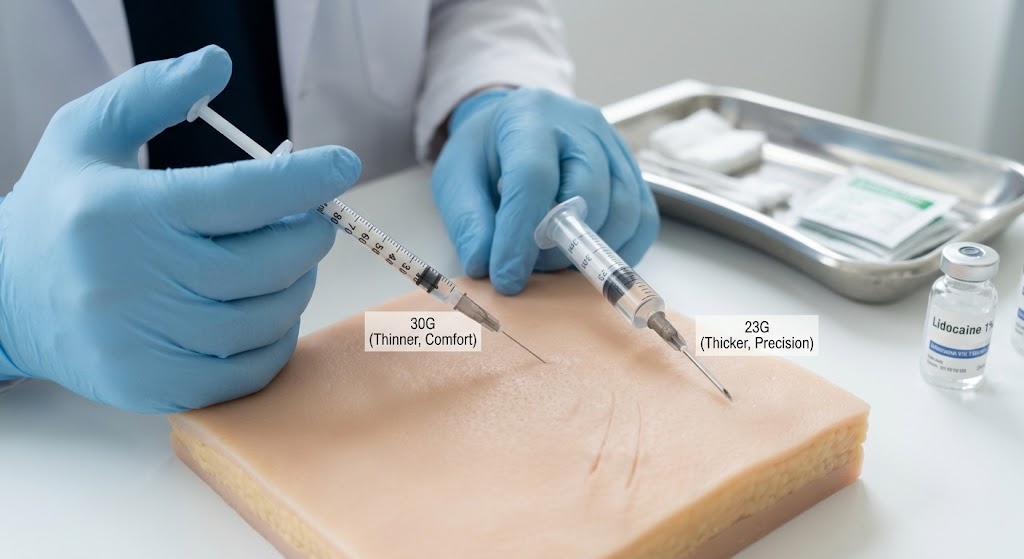
Local anesthesia is a routine yet critical part of many medical and dental procedures. While the anesthetic solution plays an important role, the needle gauge used for the injection can significantly affect both patient comfort and clinical accuracy. Selecting the correct needle gauge helps clinicians deliver anesthesia effectively while minimizing patient anxiety and tissue trauma.
In this article, we explore how needle gauge impacts injection performance, patient experience, and procedural precision.
Understanding Needle Gauge
The gauge of a needle refers to its diameter. In medical terminology:
- Higher gauge number = thinner needle
- Lower gauge number = thicker needle
For example:
- 25-gauge needle – thicker diameter
- 27-gauge needle – medium diameter
- 30-gauge needle – very thin diameter
Clinicians often assume that thinner needles always produce less pain, but research shows that needle gauge alone does not determine patient discomfort.
Common Needle Gauges Used for Local Anesthesia
Different procedures require different needle sizes to ensure accuracy and safe delivery of anesthetic solutions.
1. 25-Gauge Needles
Often used for nerve block injections where deeper penetration and aspiration reliability are required.
Advantages:
- Better aspiration reliability
- Greater structural strength
- Lower risk of needle deflection
Common Uses:
- Inferior alveolar nerve block
- Posterior superior alveolar block
- Other deep tissue injections
2. 27-Gauge Needles
A commonly used gauge that provides a balance between strength and patient comfort.
Advantages:
- Good tactile control
- Reliable aspiration
- Suitable for multiple injection techniques
Common Uses:
- Buccal infiltration
- Palatal injections
- General dental anesthesia procedures
3. 30-Gauge Needles
These thinner needles are often chosen when patient perception of comfort is a priority.
Advantages:
- Smaller puncture site
- Often perceived as less intimidating by patients
Limitations:
- Increased needle deflection
- Less reliable aspiration
- Slightly higher risk of breakage if excessive pressure is applied
Common Uses:
- Infiltration anesthesia
- Pediatric dentistry
- Superficial injections
Factors Influencing Needle Gauge Selection
Selecting the correct needle gauge requires balancing multiple clinical considerations.
1. Injection Accuracy
Thicker needles such as 25-gauge provide better control and less deflection, which is important for deep nerve blocks.
2. Aspiration Reliability
Aspiration helps confirm that the needle tip is not inside a blood vessel.
Studies indicate that larger gauge needles allow more reliable aspiration compared to very thin needles.
3. Tissue Resistance
Dense tissues require a stronger needle to maintain stability during insertion.
4. Patient Comfort
While thinner needles appear less intimidating, pain perception is more influenced by injection speed, solution temperature, and operator technique than by gauge alone.
5. Procedure Type
The depth of penetration and anatomical location determine which gauge will perform best.
Techniques to Improve Patient Comfort During Local Anesthesia
Even with the correct needle gauge, proper technique remains the most important factor in reducing discomfort.
Best practices include:
- Inject anesthetic slowly and steadily
- Apply topical anesthetic before injection
- Use sharp, high-quality sterile needles
- Maintain steady hand positioning
- Warm anesthetic solution to body temperature when possible
These practices often have a greater impact on patient comfort than the needle diameter itself.
Safety Considerations in Needle Selection
Proper needle handling and selection help prevent complications during anesthesia administration.
Key safety recommendations:
- Never insert a needle to the hub
- Avoid bending needles before injection
- Replace needles after multiple penetrations
- Use medical-grade stainless steel needles for strength and durability
Following these precautions ensures both patient safety and procedural reliability.
Conclusion
Choosing the correct needle gauge for local anesthesia requires balancing patient comfort with clinical precision. While thinner needles may appear less painful, larger gauges often provide better control, stability, and aspiration reliability, especially for deep nerve blocks.
For most procedures:
- 25-gauge needles are ideal for nerve blocks
- 27-gauge needles offer versatile performance
- 30-gauge needles work best for superficial infiltration
By combining the appropriate needle gauge with proper injection technique, clinicians can achieve effective anesthesia, improved patient comfort, and safer clinical outcomes.