
Precision in orthodontics and dental lab work often comes down to the smallest details—especially when forming loops in wires. Whether you’re adjusting appliances, crafting retainers, or fabricating custom components, the type of pliers you use directly affects the accuracy, consistency, and strength of your loops (Bird Beak vs Three-Prong pliers).
Among the most commonly used tools are Bird Beak pliers and Three-Prong pliers. While both are designed for wire bending, their structural differences make them suitable for distinct loop formations and clinical applications.
Understanding Wire Bending in Dentistry and Orthodontics
Wire bending is a fundamental skill used in:
- Orthodontic appliance adjustments
- Removable and fixed retainer fabrication
- Lab-based prosthetic components
The goal is to create loops that are:
- Symmetrical
- Stress-free
- Functionally precise
Choosing the right plier design ensures control over wire shape without compromising its integrity.
Bird Beak Pliers: Versatility and Precision
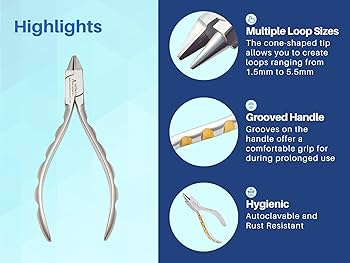
Bird Beak pliers are one of the most widely used tools in orthodontics due to their simple yet highly effective design.
Design Features
- One conical (round) beak
- One flat or pyramidal beak
- Tapered tip for fine control
This combination allows clinicians to form loops of varying diameters with smooth curvature.
Best Uses for Bird Beak Pliers
1. Circular and Helical Loops
The round beak acts as a guide for creating consistent circular loops, making it ideal for:
- Helical springs
- Adjustment loops
2. Light Wire Adjustments
Perfect for bending softer wires without creating sharp angles or stress points.
3. Gradual Curves
The tapered design allows progressive bending, which helps maintain wire strength.
Clinical Advantage: High precision and flexibility for a wide range of loop sizes.
Three-Prong Pliers: Control and Stability
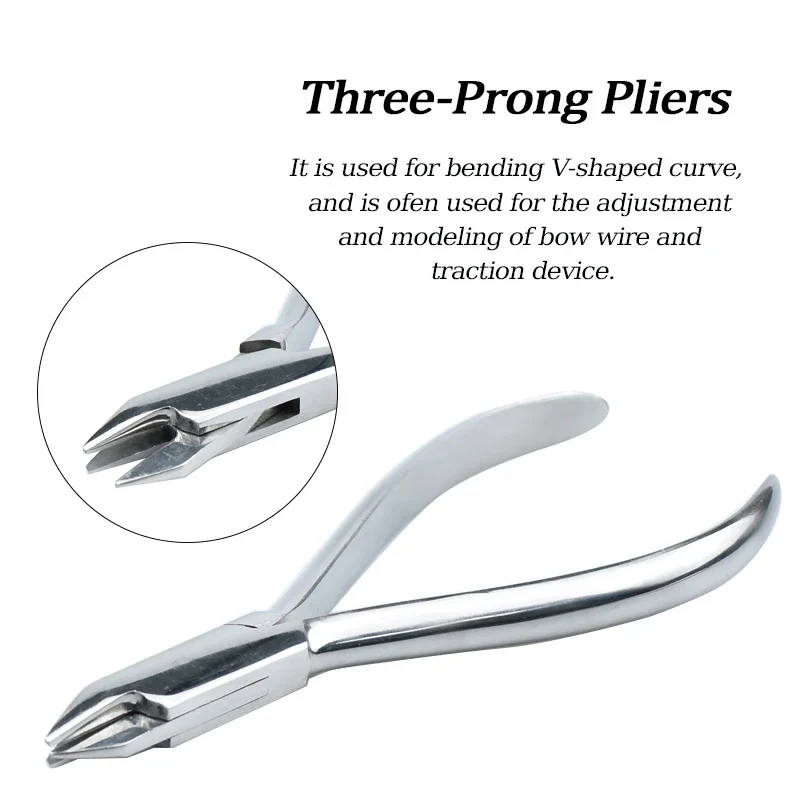
Three-Prong pliers feature a unique design that provides enhanced grip and control during bending.
Design Features
- Two prongs on one side
- One opposing prong on the other
- Even pressure distribution across three نقاط of contact
This structure stabilizes the wire during manipulation.
Best Uses for Three-Prong Pliers
1. Angular and Complex Bends
Ideal for creating:
- Sharp bends
- Step bends
- Rectangular or box loops
2. Heavy Wire Manipulation
Provides better control when working with thicker or stiffer wires.
3. Loop Positioning and Adjustment
Helps refine and adjust loop placement without distorting the overall shape.
Clinical Advantage: Superior grip and control for precise, forceful bends.
Key Differences Between Bird Beak and Three-Prong Pliers
| Feature | Bird Beak Pliers | Three-Prong Pliers |
|---|---|---|
| Beak Design | Round + flat | Three نقاط contact |
| Loop Type | Circular, helical | Angular, box-shaped |
| Wire Compatibility | Light to medium | Medium to heavy |
| Precision | High for curves | High for angles |
| Control | Flexible shaping | Strong grip & stability |
Choosing the Right Tool for the Job
Selecting between Bird Beak and Three-Prong pliers depends on the clinical requirement:
- Use Bird Beak pliers when:
- Forming smooth, rounded loops
- Working with lighter wires
- Precision shaping is needed
- Use Three-Prong pliers when:
- Creating sharp or complex bends
- Handling thicker wires
- Stability and grip are critical
In many cases, clinicians use both tools in combination to achieve optimal results.
Common Mistakes to Avoid
- Using Bird Beak pliers for sharp bends (can weaken wire)
- Applying excessive force with Three-Prong pliers (may cause deformation)
- Not matching plier type with wire thickness
- Ignoring loop symmetry during formation
Clinical Impact of Proper Tool Selection
The right plier choice leads to:
- Stronger, stress-free loops
- Improved appliance function
- Reduced risk of wire fracture
- Greater efficiency in adjustments and fabrication
Conclusion
Both Bird Beak and Three-Prong pliers are essential tools in wire bending, but they serve different purposes. Bird Beak pliers excel in creating smooth, rounded loops with precision, while Three-Prong pliers provide the control needed for sharp, complex bends.
Understanding their design differences and applications allows dental professionals to work more efficiently and produce high-quality, reliable results in both clinical and laboratory settings.