
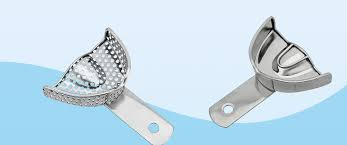
In dental impression procedures, one size never fits all. The anatomical differences between edentulous (toothless) and dentate (teeth-present) patients require specifically designed impression trays to ensure accuracy, comfort, and functional outcomes. Selecting the correct tray type is essential for capturing precise anatomical details and achieving well-fitting prosthetics or restorations.
This article explores the key differences between edentulous and dentate trays, focusing on how anatomical design features influence clinical performance.
Understanding the Two Patient Types
Before comparing tray designs, it’s important to understand the anatomical needs of each group:
- Dentate patients have natural teeth and require impressions that capture tooth morphology, occlusion, and interproximal spaces.
- Edentulous patients lack teeth and require impressions that accurately record soft tissue anatomy, ridge contours, and functional vestibular areas.
Because of these differences, impression trays are engineered with distinct shapes, depths, and extensions.
Dentate Impression Trays: Designed for Precision and Detail
Dentate trays are used when natural teeth are present, and their design focuses on capturing fine anatomical detail without distortion.
Key Design Features
1. Standard Arch Form
Dentate trays follow a natural arch shape to accommodate teeth alignment and ensure uniform material distribution.
2. Reduced Depth
These trays are typically shallower to match the reduced vertical space in a closed-mouth dentition scenario.
3. Controlled Spacing
Uniform spacing between tray walls and teeth ensures:
- Even impression material thickness
- Reduced distortion during removal
4. Perforations or Adhesive Compatibility
Most dentate trays include perforations or are designed for adhesive use to enhance retention of elastomeric materials.
5. Rigid Construction
Stiff materials prevent deformation, which is critical for capturing precise tooth anatomy and occlusal relationships.
Clinical Focus: Accuracy of marginal detail, interproximal contacts, and occlusion.
Edentulous Impression Trays: Built for Soft Tissue Accuracy
Edentulous trays are designed for patients without teeth, where soft tissue and ridge anatomy become the primary focus.
Key Design Features
1. Extended Flanges
Deep borders extend into the vestibular areas to capture:
- Functional sulcus depth
- Muscle attachments
- Peripheral seal zones
2. Increased Tray Depth
More vertical space accommodates impression materials that record soft tissue movement and ridge form.
3. Uniform Pressure Distribution
These trays help evenly distribute impression material over compressible tissues, preventing localized distortion.
4. Smooth Inner Surfaces
Smooth interiors allow controlled material flow, essential for capturing delicate mucosal anatomy.
5. Custom or Stock Options
- Stock trays: Used for preliminary impressions
- Custom trays: Often fabricated for final impressions to ensure maximum accuracy
- Clinical Focus: Stability, border extension, and functional anatomy recording.
Key Differences at a Glance
| Feature | Dentate Trays | Edentulous Trays |
|---|---|---|
| Primary Purpose | Tooth detail capture | Soft tissue & ridge recording |
| Depth | Shallow | Deep |
| Flange Extension | Minimal | Extensive |
| Anatomical Focus | Teeth & occlusion | Ridge & vestibular anatomy |
| Material Control | Thin, uniform layers | Functional bulk distribution |
Why Tray Selection Matters Clinically
Using the wrong tray type can lead to significant clinical issues:
- For dentate patients: Overextended trays may distort occlusion or damage soft tissue detail.
- For edentulous patients: Shallow trays may fail to capture vestibular depth, leading to poor denture retention.
Proper tray selection ensures:
- Improved prosthetic fit
- Reduced chairside adjustments
- Better long-term patient comfort
- More predictable treatment outcomes
Material Compatibility and Tray Design
Tray design also influences how impression materials behave:
- Elastomeric materials require consistent spacing in dentate trays for accurate detail reproduction.
- In edentulous cases, materials must remain stable over larger surface areas without tearing or displacement.
Selecting the correct tray ensures the material performs as intended under clinical conditions.
Conclusion
Dentate and edentulous impression trays are not interchangeable—they are carefully engineered tools designed for fundamentally different anatomical conditions. Dentate trays prioritize precision and detail, while edentulous trays focus on functional anatomy and tissue adaptation.
Understanding these differences allows clinicians to make better decisions, leading to more accurate impressions, improved prosthetic outcomes, and greater patient satisfaction.