
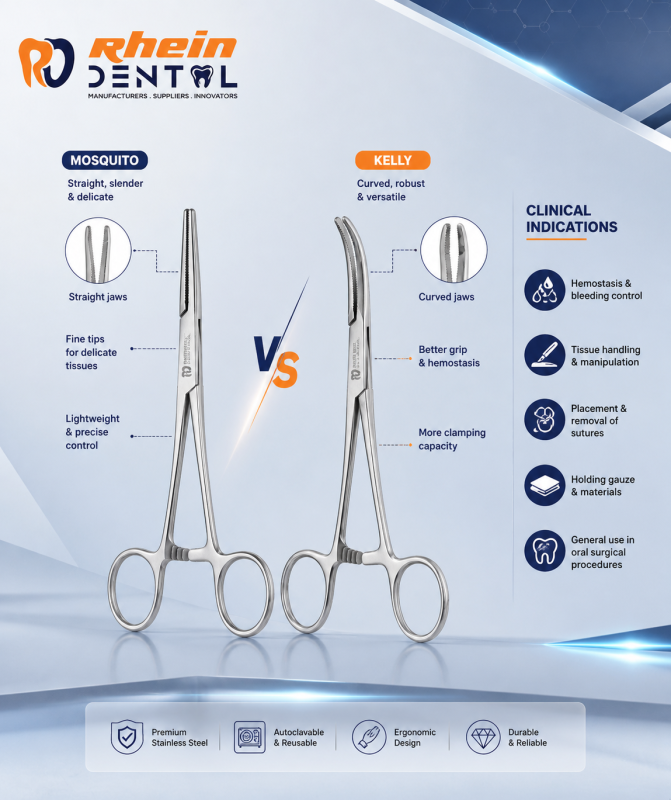
Mosquito forceps and Kelly forceps are both ratcheted hemostatic instruments used to clamp vessels, control bleeding, and handle tissue during surgical procedures. The main differences are size, jaw profile, serration pattern, and the type of vessel or tissue they are designed to control. Mosquito forceps are finer and more delicate, while Kelly forceps provide broader, stronger clamping.
Mosquito vs Kelly Forceps
If you need a fine hemostatic instrument for small vessels and delicate surgical work, a Mosquito forceps is generally the better choice. If you need a larger, broader-jawed clamp for routine hemostasis and medium-sized vessels, a Kelly forceps is usually more appropriate.
The two instruments look similar because both feature ring handles, a ratchet locking mechanism, and serrated jaws. However, their differences become important when selecting instruments for a surgical or dental procedure.
In simple terms:
- Mosquito forceps = smaller, finer, more delicate
- Kelly forceps = larger, broader, more substantial
- Mosquito = commonly used for small vessels and delicate fields
- Kelly = commonly used for general hemostasis and larger structures
- Both are available in straight and curved patterns, depending on the manufacturer and application.
The Egyptian Health Council’s surgical instrument manual similarly identifies Mosquito hemostats as thinner than Kelly forceps and associates them with smaller blood vessels, while Kelly forceps are intended for medium-to-large vessels.
What Is a Mosquito Forceps?
A Mosquito forceps, also called a Mosquito hemostats or Halsted Mosquito forceps, is a small, fine-tipped locking hemostatic instrument designed for precise clamping and control of small blood vessels.
Its compact profile makes it particularly useful when working in areas where a larger hemostat would be unnecessarily bulky.
Key characteristics of Mosquito forceps
- Fine, narrow jaws
- Compact overall profile
- Ratcheted locking mechanism
- Serrated gripping surfaces
- Commonly available in straight and curved patterns
- Designed for delicate hemostatic applications
- Useful where precision and visibility are important
The Mosquito pattern is commonly regarded as the finer member of the hemostat family. It is particularly useful when the surgeon needs controlled clamping without bringing a relatively large instrument into a small operative field.
What are Mosquito forceps used for?
Common applications include:
- Clamping small blood vessels
- Controlling localized bleeding
- Delicate soft-tissue procedures
- Minor surgical procedures
- Dental and oral surgical applications
- Holding small structures temporarily
- Working in confined operative fields
However, the exact application should always depend on the procedure, tissue, vessel size, clinician preference, and the instrument’s manufacturer specifications.
What Are Kelly Forceps?
Kelly forceps are locking hemostatic forceps designed for general vessel clamping and tissue handling. Compared with Mosquito forceps, Kelly forceps typically have a larger and more substantial jaw profile.
They are often selected when a clinician needs more jaw surface and clamping capacity than a fine Mosquito pattern provides.
Key characteristics of Kelly forceps
- Larger profile than Mosquito forceps
- Broader jaws
- Ratcheted locking mechanism
- Commonly available in straight and curved configurations
- Serrated jaws for secure gripping
- Suitable for general-purpose hemostasis
Kelly forceps may be used for clamping blood vessels, grasping or holding tissue, and other applications where a stronger, broader hemostatic instrument is appropriate.
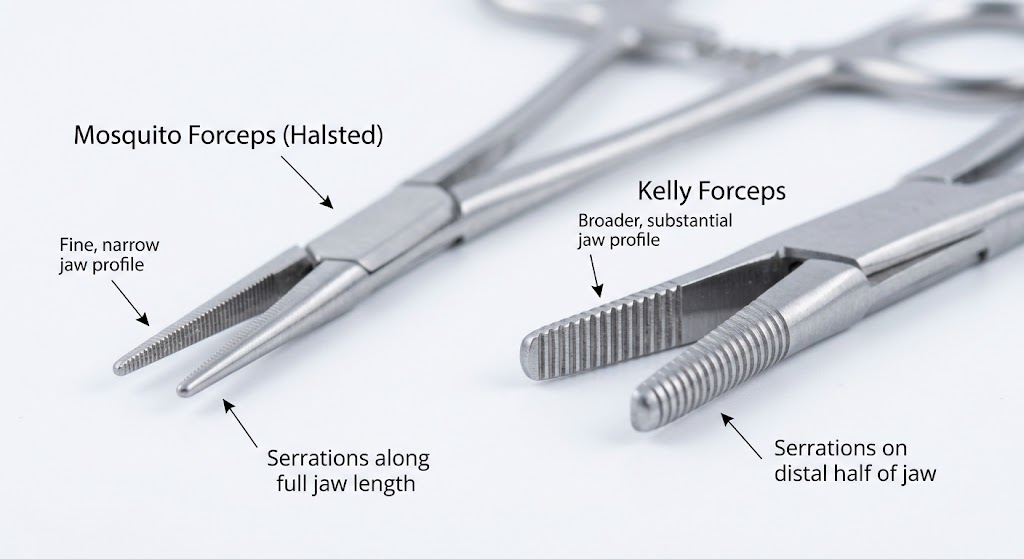
The distinction is not simply about overall length. Jaw geometry and serration pattern also matter. In the commonly encountered Kelly pattern, serrations extend over the distal portion of the jaws rather than the entire jaw length, although exact designs can vary between manufacturers and instrument variants.
Mosquito vs Kelly Forceps: Key Differences
The easiest way to understand the difference is to compare the instruments across their physical design and intended use.
| Feature | Mosquito Forceps | Kelly Forceps |
|---|---|---|
| Common alternative name | Halsted Mosquito | Kelly hemostat |
| Overall profile | Smaller and finer | Larger and broader |
| Jaw size | Fine, narrow jaws | Broader jaws |
| Typical application | Small vessels and delicate work | General hemostasis and larger structures |
| Serration pattern | Commonly serrated along most/all of the working jaw | Commonly serrated over the distal portion |
| Handling | More delicate and precise | More substantial grip |
| Surgical field | Particularly useful in confined fields | Useful where greater jaw capacity is needed |
| Configurations | Straight and curved | Straight and curved |
| Primary role | Fine hemostasis | General hemostasis |
| Best selection principle | Choose for delicate structures | Choose when a broader clamp is appropriate |
Important: Dimensions and jaw configurations are not universal. Manufacturers may produce different lengths, tip designs, finishes, and patterns. Always check the manufacturer’s product specification before purchasing or using a particular instrument.
Mosquito vs Kelly Forceps: The 5 Differences That Matter Most
1. Size and overall profile
The most obvious difference is size.
A Mosquito forceps generally has a smaller, finer profile. This allows it to enter tighter spaces and provides greater visual and mechanical precision during delicate work.
Kelly forceps generally have a larger profile and broader jaws. They therefore provide a more substantial grasp when a fine Mosquito hemostat is not sufficient.
Practical rule: If the working area is small and delicate, start by considering a Mosquito pattern. If the structure requires a broader clamp, consider Kelly.
2. Jaw design
The jaws are one of the most important differences between the two.
Mosquito forceps typically have narrow, fine jaws. Kelly forceps generally have broader jaws with greater overall working surface.
This difference affects how the instrument interacts with tissue and vessels.
A fine jaw can provide better access to small structures, while a broader jaw can offer a more substantial grip.
3. Serration pattern
Serration is another important identification feature.
A typical Mosquito hemostat has fine serrations extending along essentially the full working length of the jaw.
A typical Kelly hemostat has transverse serrations concentrated on the distal portion of the jaw, with the proximal portion closer to the box lock remaining comparatively smooth.
This distinction is useful when identifying instruments on a surgical tray.
However, clinicians and procurement teams should not rely on serration alone. Manufacturers may produce variations, and instruments such as Crile forceps can look similar while having different jaw patterns.
4. Vessel and tissue application
The instruments differ primarily in the scale of the structures they are intended to control.
Mosquito forceps are generally selected for smaller vessels and delicate structures, while Kelly forceps are more commonly selected for medium-sized vessels and broader general-purpose hemostasis.
That does not mean that a forceps should be selected solely according to a fixed vessel diameter. Clinical technique, anatomy, procedure type, instrument design, and surgeon preference all influence selection.
5. Precision versus broader clamping capacity
The choice can often be summarized as:
Mosquito → precision
Kelly → broader clamping capability
This is why a well-equipped surgical or dental instrument set may contain both patterns rather than treating them as interchangeable.
Mosquito vs Kelly Forceps: Which One Should You Choose?
Choosing between Mosquito and Kelly forceps should start with the procedure rather than the instrument name.
Ask these questions:
- What structure am I trying to control?
- How delicate is the tissue or vessel?
- How much jaw capacity is required?
- Is the operative field confined?
- Would a larger instrument obstruct visibility or access?
- Does the procedure protocol specify a particular hemostat?
- Does the instrument’s size and jaw configuration match the intended application?
Choose Mosquito forceps when:
- You need a fine hemostatic instrument.
- The operative field is relatively small.
- The structures being controlled are delicate.
- A narrow jaw provides better access.
- Precise handling is more important than broad clamping capacity.
Choose Kelly forceps when:
- You need a broader hemostatic clamp.
- General-purpose vessel clamping is required.
- A larger jaw profile is appropriate.
- The structure being controlled does not require a fine Mosquito pattern.
- Your surgical technique or procedure specifically calls for Kelly forceps.
Straight vs Curved Mosquito and Kelly Forceps
Both Mosquito and Kelly patterns can be found in straight and curved configurations.
The choice is not necessarily about one being “better.” Instead, the geometry should match the surgical field.
Straight forceps
Straight hemostatic forceps can be useful when:
- Direct access is available.
- The target structure is close to the instrument’s axis.
- Straight-line clamping is preferred.
- The clinician wants direct visualization of the jaws.
Curved forceps
Curved hemostats can be useful when:
- The surgical field is deeper.
- The clinician needs to approach a structure from an angle.
- The curve improves access or visualization.
- Straight jaws would interfere with surrounding structures.
Quick selection tip
Need fine access? → Consider Mosquito.
Need a broader clamp? → Consider Kelly.
Need angled access? → Consider the curved pattern.
Need direct access? → Consider the straight pattern.
Mosquito vs Kelly vs Crile Forceps
One common source of confusion is the difference between Mosquito, Kelly, and Crile forceps.
All three belong to the hemostatic forceps family, but they are not identical.
| Instrument | General profile | Common distinguishing feature | Typical role |
| Mosquito | Small and fine | Fine jaws; commonly full-length serrations | Delicate hemostasis |
| Kelly | Larger and broader | Commonly distal-half serrations | General hemostasis |
| Crile | Intermediate/general-purpose | Commonly full-length serrations | General vessel clamping |
The exact dimensions and jaw patterns vary by manufacturer, so product specifications should take precedence over generic descriptions.
The Egyptian Health Council classifies hemostats according to factors including size, shape, and tip dimensions, and identifies Mosquito and Kelly as distinct hemostatic patterns.
Are Mosquito and Kelly Forceps the Same as Hemostats?
Not exactly.
Hemostat is the broader term for an instrument designed to help control bleeding by clamping vessels or tissue.
Mosquito and Kelly are specific patterns of hemostatic forceps.
Therefore:
Mosquito forceps are hemostats, but not all hemostats are Mosquito forceps.
The hemostat family also includes patterns such as:
- Mosquito/Halsted
- Kelly
- Crile
- Kocher
- Rochester-Pean
- Carmalt
Each pattern has its own geometry and intended applications.
For example, Carmalt forceps have a different longitudinal serration arrangement and are designed for specific clamping applications. The Egyptian Health Council’s instrument manual distinguishes Carmalt from the transverse-serrated Kelly and Mosquito patterns.
How to Identify Mosquito and Kelly Forceps on a Surgical Tray
When several hemostats look similar, use a systematic identification process.
Step 1: Look at overall size
Start by comparing the instruments side by side.
A smaller, finer instrument is more likely to be a Mosquito pattern.
A larger, broader instrument may be Kelly.
Step 2: Examine the jaws
Look at:
- Jaw width
- Jaw length
- Tip shape
- Serration coverage
Step 3: Check the serrations
A typical:
- Mosquito: fine serrations across most or all of the jaw
- Kelly: serrations concentrated toward the distal jaw
Step 4: Check the curvature
Determine whether the forceps are:
- Straight
- Curved
Step 5: Check the product markings
Where available, inspect:
- Manufacturer marking
- Product code
- Size
- Pattern designation
Step 6: Verify the manufacturer’s specification
This is especially important when purchasing instruments because similar-looking patterns can have different dimensions and configurations.
Why Instrument Quality Matters
A hemostatic forceps is more than a piece of stainless steel. Its performance depends on the quality and consistency of its construction.
For reusable surgical instruments, important quality considerations include:
- Appropriate medical-grade material
- Accurate jaw alignment
- Consistent serration geometry
- Smooth box-lock movement
- Reliable ratchet engagement
- Proper jaw closure
- Corrosion resistance
- Surface finish
- Appropriate hardness and resilience
- Compatibility with the manufacturer’s validated reprocessing instructions
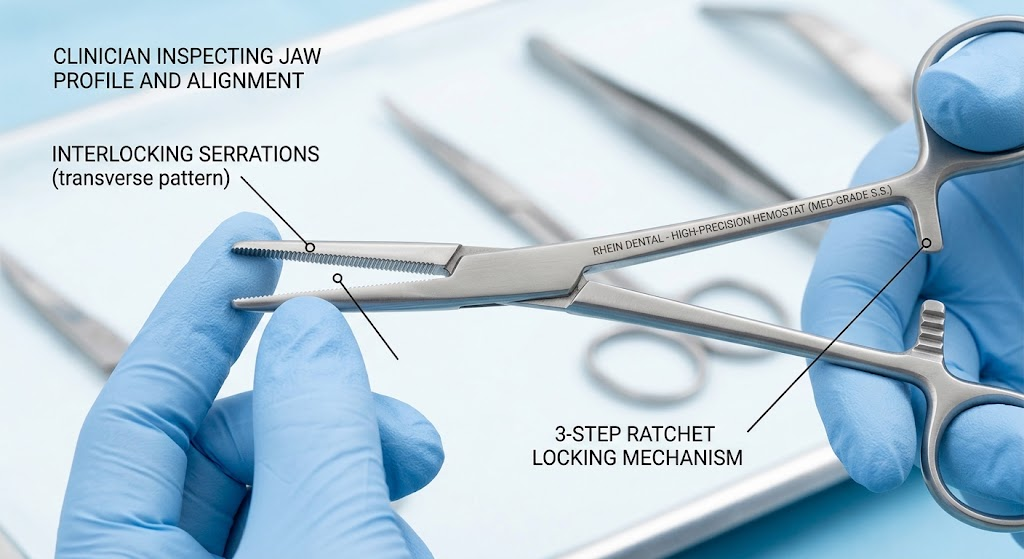
A high-quality ratchet should engage predictably without requiring excessive force. The jaws should meet correctly and should not show obvious misalignment, excessive lateral play, burrs, or damaged serrations.
A practical inspection checklist
Before placing a reusable hemostat into service, inspect:
- Jaw alignment
- Serration condition
- Ratchet engagement
- Box-lock movement
- Handle integrity
- Surface condition
- Signs of corrosion or pitting
- Cracks or deformation
- Correct instrument pattern and size
This type of inspection is particularly important because instrument performance can deteriorate gradually rather than failing dramatically.
Cleaning and Sterilization of Reusable Hemostatic Forceps
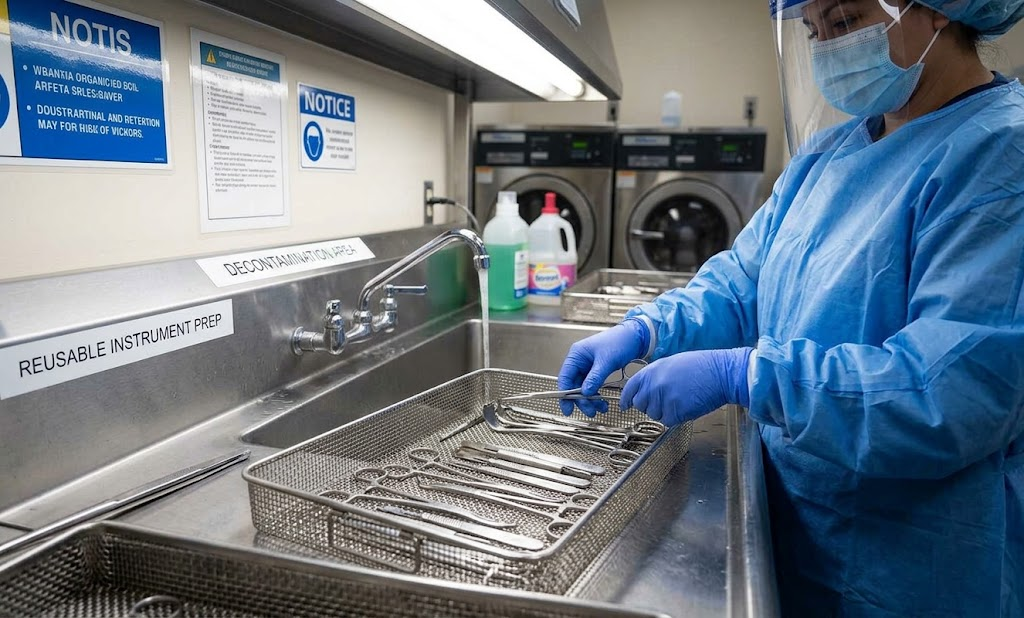
Correct reprocessing is essential for reusable surgical and dental instruments.
The CDC emphasizes that cleaning must occur before disinfection or sterilization because blood, tissue, and other organic material can interfere with the effectiveness of the subsequent process.
AORN’s current perioperative guidance also emphasizes point-of-use treatment, appropriate transport, decontamination, inspection, and cleaning as part of safe instrument processing.
Basic reprocessing workflow
1. Point-of-use treatment
Remove gross contamination as soon as practical after use.
Do not allow blood or tissue to dry onto the instrument.
AORN notes that point-of-use care helps prevent organic material from drying and supports subsequent decontamination.
2. Cleaning
Clean the forceps according to the manufacturer’s instructions.
Depending on the validated process, cleaning may involve:
- Manual cleaning
- Ultrasonic cleaning
- Washer-disinfector processing
- Appropriate detergent or enzymatic cleaner
The CDC recommends meticulous cleaning before sterilization and advises selecting cleaning agents compatible with the instrument materials.
3. Inspect the instrument
After cleaning, inspect:
- Jaws
- Serrations
- Box lock
- Ratchet
- Surface finish
- Alignment
Any instrument that cannot function as intended or cannot be adequately cleaned should be removed from service according to the facility’s instrument-management procedures.
4. Prepare for sterilization
Follow the manufacturer’s instructions for opening hinged instruments, packaging, and sterilization.
For heat-compatible critical surgical instruments, the CDC identifies steam sterilization as the preferred method when the instrument is not damaged by heat, steam, pressure, or moisture.
5. Store correctly
After sterilization, protect instruments and sterile packs from contamination, moisture, and damage.
Always follow your facility’s validated sterilization and storage protocols.
Why Proper Cleaning Extends Instrument Life
Instrument care is not only an infection-control issue. It also affects the long-term value of an instrument set.
Dried blood and tissue can make cleaning more difficult. Corrosion, pitting, damaged serrations, or a poorly maintained box lock can reduce instrument performance and shorten useful service life.
AORN specifically highlights the relationship between point-of-use care, biofilm prevention, instrument condition, and the efficiency of subsequent decontamination.
The CDC likewise recommends cleaning instruments as soon as practical because dried contamination becomes more difficult to remove and can compromise subsequent disinfection or sterilization.
Important care reminder
Do not assume that because a forceps is stainless steel, it is immune to corrosion.
Instrument material, water quality, chemicals, cleaning methods, exposure time, mechanical damage, and sterilization practices can all affect instrument condition.
Common Mistakes When Choosing Mosquito vs Kelly Forceps
Mistake 1: Choosing based only on length
Length matters, but it is not enough.
Jaw width, serration pattern, curvature, and intended application also influence instrument selection.
Mistake 2: Assuming every Kelly looks identical
There can be manufacturer-specific differences in dimensions and configurations.
Always verify the actual product specification.
Mistake 3: Using a larger forceps when a finer one is appropriate
A larger hemostat can be unnecessarily cumbersome in a confined field.
The smallest appropriate instrument is often preferable when precision and access are important.
Mistake 4: Treating all hemostats as interchangeable
Mosquito, Kelly, Crile, Kocher, and Carmalt patterns have different designs.
Instrument selection should reflect the clinical application rather than relying solely on the generic term “hemostat.”
Mistake 5: Neglecting reprocessing instructions
Even a well-manufactured forceps requires appropriate cleaning, inspection, sterilization, and maintenance.
Pros and Cons: Mosquito vs Kelly Forceps
Mosquito Forceps
Pros
- Fine, compact profile
- Excellent for delicate applications
- Useful in confined surgical fields
- Precise handling
- Suitable for small-vessel hemostasis
Cons
- Smaller jaws provide less overall clamping capacity
- May be unsuitable for larger structures
- Fine tips require careful handling to prevent damage or misalignment
Kelly Forceps
Pros
- Broader jaws
- Useful for general hemostasis
- More substantial clamping profile
- Available in straight and curved patterns
- Versatile for a range of surgical applications
Cons
- Less delicate than a Mosquito
- May be unnecessarily large for very fine work
- Requires appropriate selection based on tissue and vessel size
Mosquito vs Kelly Forceps Selection Checklist
Before purchasing or adding either instrument to a dental or surgical set, consider:
- What procedure will the instrument support?
- Is delicate or broader clamping required?
- Is a straight or curved pattern preferable?
- What length is appropriate?
- What jaw width is required?
- What serration pattern is specified?
- Is the instrument intended for repeated reprocessing?
- Are manufacturer reprocessing instructions available?
- Does the instrument have reliable ratchet engagement?
- Are the jaws properly aligned?
- Is the finish smooth and free from visible corrosion or pitting?
- Does the supplier provide consistent specifications?
- Is the instrument appropriate for your facility’s validated sterilization process?
Expert Takeaway: Mosquito or Kelly?
The best way to remember the difference is simple:
Mosquito forceps are the finer choice for delicate hemostatic work, while Kelly forceps provide a broader, more substantial clamping profile for general hemostasis.
However, instrument selection should never be based on appearance alone. The procedure, anatomy, jaw geometry, instrument size, clinician preference, and manufacturer specifications all matter.
For healthcare facilities and dental practices, purchasing consistent, well-finished instruments from a reliable manufacturer or supplier can also simplify tray standardization, instrument identification, maintenance, and replacement planning.
Why Choose Rhein Dental Surgical Instruments?
For dental and surgical professionals, reliable instruments are an important part of an effective clinical workflow.
When evaluating hemostatic forceps, look beyond the product name. Consider the precision of the jaws, consistency of the ratchet, surface finish, construction quality, available configurations, and suitability for your reprocessing workflow.
Rhein Dental provides dental and surgical instrumentation for professional healthcare applications, with a focus on precision manufacturing and dependable instrument performance.
Whether you are looking for Mosquito forceps, Kelly forceps, surgical hemostats, dental surgical instruments, or other reusable instruments, selecting the correct pattern and specification is the first step toward building a practical and reliable instrument set.
Explore Rhein Dental’s surgical instrument range, request a product catalogue, or contact our team to discuss your instrument requirements and sourcing needs.
Frequently Asked Questions
What is the main difference between Mosquito and Kelly forceps?
The main difference is their size, jaw design, serration pattern, and typical application. Mosquito forceps are smaller and finer, making them suitable for delicate hemostasis. Kelly forceps are generally larger and broader and are commonly used for general hemostatic clamping.
Is a Mosquito forceps smaller than a Kelly forceps?
Yes, generally. Mosquito forceps are designed with a smaller, finer profile than Kelly forceps. However, exact dimensions vary among manufacturers and product models.
Are Mosquito forceps and Kelly forceps both hemostats?
Yes. Both are types of hemostatic forceps. “Hemostat” is the broader category, while Mosquito and Kelly describe specific instrument patterns.
What are Mosquito forceps used for?
Mosquito forceps are commonly used for controlling small blood vessels, localized bleeding, and delicate tissue handling where a fine instrument is advantageous.
What are Kelly forceps used for?
Kelly forceps are commonly used for general hemostasis, vessel clamping, and selected tissue-handling applications where a broader jaw profile is appropriate.
Which is better: Mosquito or Kelly forceps?
Neither is universally better. The correct choice depends on the procedure, anatomy, vessel or tissue size, surgical field, instrument geometry, and clinician preference.
Are Kelly forceps straight or curved?
Kelly forceps are commonly manufactured in both straight and curved configurations. The appropriate version depends on access, depth, and the requirements of the procedure.
Are Mosquito forceps straight or curved?
Mosquito forceps are also available in straight and curved patterns. Curved versions can help with angled access, while straight versions provide direct access along the instrument axis.
What is the difference between Kelly and Crile forceps?
A commonly used distinction is the serration pattern. Kelly forceps typically have serrations on the distal portion of the jaws, whereas Crile forceps commonly have transverse serrations extending along the full jaw. Product designs can vary, so manufacturer specifications should be checked.
What is the difference between Mosquito and Crile forceps?
Both are commonly associated with full-length serrated jaws, but Mosquito forceps are generally smaller and finer, while Crile forceps are typically larger and intended for more general-purpose hemostatic use.
Can Mosquito forceps be used in dentistry?
Yes. Depending on the procedure and clinician preference, Mosquito hemostats can be useful in oral and dental surgical procedures requiring fine hemostatic control.
Can Kelly forceps be used in dental surgery?
Yes, when their size and jaw configuration are appropriate for the intended procedure. The choice should be based on the clinical application rather than simply the fact that an instrument is labeled “Kelly.”
How should reusable Mosquito and Kelly forceps be sterilized?
Reusable instruments should be cleaned and reprocessed according to the manufacturer’s validated instructions and the healthcare facility’s infection-control procedures. The CDC recommends cleaning before sterilization and identifies steam as the preferred sterilization method for heat-, moisture-, and pressure-compatible critical instruments.
How do I identify a Mosquito forceps?
Look for its relatively small, fine profile, narrow jaws, ring handles, ratchet lock, and fine serrated working surfaces. Confirm identification using the manufacturer’s markings and specifications where available.
How do I identify a Kelly forceps?
Look for its larger and broader profile, ring handles, ratchet lock, and characteristic serration arrangement. Because several hemostats look similar, confirm the pattern against the manufacturer’s product information.
What should I look for when buying hemostatic forceps?
Consider:
- Material and manufacturing quality
- Jaw alignment
- Serration consistency
- Ratchet performance
- Box-lock construction
- Surface finish
- Available sizes
- Straight or curved configuration
- Reprocessing compatibility
- Manufacturer documentation
- Quality assurance and regulatory compliance appropriate to your market