
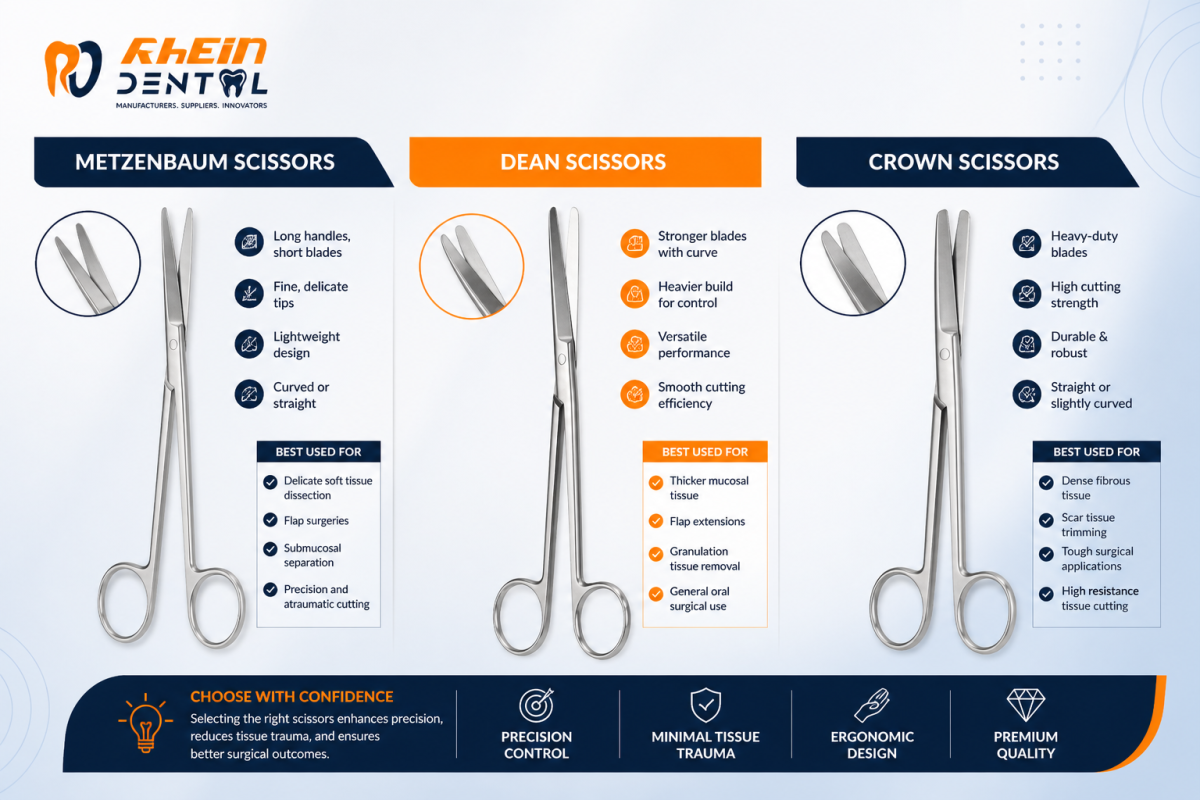
In oral and maxillofacial surgery, tissue handling is a delicate balance between precision, control, and minimal trauma. Among the most frequently used instruments for soft tissue dissection are surgical scissors. While they may appear similar at first glance, Metzenbaum, Dean, and Crown scissors are designed with distinct anatomical features that make each one uniquely suited for specific surgical tasks.
Understanding their differences is essential for selecting the right instrument at the right time—and achieving clean, controlled surgical outcomes.
The Role of Tissue Scissors in Oral Surgery
Tissue scissors are designed to:
- Dissect soft tissue with minimal trauma
- Separate layers of mucosa, fascia, and connective tissue
- Assist in flap elevation and trimming
- Improve surgical precision in confined oral spaces
The key difference between scissor types lies in their blade length, curvature, and cutting efficiency.
Metzenbaum Scissors: Precision for Delicate Dissection
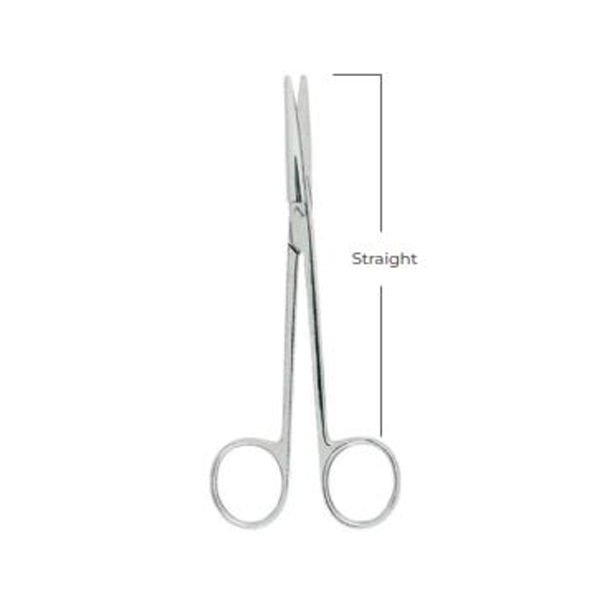
Metzenbaum scissors are the most commonly used fine tissue scissors in oral surgery.
Key Features:
- Long handles with short blades
- Slightly curved or straight design
- Fine, blunt tips to reduce tissue damage
- Lightweight construction for better control

Best Clinical Uses:
- Soft tissue dissection in flap surgeries
- Submucosal and connective tissue separation
- Periodontal and implant surgeries
- Gentle trimming of delicate oral tissues
Why They Excel:
Metzenbaum scissors are designed for precision over power. Their long handles provide leverage, while the short blades allow controlled, fine dissection in sensitive areas.
Dean Scissors: Strength Meets Control
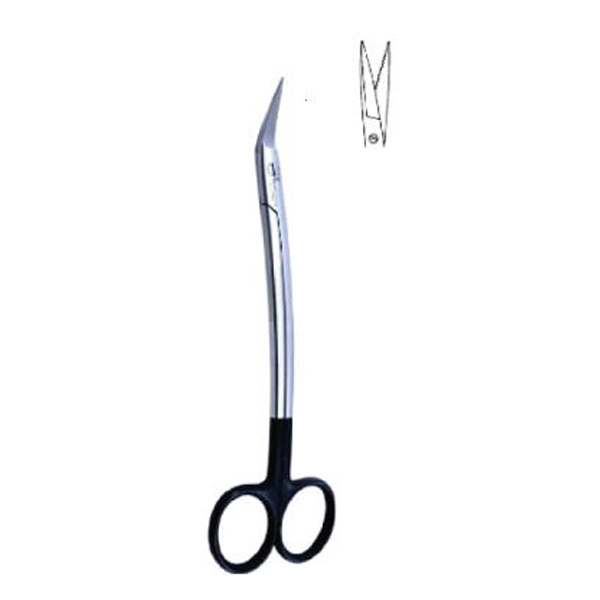
Dean scissors are sturdier than Metzenbaum scissors and are designed for slightly tougher tissue handling.
Key Features:
- Heavier and more robust build
- Longer, stronger blades
- Curved design for deeper access
- Serrated or reinforced cutting edges in some variants

Best Clinical Uses:
- Dissecting thicker mucosal or fibrous tissue
- Oral surgical flap extensions
- Removal of granulation tissue
- Procedures requiring moderate cutting force
Why They Excel:
Dean scissors bridge the gap between delicate and heavy-duty cutting. They provide more cutting strength without sacrificing precision, making them highly versatile in oral surgical procedures.
Crown Scissors: Heavy-Duty Surgical Performance
Crown scissors are the most robust among the three, designed for challenging surgical environments.
Key Features:
- Thick, reinforced blades
- Strong cutting edges for dense tissue
- Excellent durability under pressure
- Typically straight or slightly curved depending on model
Best Clinical Uses:
- Cutting dense fibrous tissue
- Trimming scar tissue or hyperplastic areas
- Surgical procedures involving tough oral structures
- Situations requiring higher cutting force
Why They Excel:
Crown scissors are built for power and endurance. When tissue resistance is high, they outperform lighter scissors by maintaining sharpness and stability under force.
Metzenbaum vs. Dean vs. Crown: Key Differences
| Feature | Metzenbaum Scissors | Dean Scissors | Crown Scissors |
|---|---|---|---|
| Tissue Type | Delicate soft tissue | Moderate fibrous tissue | Dense/strong tissue |
| Blade Strength | Light | Medium | Heavy-duty |
| Precision Level | Very high | High | Moderate |
| Cutting Power | Low | Medium | High |
| Surgical Use | Fine dissection | Versatile use | Tough tissue cutting |
Choosing the Right Scissors in Surgery
Selecting the appropriate scissors depends on tissue resistance and surgical goals:
- For delicate flap work and precision dissection → Metzenbaum
- For general oral surgical tissue handling → Dean
- For dense or resistant tissue → Crown
Experienced surgeons often keep all three on the tray, switching between them as tissue characteristics change during the procedure.
Clinical Insight: Why Anatomy Matters
The design of each scissor is rooted in surgical biomechanics:
- Longer handles increase leverage
- Shorter blades enhance control
- Heavier construction increases cutting force
- Curvature improves visibility in deep oral spaces
This is why even small differences in design can significantly affect surgical efficiency and tissue response.
Conclusion
Metzenbaum, Dean, and Crown scissors each serve a distinct role in oral surgery. While Metzenbaum scissors offer unmatched delicacy, Dean scissors provide balanced versatility, and Crown scissors deliver superior cutting strength.
Mastering their use allows surgeons to adapt to varying tissue conditions with confidence, ensuring smoother procedures and better healing outcomes.
In modern oral surgery, precision doesn’t come from one instrument—it comes from knowing which tool performs best at each stage of tissue handling.