
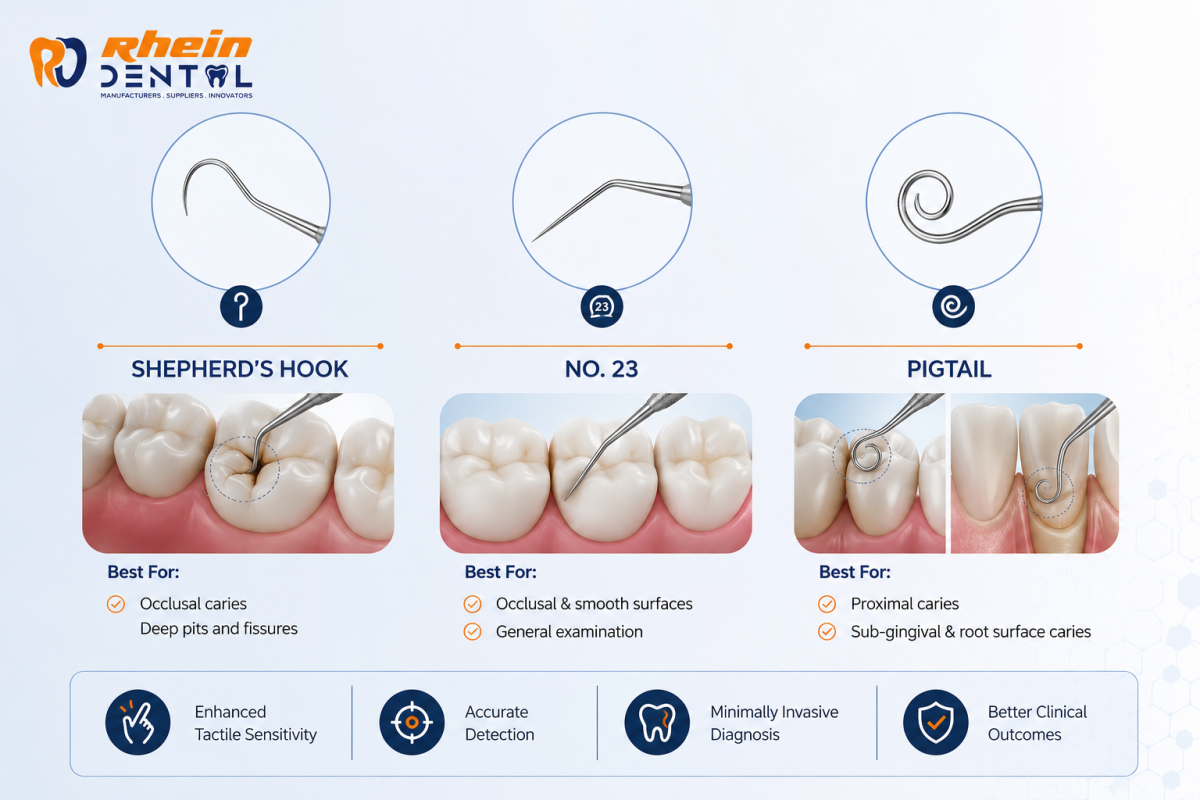
In preventive and diagnostic dentistry, the dental explorer remains one of the most tactile and technique-sensitive instruments. While modern tools like radiographs and intraoral scanners support diagnosis, the explorer provides immediate, chairside feedback that often guides early clinical decisions (Explorer tip geometries for caries detection).
However, not all explorers are created equal. The geometry of the tip—its curvature, length, angulation, and sharpness—directly influences how effectively a clinician can detect caries in different regions of the tooth. Among the most commonly used designs are the Shepherd’s Hook, No. 23, and Pigtail explorers, each engineered for specific diagnostic scenarios.
Understanding their differences allows clinicians to select the right instrument for occlusal, proximal, and sub-gingival caries detection with greater accuracy (Explorer tip geometries for caries detection).
Why Tip Geometry Matters in Caries Detection
Explorer effectiveness depends on two primary factors:
- Tactile sensitivity – the ability to feel surface irregularities
- Access – the ability to reach anatomically complex areas
Even minor differences in tip curvature can determine whether a lesion is detected early or missed entirely. A well-designed explorer tip enhances:
- Surface penetration into pits and fissures
- Adaptation along tooth contours
- Controlled pressure without damaging enamel
Shepherd’s Hook Explorer: Precision for Occlusal Surfaces
The Shepherd’s Hook (commonly referred to as No. 23 in many regions) features a long, thin, sharply curved tip resembling a shepherd’s staff.
Key Characteristics:
- Tight curvature for deep fissure access
- Fine tip for high tactile sensitivity
- Excellent reach into occlusal grooves
Best Used For:
- Detecting occlusal caries
- Exploring pits and fissures
- Identifying early enamel breakdown
Clinical Insight:
The sharp tip can “catch” in demineralized क्षेत्रों, helping clinicians identify sticky fissures—an early sign of caries. However, excessive force should be avoided, as it may damage demineralized enamel or create false positives.
No. 23 Explorer: The Classic Diagnostic Standard
The No. 23 explorer is often confused with the Shepherd’s Hook because in many classifications, they are essentially the same or very similar. However, in practical use, “No. 23” typically refers to a standardized version with consistent angulation and balanced flexibility.
Key Characteristics:
- Balanced curvature for general use
- Strong tactile feedback
- Versatile across multiple surfaces
Best Used For:
- Occlusal and smooth surface caries
- General examination
- Margin evaluation of restorations
Clinical Insight:
The No. 23 is a go-to instrument in routine exams due to its adaptability. It offers a good balance between الوصول and control, making it suitable for both experienced clinicians and students.
Pigtail Explorer: Accessing Proximal and Sub-Gingival Areas
The Pigtail explorer features a more complex, looped or spiral-like curvature, allowing it to adapt to areas that straight or single-curve explorers cannot easily reach.
Key Characteristics:
- Double-curved or spiral tip
- Enhanced adaptation around tooth contours
- Improved الوصول to interproximal spaces
Best Used For:
- Detecting proximal caries
- Exploring sub-gingival क्षेत्रों
- Assessing root surfaces
Clinical Insight:
Its unique geometry allows clinicians to slide the tip gently beneath the contact point and along the gingival margin. This makes it particularly valuable in periodontal and restorative assessments where visibility is limited.
Comparing Explorer Tip Geometries
Here’s how these three explorers differ in practical application:
Note: Values represent relative clinical effectiveness (scale 1–10) based on typical usage patterns.
Choosing the Right Explorer for the Right Task
No single explorer can perform all diagnostic functions perfectly. The key is selecting the appropriate geometry based on the clinical objective:
- Use Shepherd’s Hook for detailed occlusal examination
- Use No. 23 for general-purpose diagnostics
- Use Pigtail for hard-to-reach proximal and sub-gingival क्षेत्रों
Many clinicians prefer to use a combination during a single examination to ensure comprehensive assessment.
Clinical Best Practices
To maximize diagnostic accuracy while minimizing damage:
- Use light exploratory pressure
- Avoid forceful “sticking” techniques
- Combine tactile findings with visual and radiographic evidence
- Replace worn or blunt explorers regularly
Modern dentistry is shifting toward minimally invasive diagnostics, so explorers should be used as detective tools, not excavators.
The Future of Caries Detection
While technologies like laser fluorescence and डिजिटल imaging continue to evolve, the dental explorer remains indispensable. Its simplicity, affordability, and immediate feedback ensure its continued relevance in both general and specialized practice.
Advancements in material science and ergonomic design are also improving explorer performance, making them sharper, more durable, and more comfortable to use.
Conclusion
Explorer tip geometry plays a critical role in detecting caries across different مناطق of the tooth. The Shepherd’s Hook, No. 23, and Pigtail explorers each offer distinct advantages depending on the clinical scenario.
By understanding their design and application, clinicians can significantly improve diagnostic precision, reduce missed lesions, and deliver better patient outcomes.
In the end, it’s not just about having an explorer—it’s about having the right explorer for the right task.