
Tapered vs. Blunt Periosteal Elevator: Soft Tissue Management Guide
Introduction
Choosing the wrong periosteal elevator slows procedures, tears tissue, and compromises the surgical field. The core design decision comes down to two options — a tapered sharp blade or a broad blunt edge. Both reflect the mucoperiosteal flap, but each excels in very different clinical conditions. Understanding their structural differences helps surgeons choose faster, work cleaner, and protect soft tissue more effectively (Periosteal Elevator Blade Design).
Understanding Periosteal Elevators: A Quick Overview
Surgeons use periosteal elevators to lift the mucoperiosteal flap cleanly away from bone. The periosteum attaches firmly to the bone surface, making separation challenging. Consequently, blade geometry directly determines how efficiently and atraumatically a surgeon reflects the flap — which is precisely why this design choice carries real clinical weight.
The Tapered Sharp Blade — Precision for Tight and Complex Anatomy
What Defines a Tapered Sharp Blade?
A tapered sharp blade narrows progressively toward its working tip and carries a sharpened beveled edge. Together, these features allow precise penetration of the tissue-bone interface with minimal resistance and maximum directional control.
Where the Tapered Sharp Blade Excels
The tapered sharp blade performs best in tight anatomical spaces near roots, interdental areas, and implant sites. It handles tough periosteal attachments efficiently and excels at initial flap entry — where the tissue-bone junction resists most. Furthermore, it suits minimally invasive procedures where precise flap margins matter.
Clinical Advantages of the Tapered Sharp Blade
The sharp tapered design reduces entry force, minimizes tissue distortion, and delivers strong tactile feedback. Surgeons feel the blade advancing through tissue layers clearly and adjust pressure in real time. Additionally, the sharp bevel cuts through fibrous scar tissue in re-entry procedures where blunt instruments would struggle.
Limitations of the Tapered Sharp Blade
However, the narrow working surface covers less territory per stroke. Over wide bony surfaces, using a tapered blade alone becomes inefficient and time-consuming. It also demands careful technique — too much lateral pressure risks cutting into the flap rather than separating it cleanly (Periosteal Elevator Blade Design).
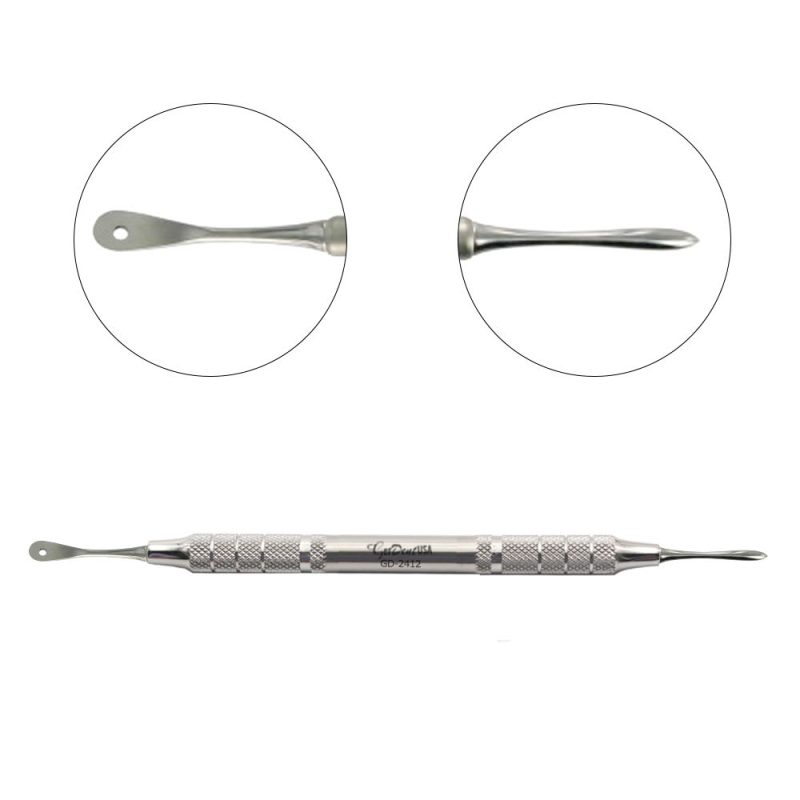
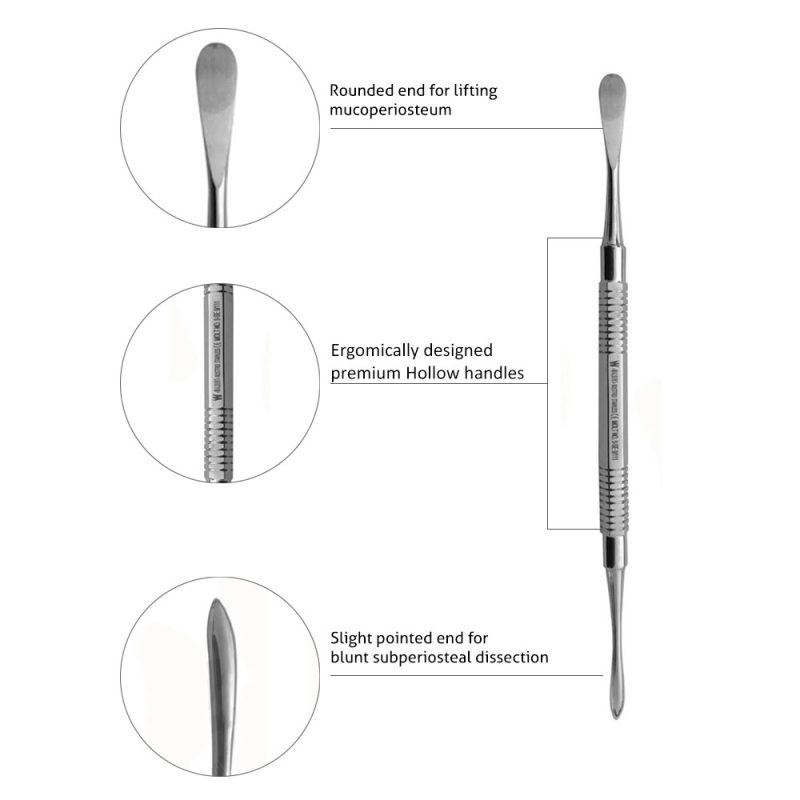
The Broad Blunt Edge — Efficiency Across Wide Tissue Surfaces
What Defines a Broad Blunt Edge?
A broad blunt edge features a wider working surface and a rounded, non-sharpened tip. Rather than cutting, it lifts and pushes the periosteum away from bone through evenly distributed mechanical pressure. The blunt tip eliminates the risk of accidental tissue cutting entirely.
Where the Broad Blunt Edge Excels
The broad blunt edge covers wide bony surfaces efficiently, making it ideal for large flap procedures and orthognathic surgery. It also protects fragile or thin tissue by distributing pressure broadly rather than concentrating it at a single point. Moreover, it maintains the subperiosteal plane reliably once a surgeon establishes it.
Clinical Advantages of the Broad Blunt Edge
The broad blunt edge reduces the total number of instrument strokes needed for large flap reflection. Fewer strokes mean less tissue handling, shorter surgical time, and less cumulative trauma. Its non-cutting design also provides a wider margin of technique error — making it more forgiving for developing surgeons.
Limitations of the Broad Blunt Edge
The broad blunt edge, however, struggles at initial tissue entry. In dense or fibrous periosteum, it requires significantly more force — increasing trauma and tearing risk. Additionally, the wide working surface cannot navigate tight interdental or interradicular spaces accurately.
Head-to-Head Comparison: Tapered Sharp Blade vs. Broad Blunt Edge
| Clinical Factor | Tapered Sharp Blade | Broad Blunt Edge |
|---|---|---|
| Initial tissue entry | Excellent | Moderate |
| Tight anatomical spaces | Excellent | Poor |
| Wide bony surfaces | Moderate | Excellent |
| Fragile or thin tissue | Requires care | Excellent |
| Dense/fibrous periosteum | Excellent | Poor |
| Large flap procedures | Time-consuming | Highly efficient |
| Beginner-friendly | Requires experience | More forgiving |
Choosing the Right Design: A Practical Decision Framework
Choose the tapered sharp blade when the site involves tight spaces, dense periosteum, scar tissue, or a small precise flap. Choose the broad blunt edge when the flap covers a wide surface, tissue is fragile, or speed across broad anatomy is the priority. Many experienced surgeons use both — the tapered blade to initiate entry, then the broad blunt edge to extend the reflection efficiently. This dual approach delivers the best overall soft tissue management.
Impact on Soft Tissue Management and Patient Outcomes
The right blade design reduces tissue trauma, shortens procedure time, and directly supports better post-operative healing. By contrast, the wrong instrument creates preventable problems — tearing with a blunt blade in tough tissue, or excessive strokes with a sharp blade across wide surfaces. Instrument selection is therefore an integral part of surgical planning, not an afterthought.
Who Should Read This Guide?
This comparison benefits oral and maxillofacial surgeons, periodontists, implant surgeons, general dentists expanding into surgery, and dental students building their instrument selection knowledge. Understanding blade design sharpens clinical decision-making at every experience level (Periosteal Elevator Blade Design).
Maintenance and Care for Both Designs
Both designs withstand repeated autoclave sterilization with proper care. For the tapered sharp blade, inspect the beveled tip regularly — a dull edge loses its precision advantage. For the broad blunt edge, check the wide working face for nicks or warping that compromise even pressure distribution. Storing both in protective cassettes extends service life and preserves performance.
Conclusion
The tapered sharp blade delivers precision in tight spaces and through dense tissue. The broad blunt edge delivers efficiency across wide surfaces and in fragile tissue. Neither is universally superior — the right choice depends on anatomy, tissue quality, and procedural scope. Surgeons who understand both designs and deploy each appropriately protect tissue more effectively, work more efficiently, and give patients the best foundation for healing.