
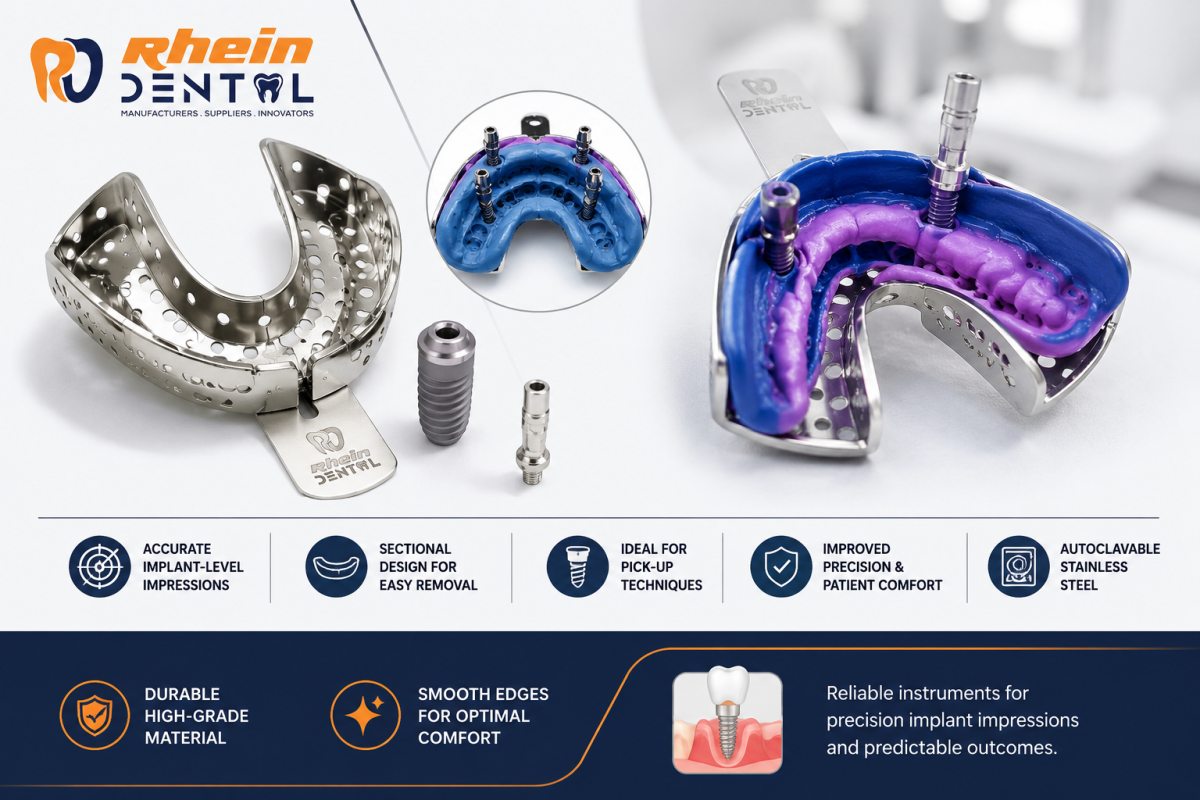
Precision is everything in implant dentistry. When margins are tight and passive fit is critical, even small distortions in an impression can lead to costly remakes or long-term complications. That’s where sectional impression trays come in—a smart, practical solution for improving accuracy, especially in complex implant cases and pick-up techniques (Suctional Impression Trays).
What Are Sectional Impression Trays?
Sectional impression trays are modular trays divided into segments (usually two or more pieces) that can be assembled intraorally or extraorally. Unlike conventional full-arch trays, these are designed to:
- Capture specific areas with high precision
- Allow easier removal in challenging cases
- Reduce distortion during impression taking
They’re particularly useful when dealing with limited mouth opening, multiple implants, or angulated implant positions.
Why They Matter in Implant-Level Impressions
Implant-level impressions demand exact transfer of implant position, depth, and angulation. Sectional trays enhance this in several ways:
1. Improved Accuracy
By focusing on smaller sections, there’s less material bulk, which reduces polymerization shrinkage and distortion. This leads to a more accurate transfer of implant positions.
2. Better Control in Complex Cases
In cases involving:
- Multiple implants
- Divergent implant angulations
- Full-arch restorations
Sectional trays allow clinicians to manage each segment independently, ensuring better seating and stability.
3. Reduced Tray Flex
Large trays can flex during insertion or removal. Sectional trays minimize this risk, preserving the dimensional stability of the impression (Suctional Impression Trays).
Benefits in Pick-Up Impression Techniques
The pick-up (open tray) technique is widely used for implant impressions because it captures the impression copings within the material. Sectional trays significantly enhance this method.
1. Easier Access to Coping Screws
Sectional trays can be designed with precise openings, making it easier to access and unscrew impression copings without disturbing the impression.
2. Simplified Removal
Removing a full-arch open tray can be difficult, especially in patients with limited mouth opening. Sectional trays allow piece-by-piece removal, reducing stress on:
- Impression material
- Copings
- Patient comfort
3. Reduced Risk of Distortion
Because each section is removed individually, there’s less force applied overall—helping maintain accurate coping positions within the impression.
Clinical Situations Where Sectional Trays Excel
Sectional impression trays are especially useful in:
- Full-arch implant restorations
- All-on-4 or All-on-6 cases
- Patients with restricted mouth opening (trismus)
- Posterior implant cases with limited access
- Highly angulated implants
Material Compatibility
Sectional trays work well with common impression materials like:
- Polyvinyl siloxane (PVS)
- Polyether
These materials already offer excellent detail reproduction, and when paired with sectional trays, the overall accuracy improves further.
Workflow Efficiency
While sectional trays may seem more complex initially, they often:
- Reduce chairside time in difficult cases
- Lower the need for remakes
- Improve lab communication with clearer impressions
In the long run, they contribute to a more predictable and efficient workflow.
Limitations to Consider
No tool is perfect. Sectional trays do require:
- Proper planning and assembly
- Familiarity with technique
- Slightly longer setup time
However, these are minor trade-offs compared to the accuracy gains in implant cases.
Final Thoughts
Sectional impression trays are not just an alternative—they’re a precision-driven upgrade for implant dentistry. Whether you’re dealing with multiple implants, challenging angulations, or limited patient access, they provide better control, improved accuracy, and a more predictable outcome.
For clinicians focused on delivering high-quality implant restorations, incorporating sectional trays into your workflow can make a measurable difference—both in results and patient satisfaction.