
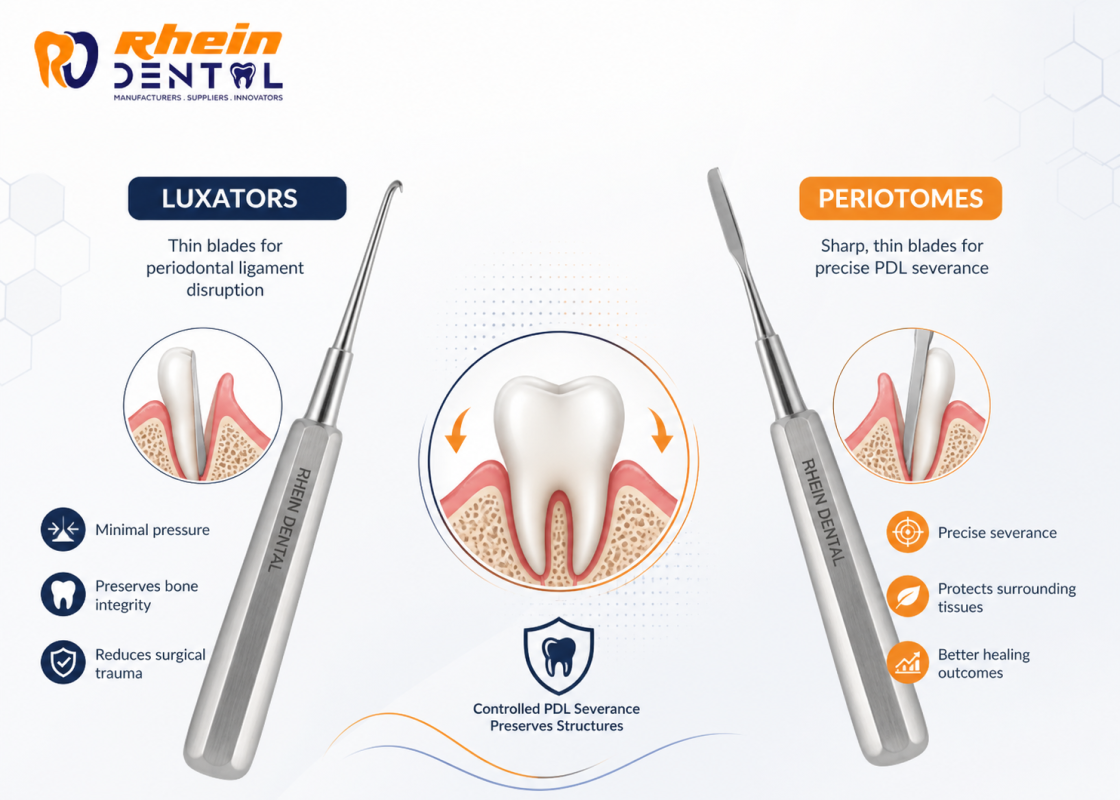
Modern dental extraction is no longer about force—it is about precision, tissue preservation, and biomechanical control. As minimally invasive dentistry continues to evolve, instruments like luxators and periotomes have become essential for reducing surgical trauma during tooth removal (Luxators vs periotomes).
Although both tools are designed to sever the periodontal ligament (PDL), their structure, application, and clinical behavior differ significantly. Understanding these differences helps clinicians choose the right instrument for safer, more predictable extractions.
Understanding the Role of the Periodontal Ligament (PDL)
Before comparing instruments, it is important to understand the target structure.
The periodontal ligament is a fibrous connective tissue that anchors the tooth to the alveolar bone. During extraction, this ligament must be disrupted to allow tooth mobility.
However, traditional force-based extraction often causes:
- Excessive bone compression
- Soft tissue tearing
- Root fractures
- Delayed healing
To minimize these risks, clinicians now rely on atraumatic techniques that focus on controlled PDL severance instead of brute force.
Luxators: Thin Blades for Controlled Expansion
Luxators are precision instruments designed to gently enlarge the socket and sever periodontal fibers.
Key Design Features:
- Ultra-thin, sharp blade for minimal resistance
- Slightly curved working end for anatomical adaptation
- Reinforced handle for controlled pressure application
- Designed for cutting rather than levering
How Luxators Work:
Instead of pulling the tooth, luxators are inserted into the periodontal space and gently advanced. This motion allows the blade to cut PDL fibers while expanding the socket gradually.
As a result, luxators reduce stress on surrounding bone structures and improve initial mobility before extraction forceps are used.
Clinical Advantage:
Luxators are especially useful in:
- Single-rooted teeth
- Periodontally compromised teeth
- Pre-extraction mobilization phases
Periotomes: Precision Instruments for Atraumatic Severance
Periotomes are specifically engineered for deep, controlled penetration into the PDL space with minimal trauma.
Key Design Features:
- Extremely thin, knife-like blades
- Parallel-sided working end for uniform insertion
- Flexible neck to reduce cortical bone damage
- Designed for cutting PDL fibers at root surface level
How Periotomes Work:
Unlike luxators, periotomes are inserted parallel to the root surface and advanced apically. This technique allows for precise severing of periodontal fibers along the root circumference.
Consequently, the tooth becomes more mobile with significantly less force required during extraction.
Clinical Advantage:
Periotomes are highly effective in:
- Aesthetic zone extractions
- Implant site preservation cases
- Fragile bone conditions
- Orthodontic extractions requiring minimal trauma
Luxators vs. Periotomes: Key Differences
Although both instruments aim to reduce trauma, their design philosophy is not identical.
| Feature | Luxators | Periotomes |
|---|---|---|
| Primary function | Socket expansion + PDL cutting | Precise PDL severance |
| Blade thickness | Thin but reinforced | Extremely thin and sharp |
| Motion type | Levering + insertion | Parallel insertion + slicing |
| Bone impact | Mild expansion effect | Minimal bone disturbance |
| Ideal use | Pre-extraction mobilization | Atraumatic root detachment |
How Thin Blades Reduce Surgical Trauma
Thin-bladed instruments play a crucial role in modern extraction techniques. Because they require less force to penetrate the periodontal space, they significantly reduce stress on surrounding structures.
In fact, reduced blade thickness leads to:
- Less alveolar bone compression
- Improved preservation of socket walls
- Lower risk of root fracture
- Faster post-operative healing
Moreover, controlled blade insertion ensures that force is distributed along the periodontal fibers rather than concentrated at a single point.
Why Controlled PDL Severance Matters
Traditional extraction methods often rely on mechanical force to dislodge a tooth. However, this approach can unintentionally damage surrounding tissues.
In contrast, controlled PDL severance:
- Preserves bone integrity
- Maintains socket architecture for implants
- Minimizes patient discomfort
- Reduces inflammation and healing time
Therefore, luxators and periotomes are not just alternative tools—they represent a shift toward biologically respectful extraction techniques.
When to Choose Luxators vs Periotomes
Selection depends on clinical goals and anatomical conditions.
- Choose luxators when gradual socket widening is required or when initial mobility must be created before forceps use.
- Choose periotomes when maximum tissue preservation is needed, especially in aesthetic or implant-driven cases.
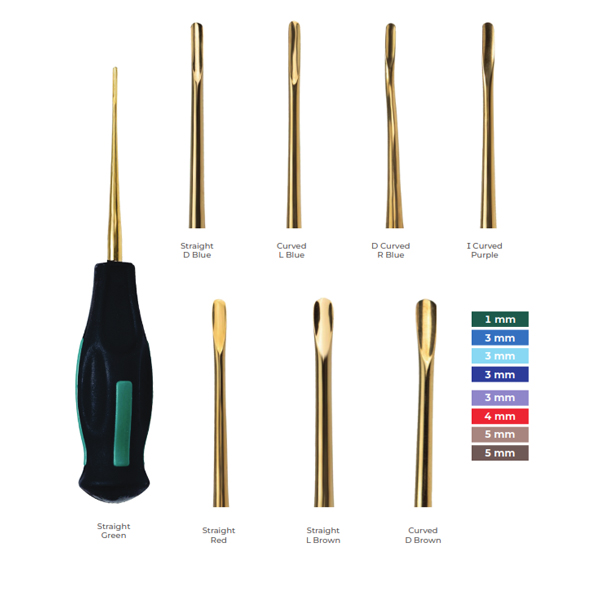
In many clinical scenarios, both instruments are used sequentially for optimal results.
Final Thoughts
Luxators and periotomes have transformed extraction dentistry by shifting the focus from force-based removal to controlled, anatomy-respecting techniques.
While luxators prioritize gentle expansion and initial mobility, periotomes excel in precise periodontal ligament severance. Together, they enable clinicians to perform extractions that are safer, cleaner, and far less traumatic.
Ultimately, the success of atraumatic extraction depends not on strength—but on precision, understanding of anatomy, and the right instrument choice.