
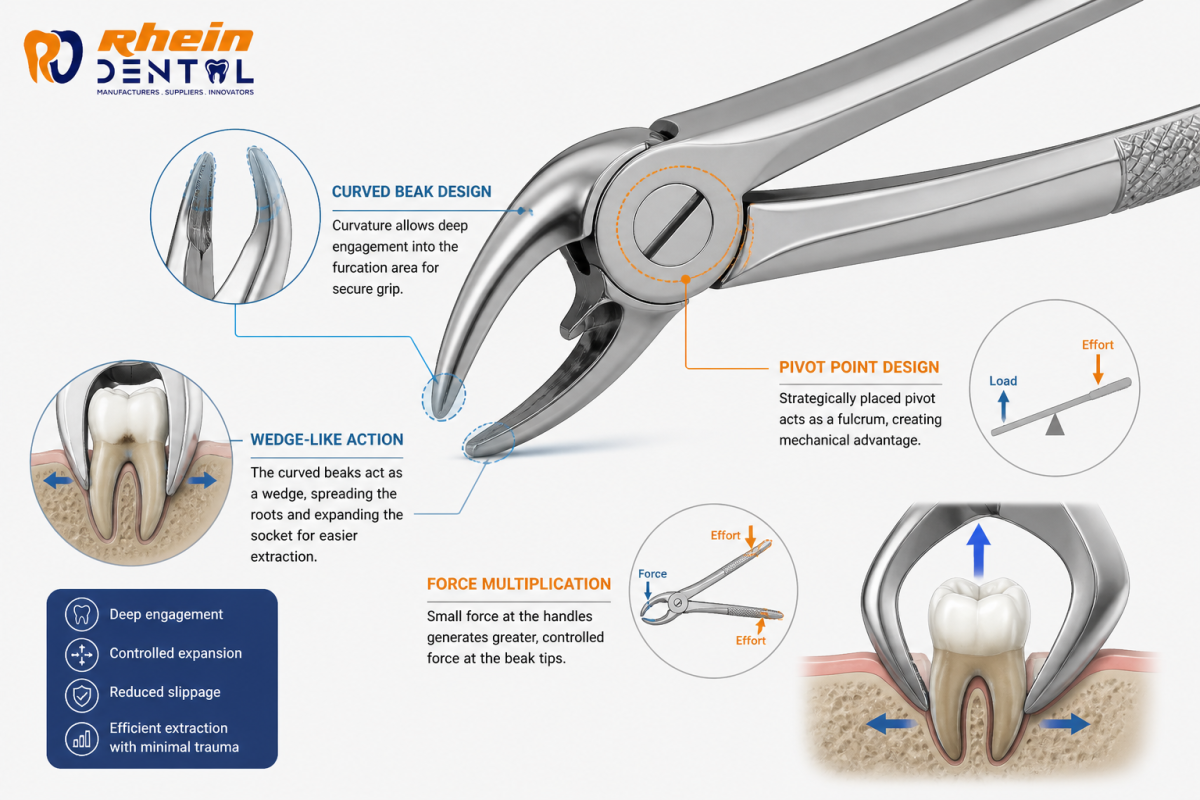
Dental extraction is not just about force. Instead, it depends on controlled biomechanics, precision, and proper instrument design. Among extraction instruments, Cowhorn forceps stand out because they combine mechanical efficiency with anatomical adaptability. Moreover, their design helps clinicians manage difficult molar extractions with greater control and reduced trauma (Cowhorn Forceps Mechanics).
What Are Cowhorn Forceps?
Cowhorn forceps serve as specialized instruments for mandibular molar extraction. Clinicians use them primarily when molars have compromised support or deep-rooted anatomy. In addition, their distinctive horn-shaped beaks allow direct engagement into the furcation area of molars.
Unlike standard forceps, which mainly grip the crown, cowhorn forceps actively engage the root structure. As a result, they provide stronger mechanical leverage and more predictable extraction outcomes.
Beak Curvature and Its Mechanical Role
The curved beak design plays a central role in how these forceps function. First of all, the curvature allows deep access into the furcation between molar roots. Then, once positioned correctly, the beaks anchor firmly into the tooth structure.
1. Deep Furcation Engagement
Because of the sharp curvature, the beaks penetrate directly into the furcation area. Consequently, the instrument locks into place rather than slipping over the crown. This improves stability during force application.
2. Wedge-Like Expansion Effect
Furthermore, when the clinician applies pressure, the curved beaks act as a wedge. They gradually separate the roots and expand the socket. As a result, resistance decreases, and the tooth becomes easier to mobilize.
3. Improved Stability and Reduced Slippage
In addition, the interlocking design significantly reduces slippage. This ensures that force transfers directly to the tooth instead of wasting energy on movement loss. Therefore, the risk of crown fracture decreases.
Overall, the beak curvature transforms applied hand force into controlled lateral expansion.
Pivot Point Design and Force Amplification
While the beak interacts with the tooth, the pivot point controls how force travels through the instrument. Importantly, this hinge mechanism determines efficiency and power delivery.
1. Lever-Based Mechanical Advantage
Cowhorn forceps operate on a lever system. Specifically, the pivot acts as the fulcrum, allowing small hand movements to generate significant force at the beaks. Therefore, clinicians achieve higher output with less effort.
2. Focused Force Transmission
Moreover, the pivot design directs force precisely toward the beak tips. As a result, energy loss remains minimal, and most of the applied force acts directly on the tooth structure.
3. Controlled Motion Path
In addition, the pivot allows a predictable arc of movement. This controlled motion reduces sudden jerks and, therefore, minimizes the risk of alveolar bone damage.
How Beak Curvature and Pivot Design Work Together
When combined, both components create a highly efficient extraction system. First, the beak curvature ensures deep and secure engagement. Then, the pivot amplifies and directs force in a controlled manner.
As a result, the system provides several advantages:
- It converts vertical force into controlled wedging pressure.
- It enhances root separation with minimal resistance.
- It improves operator control during extraction.
- It reduces unnecessary trauma to surrounding bone.
Furthermore, this synergy becomes especially valuable in molars with multiple roots, where stability and precision matter most.
Clinical Advantages of Cowhorn Forceps Mechanics
Because of their biomechanical efficiency, cowhorn forceps offer several clinical benefits. For example:
- They work effectively in heavily decayed molars.
- They perform well in teeth with weak periodontal support.
- They reduce dependence on excessive auxiliary instruments.
- They help lower the risk of crown fracture.
- They improve efficiency during difficult extractions.
However, clinicians must still apply proper angulation and controlled force. Otherwise, excessive pressure may still cause bone stress or unintended fracture.
Key Takeaway
Cowhorn forceps demonstrate how thoughtful engineering improves clinical performance. On one hand, the beak curvature ensures secure engagement and controlled expansion. On the other hand, the pivot point amplifies force and maintains precision.
Together, these features transform simple hand pressure into a highly controlled extraction mechanism. Therefore, when used correctly, cowhorn forceps provide both efficiency and safety in complex molar extractions. they rely on mechanical intelligence—making them a powerful tool when used with proper technique and anatomical understanding.