
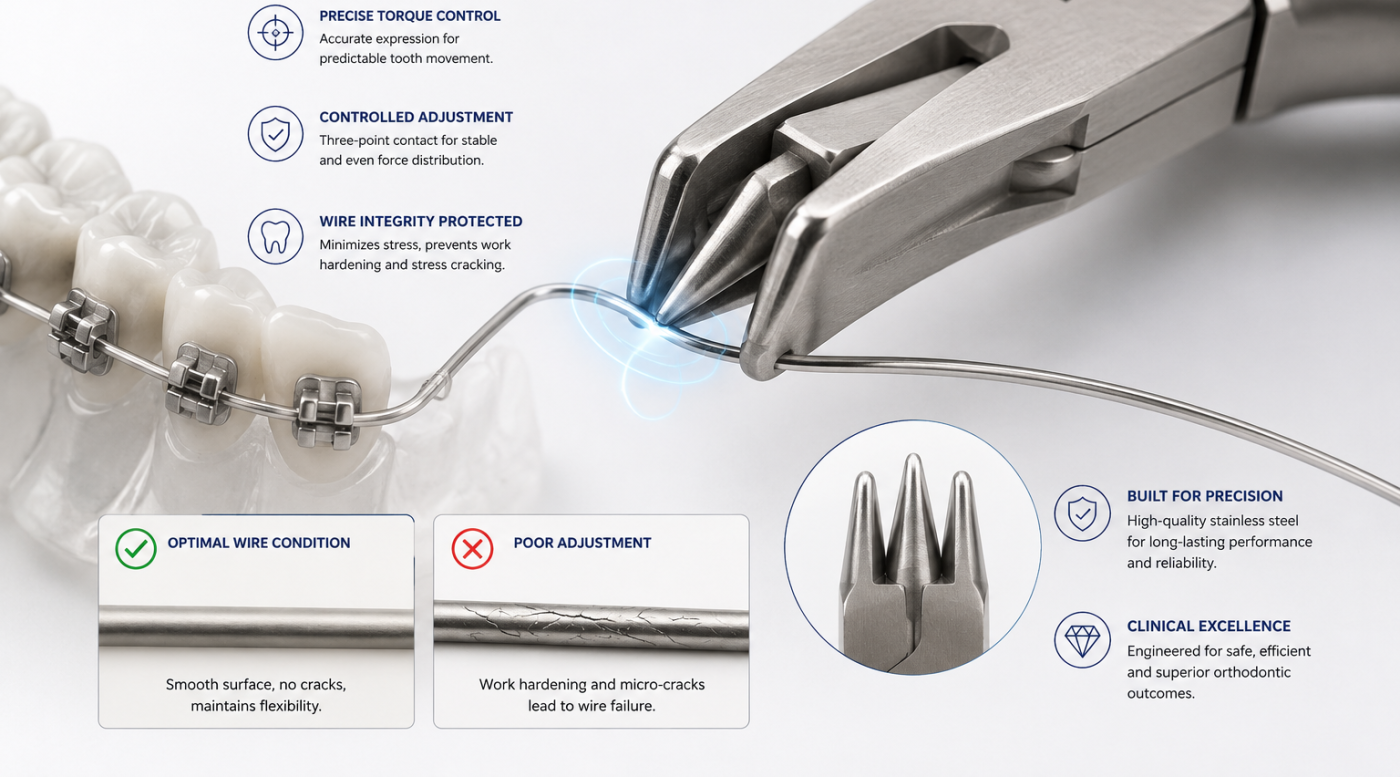
In modern orthodontics, precision is everything. From bracket placement to archwire finishing, even the smallest adjustment can influence treatment efficiency, patient comfort, and final outcomes. Among the essential instruments used during wire detailing and torque control, three-prong pliers remain a trusted tool for orthodontists who require controlled wire manipulation without compromising wire integrity (Three Prong Pliers for Torque Expression).
When used correctly, three-prong pliers allow clinicians to create precise bends and torque adjustments while minimizing the risks of work hardening, wire fatigue, or stress cracking. Understanding how these pliers function — and how material science affects wire behavior during adjustment — is critical for achieving predictable clinical results.
Understanding Torque Expression in Orthodontics
Torque expression refers to the rotational control of a tooth through the interaction between the bracket slot and the archwire. Proper torque control helps guide root positioning, optimize occlusion, and improve aesthetics during treatment.
Orthodontists often need to introduce fine adjustments into archwires to improve:
- Root angulation
- Buccolingual positioning
- Incisor inclination
- Arch coordination
- Finishing and detailing precision
These adjustments require an instrument capable of applying controlled force without damaging the structural properties of the wire. This is where three-prong pliers become highly valuable.
What Are Three-Prong Pliers?
Three-prong pliers are orthodontic instruments designed with two opposing prongs on one jaw and a single central prong on the other. This configuration allows clinicians to grip and bend archwires evenly while maintaining precise control over force distribution.
They are commonly used for:
- Torque adjustments
- Step bends
- Offset bends
- Loop modifications
- Wire contouring
- Finishing bends in stainless steel and beta-titanium wires
The balanced design reduces concentrated stress points, making the instrument especially effective for detailed wire manipulation.
Why Controlled Wire Adjustment Matters
Orthodontic wires are engineered to deliver continuous and biologically appropriate forces. Excessive manipulation or improper bending techniques can alter the metallurgical properties of the wire.
Poorly controlled adjustments may lead to:
- Work hardening
- Microfractures
- Stress cracking
- Reduced elasticity
- Permanent deformation
- Premature wire failure
These issues not only affect treatment performance but may also require unnecessary wire replacement, increasing chair time and material costs.
Preventing Work Hardening During Wire Adjustment
Work hardening occurs when repeated mechanical deformation increases the hardness and brittleness of a metal wire. While some hardening is inevitable during bending, excessive or uncontrolled manipulation significantly raises the risk of fracture.
Three-prong pliers help minimize this problem by distributing pressure more evenly across the wire surface.
Best Practices to Reduce Work Hardening
Use Smooth, Controlled Movements
Abrupt or repeated bending in the same area increases internal stress within the wire. Gentle and deliberate adjustments help preserve the wire’s flexibility.
Avoid Excessive Repositioning
Repeatedly correcting bends weakens the wire structure. Planning the bend carefully before applying force improves precision and reduces material fatigue.
Match the Pliers to the Wire Material
Different wire alloys respond differently to bending forces:
- Stainless steel wires tolerate detailed adjustments well
- Nickel-titanium wires are less suitable for extensive bending
- Beta-titanium wires provide excellent formability with lower fracture risk
Using the appropriate plier design for the wire type improves safety and accuracy.
Inspect the Instrument Tips Regularly
Damaged or misaligned plier tips can create uneven stress concentrations that contribute to cracking or wire damage.
Stress Cracking and Orthodontic Wire Failure
Stress cracking develops when microscopic defects expand under repeated loading or bending forces. These cracks may not be immediately visible but can eventually lead to wire breakage during treatment.
Several factors contribute to stress cracking:
- Sharp bending angles
- Repeated manipulation
- Inferior instrument alignment
- Excessive force application
- Surface damage from worn plier tips
Three-prong pliers help reduce localized pressure by supporting the wire from multiple contact points during adjustment.
Advantages of Three-Prong Pliers in Orthodontics
Enhanced Torque Control
The three-point contact design enables accurate torque expression with minimal distortion of adjacent wire segments.
Reduced Wire Trauma
Balanced force application lowers the risk of surface scoring, flattening, or stress concentration.
Improved Clinical Precision
Orthodontists can create highly detailed bends while maintaining wire integrity and consistency.
Versatility Across Procedures
Three-prong pliers can be used for multiple orthodontic adjustments, reducing the need for frequent instrument changes during procedures.
Better Finishing Outcomes
Fine detailing bends contribute to improved tooth positioning and more predictable finishing results.
Choosing High-Quality Three-Prong Pliers
Instrument quality directly affects performance and durability. Precision-manufactured orthodontic pliers provide smoother handling, better alignment, and reduced risk of wire damage.
When selecting three-prong pliers, clinicians should look for:
- High-grade stainless steel construction
- Precision-aligned beaks
- Corrosion resistance
- Ergonomic grip design
- Smooth tip finishing
- Reliable sterilization compatibility
Premium instruments maintain consistent performance over repeated clinical use and sterilization cycles.
Instrument Care and Maintenance
Proper maintenance preserves both instrument performance and wire safety.
Cleaning Recommendations
- Clean immediately after use
- Remove debris from hinge areas carefully
- Use non-abrasive cleaning solutions
- Dry thoroughly before sterilization
Sterilization Considerations
Repeated autoclaving can gradually affect instrument alignment if the pliers are poorly manufactured. High-quality orthodontic instruments are designed to withstand frequent sterilization without losing precision.
Routine Inspection
Clinicians should regularly inspect:
- Tip alignment
- Surface wear
- Joint stability
- Corrosion signs
- Smooth opening and closing action
Early maintenance prevents performance issues and extends instrument lifespan.
The Role of Precision Instruments in Modern Orthodontics
As orthodontic treatment becomes increasingly focused on efficiency and accuracy, precision hand instruments continue to play a major role in clinical success. Three-prong pliers allow orthodontists to perform detailed wire adjustments safely while protecting the mechanical properties of advanced archwire materials.
By minimizing work hardening and reducing the risk of stress cracking, these instruments support more predictable torque expression, smoother treatment progression, and improved finishing accuracy.
For clinicians who prioritize precision and long-term instrument reliability, investing in high-quality orthodontic pliers is essential for maintaining consistent treatment standards.