
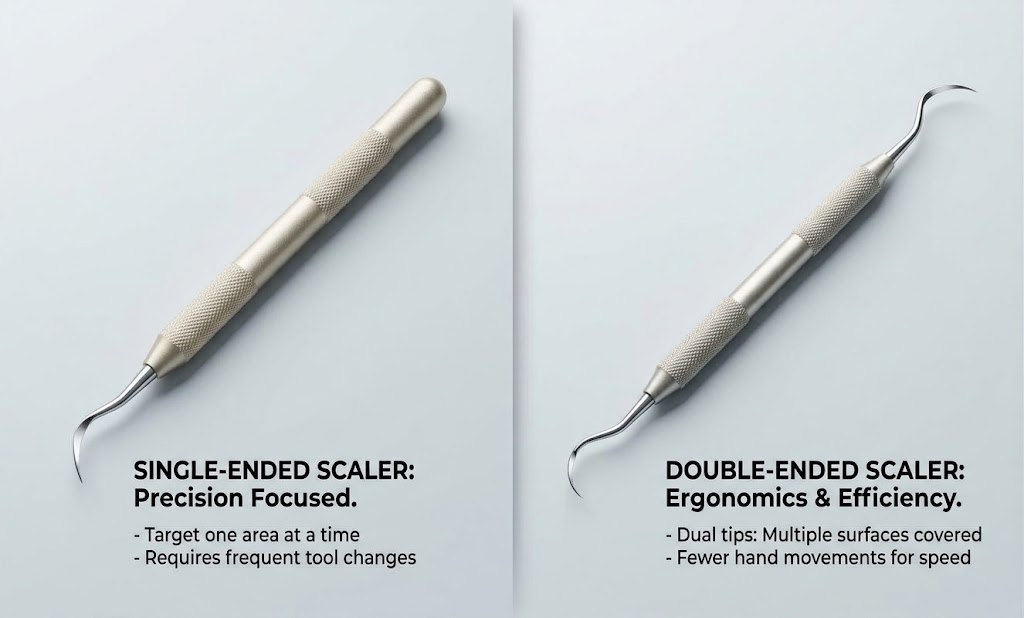
Dental scalers are vital instruments for effective plaque and calculus removal, and choosing the right type can significantly impact both clinician comfort and procedural outcomes. Double-ended and single-ended scalers each have unique advantages, and understanding their ergonomic benefits and efficiency can optimize dental practice performance.
Understanding Single-Ended Scalers
Single-ended scalers have a cutting edge on one side only, typically designed for specific surfaces or areas of the tooth.
Benefits of Single-Ended Scalers:
- Precision – Ideal for targeted scaling in narrow or hard-to-reach areas
- Simplicity – Easier to handle and control, especially for beginners
- Lightweight Design – Reduces hand fatigue during short procedures
Limitations:
- Limited reach compared to double-ended instruments
- May require instrument changes frequently for different surfaces
Advantages of Double-Ended Scalers
Double-ended scalers have cutting edges on both ends, often with different designs on each tip.
Ergonomic Benefits:
- Reduced Hand Movements – Clinicians can switch between ends without changing instruments
- Balanced Design – Symmetrical handles allow better control and reduce strain
- Time Efficiency – Fewer instrument changes speed up procedures
Procedural Efficiency:
- One instrument can cover multiple tooth surfaces
- Suitable for both supragingival and subgingival scaling
- Adaptable for a variety of clinical situations
Ergonomic Considerations
When choosing between single- and double-ended scalers, ergonomics is critical:
- Grip Comfort – Instruments with textured, lightweight handles reduce fatigue
- Balance and Weight – Properly balanced scalers allow smoother strokes
- Stroke Mechanics – Minimizing wrist deviation prevents repetitive strain injuries
Choosing the Right Scaler for Your Practice
- Single-Ended Scalers: Best for precise, focused work in limited areas
- Double-Ended Scalers: Ideal for longer procedures, varied surfaces, and efficiency-focused clinics
- Consider clinician hand size, procedure type, and patient comfort when selecting instruments
Conclusion
Both single-ended and double-ended scalers have their place in modern dentistry. Single-ended scalers excel in precision, while double-ended instruments enhance ergonomics and procedural efficiency. Selecting the right scaler based on clinical needs and ergonomic principles ensures effective scaling, reduced clinician fatigue, and better patient outcomes.