
Rhein Dental
Dental Forcep 150 and the Extracting Forceps Range: Article RD-ID-12-0017
A practical guide for surgeons, distributors and wholesalers to extracting forceps dental patterns, from the dental forcep 150 and 151 to Ash, cowhorn, 88L and 65, with the full specification of Rhein Dental article RD-ID-12-0017.
Overview: Extracting Forceps for Everyday Dental Surgery
A reliable dental forcep 150 or its lower-jaw partner is one of the first instruments a dental surgeon reaches for when a tooth cannot be saved. Choosing the right extracting forceps shortens the procedure, protects the surrounding bone and makes the patient’s visit more comfortable. For distributors and wholesalers, the same choice decides which patterns sell steadily and which sit on the shelf.
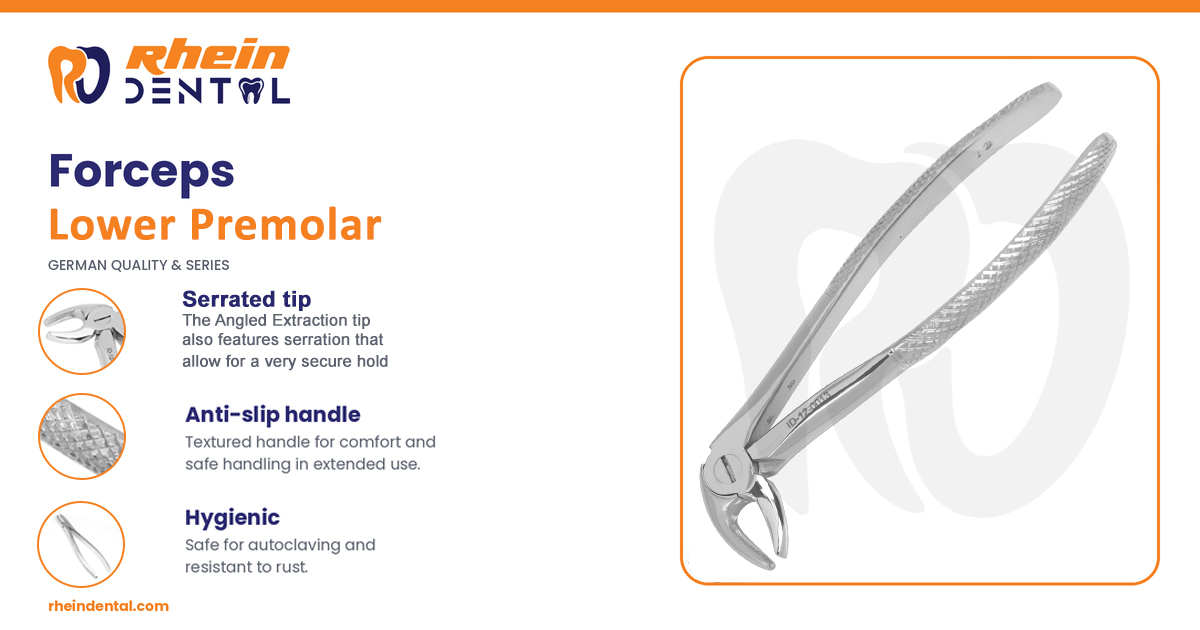
Rhein Dental article RD-ID-12-0017 is a stainless steel extracting forcep built for a firm, controlled grip. It combines a grooved extraction tip, a cross-hatched anti-slip handle and a finish that survives repeated autoclave cycles without rusting.
What Are Extracting Forceps Dental Instruments?
Extracting forceps dental instruments are hinged, two-handled tools used to grip a tooth or root, loosen it from the socket and lift it out. The beaks (the working end) are shaped to match the root anatomy of a specific tooth group, while the handles are shaped to match the angle of approach from the upper or lower arch.
Every extracting forcep dental instrument works on the same principle: the beaks grip the tooth below the crown margin, the surgeon applies controlled pressure and rotation to widen the socket, and the tooth is then delivered. The pattern number, such as 150, 151, 88L or 65, tells you which tooth group the beak was designed for.
Why the Right Forcep Dental Instrument Matters
A forcep dental instrument that does not fit the tooth slips, crushes the crown or fractures the root. A well-matched pattern spreads force evenly along the root surface. That is why surgeons keep a small set of patterns on the tray rather than one general-purpose tool, and why wholesalers who stock the full range win repeat orders from clinics and dental colleges.
Specification: Extracting Forceps RD-ID-12-0017
The table below lists the details for this article. Use the article number when placing orders so the correct pattern ships every time.
| Article number | RD-ID-12-0017 (engraved on the instrument as ID-12-0017) |
|---|---|
| Product type | Dental extracting forceps |
| Material | Stainless steel |
| Working tip | Grooved extraction beaks for a secure hold on the tooth |
| Handle | Cross-hatched textured grip, anti-slip |
| Joint | Screw-type hinge at the pivot |
| Sterilization | Safe for autoclaving |
| Corrosion resistance | Rust resistant |
| Brand | Rhein Dental |
| Intended users | Dental surgeons, clinics, hospitals, dental colleges, distributors and wholesalers |
Key Features of the RD-ID-12-0017 Dental Forcep
Three design choices set this instrument apart on the tray and on the shelf.
Grooved Tip
The extraction tip is grooved so the beaks bite into the tooth surface and hold it firmly, which reduces slipping during rotation and traction.
Anti-Slip Handle
A textured, cross-hatched handle improves comfort and keeps the grip steady during long or difficult sessions, even with gloved, wet hands.
Hygienic Build
The instrument is safe for autoclaving and resistant to rust, so it holds its finish and function across repeated sterilization cycles.
Grooved Tip: A Secure Hold on Every Extraction
Grip is the first thing a surgeon notices. The grooves on the beaks create friction against enamel and root surface, so the tooth stays seated in the forcep as pressure builds. This is especially useful on smooth, conical roots and on teeth with limited crown height.
Anti-Slip Handle: Comfort During Extended Use
The cross-hatched pattern on the handles gives the fingers and palm positive contact. A steadier hand means more controlled movements, less fatigue and fewer repositioning pauses in a busy list of extractions.
Hygienic and Rust Resistant: Built for Repeated Sterilization
Clinics sterilize extracting forceps after every patient. A forcep that is safe for autoclaving and resists rust keeps its hinge smooth and its surfaces clean, which protects both infection control standards and the working life of the instrument.
Clinical Applications: Matching the Forcep to the Tooth
Extracting forceps are grouped by jaw and tooth type. Numbering systems differ between the American and English patterns and between manufacturers, so always confirm the pattern against the catalogue before you order. The overview below covers the most searched patterns and what each is generally used for.
| Pattern | Typical use | Jaw |
|---|---|---|
| Dental forcep 150 | Universal forceps for upper incisors, canines and premolars | Upper |
| 151 dental forcep | Universal forceps for lower incisors, canines and premolars | Lower |
| Ash forcep dental | Straight-handled forceps for anterior and premolar teeth | Upper and lower, by pattern |
| Cowhorn dental | Lower molars with a split (bifurcated) root | Lower |
| 88L dental forcep | Upper left molars | Upper |
| 65 dental forcep | Root-type extractions where little crown remains | Check catalogue |
Dental Forcep 150: Upper Universal Extractions
The dental forcep 150 is the workhorse for the upper front and premolar region. Its beaks close around the tooth in a single line, which suits the single, tapered roots found in the upper anterior teeth. Surgeons choose it for routine extractions, for loose teeth in periodontal cases and for teeth removed before orthodontic treatment.
151 Dental Forcep: Lower Universal Extractions
The 151 dental forcep is the lower-jaw counterpart. Its handle angle lets the surgeon reach the lower arch comfortably, and its beaks grip lower incisors, canines and premolars. Clinics that stock a 150 almost always stock a 151 alongside it, which makes the pair an easy bundle for distributors.
Ash Forcep Dental: Straight-Handled Control
An Ash forcep dental instrument is known for its straight handle and simple, balanced design. Many surgeons prefer it for anterior teeth and premolars because the straight line between hand and beak gives a clear feel for the direction of force. Ash style forceps are also popular in training, where students learn to apply controlled pressure.
Cowhorn Dental Forceps: Lower Molar Specialists
People often search for cowhorn dental instruments without typing the words “extracting forceps”, yet they are looking for the same product family. Cowhorn forceps have two pointed, curved beaks shaped like the horns of a cow. The points seat into the split between the roots of a lower molar. When the surgeon closes the handles, the beaks work between the roots and lift the tooth out of its socket. They are the instrument of choice for lower molars with a bifurcation and are a standard item in oral surgery sets.
88L Dental Forcep: Upper Molar Pattern
The 88L dental forcep is an upper molar pattern made for the left side. Upper molars have three roots, so the beaks are shaped to follow the broad palatal and buccal surfaces. Left and right versions are sold separately, so wholesalers should stock both sides to avoid backorders.
65 Dental Forcep: Root-Type Extractions
The 65 dental forcep is listed in many catalogues for root-type work, where the crown has broken down and only the root portion is left to grip. Because designations vary between suppliers, check the beak shape and jaw specification in the product sheet before purchase.
Where RD-ID-12-0017 Fits
Article RD-ID-12-0017 gives surgeons a firm, well-gripped extraction forcep for general extraction work. Its grooved beaks and anti-slip handle suit private clinics, hospital dental departments, oral surgery units and dental teaching institutions that perform high volumes of extractions.
- Routine simple extractions in general dental practice
- Extraction of loose or mobile teeth
- Pre-orthodontic and pre-prosthetic extractions
- Hospital outpatient dental clinics and extraction camps
- Dental college practical training
Buying Guide for Distributors and Wholesalers
Extracting forceps are a repeat-purchase category. Every clinic needs several patterns, replaces worn units and adds new sets as the practice grows. A well-planned range keeps your customers buying from one source.
Build a Range Around the Core Patterns
- Start with the pair: dental forcep 150 and 151 cover the most common extractions.
- Add molar patterns: 88L with its right-side partner, and cowhorn forceps for lower molars.
- Include specialist items: Ash style and root-type forceps such as the 65 for surgeons with specific needs.
- Sell complete sets: bundles for new clinics, dental students and extraction camps move faster than single pieces.
Quality Points to Check Before You Order
- Smooth hinge action with no wobble at the screw joint
- Beaks that meet evenly along the full gripping edge
- Deep, even grooves and a handle texture that grips without sharp edges
- A clean, polished finish with no pitting, which signals good corrosion resistance
- Clear article number marking, such as ID-12-0017, so reorders are accurate
For availability, bulk quantities and private labelling options, contact the team at rheindental.com.
Care and Sterilization of Extracting Forceps
Good care extends the life of every extracting forcep. Follow the steps below after each procedure.
- Rinse early: remove blood and tissue before they dry on the beaks and in the grooves.
- Clean thoroughly: brush the grooved tips and handle texture with a soft instrument brush and a suitable detergent, or use an ultrasonic cleaner.
- Dry completely: moisture left in the hinge is the main cause of stiffness and spotting.
- Lubricate the joint: apply instrument-safe lubricant to the screw hinge as needed.
- Autoclave in pouches: RD-ID-12-0017 is safe for autoclaving, so sterilize it according to your clinic’s protocol.
- Store dry: keep instruments in a clean, dry tray or cassette.
Frequently Asked Questions
What is a dental forcep 150 used for?
A dental forcep 150 is a universal extracting forceps used mainly for upper incisors, canines and premolars. It is one of the most common patterns in general dental practice.
What is the difference between a 150 and a 151 dental forcep?
The 150 is designed for the upper arch and the 151 for the lower arch. The handle angle and beak position differ so the surgeon can reach each jaw comfortably.
What are cowhorn dental forceps used for?
Cowhorn forceps are used to extract lower molars that have a split root. The two pointed beaks seat between the roots and lift the tooth from its socket.
Are Rhein Dental extracting forceps autoclavable?
Yes. Article RD-ID-12-0017 is safe for autoclaving and resistant to rust.
Can distributors order extracting forceps in bulk?
Yes. Distributors and wholesalers can contact Rhein Dental through rheindental.com for quantities, patterns and availability.
Conclusion
From the everyday dental forcep 150 and 151 to Ash, cowhorn, 88L and 65 patterns, the right extracting forceps make every procedure more controlled and every instrument range easier to sell. Rhein Dental article RD-ID-12-0017 delivers the features that matter most in daily use: a grooved tip for a secure hold, an anti-slip handle for comfort, and a hygienic, rust-resistant build that is safe for autoclaving.
Surgeons, distributors and wholesalers can explore the full extracting forceps range and request details for RD-ID-12-0017 at rheindental.com.
Pattern numbering varies between American and English systems and between manufacturers. Confirm the pattern against the product sheet before ordering.