
Orthodontic treatment requires exceptional precision, reliability, and patient safety. Whether you’re placing brackets, adjusting archwires, or removing bands, every instrument directly impacts treatment outcomes. This is why CE certified orthodontic tools have become the preferred choice for orthodontists, dental clinics, hospitals, universities, and distributors across Europe and many international markets.
CE certification demonstrates that orthodontic instruments meet stringent European safety, performance, and quality standards. It assures clinicians that the tools they use comply with applicable regulations for reusable medical devices while supporting consistent clinical performance.
In this guide, we’ll explain everything you need to know about CE certification for orthodontic instruments, why it matters, how it benefits dental professionals, and what to look for when purchasing compliant orthodontic tools.
What Does CE Certification Mean?
CE stands for Conformité Européenne, meaning European Conformity.
A CE mark indicates that a medical device has been assessed according to relevant European regulations and complies with essential requirements related to:
- Safety
- Performance
- Risk management
- Manufacturing quality
- Clinical evaluation
- Traceability
- Documentation
For orthodontic instruments, CE certification ensures that manufacturers have implemented rigorous quality systems throughout product development and manufacturing.
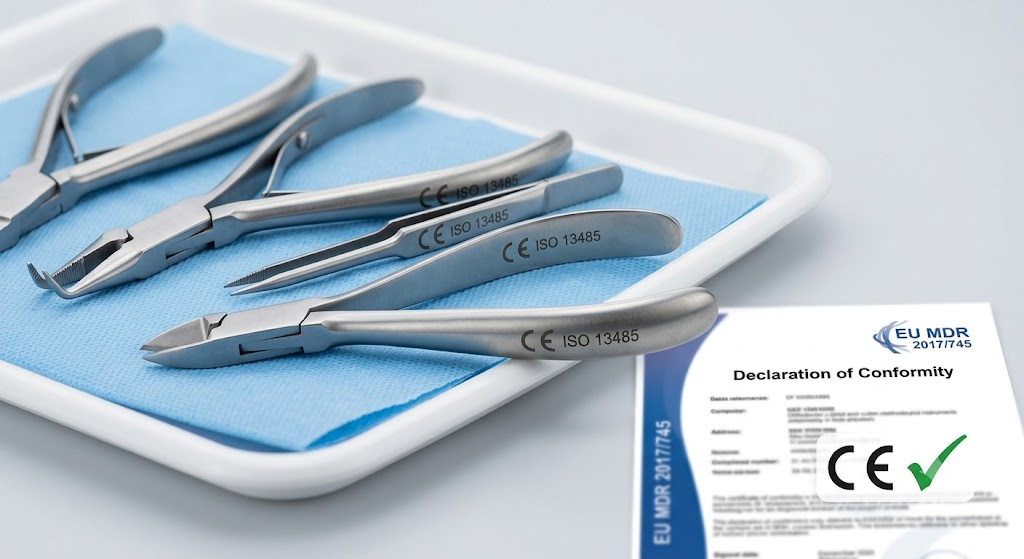
Why CE Certified Orthodontic Tools Are Important
Selecting certified orthodontic instruments isn’t simply about regulatory compliance—it directly affects clinical efficiency and patient outcomes.
Benefits include:
Improved Patient Safety
High-quality instruments reduce the likelihood of:
- Instrument failure
- Material defects
- Corrosion
- Surface contamination
- Clinical complications
Reliable instruments contribute to safer orthodontic procedures and enhanced patient confidence.
Consistent Clinical Performance
Orthodontists rely on accurate force application every day.
CE certified orthodontic tools provide:
- Precise alignment
- Consistent grip
- Accurate wire bending
- Reliable cutting performance
- Long-lasting functionality
Consistency improves treatment efficiency while minimizing unnecessary adjustments.
Regulatory Compliance
Dental practices across Europe often require instruments that comply with applicable medical device regulations.
Using compliant instruments helps clinics maintain procurement standards while supporting inspections and quality assurance programs.
Greater Durability
Premium stainless steel combined with controlled manufacturing processes results in:
- Longer service life
- Better corrosion resistance
- Reduced maintenance
- Reliable sterilization performance
This lowers replacement costs over time.
Understanding CE Certification Under the European MDR
The European Medical Device Regulation (MDR) introduced stricter requirements than previous directives.
Manufacturers must demonstrate:
- Comprehensive technical documentation
- Risk analysis
- Clinical evaluation
- Post-market surveillance
- Manufacturing quality controls
- Device traceability
- Ongoing compliance
When choosing an orthodontic instrument manufacturer, verifying MDR compliance provides additional confidence in product quality.
Characteristics of High-Quality CE Certified Orthodontic Tools
When evaluating orthodontic instruments, consider several important factors beyond the CE mark.
Medical-Grade Stainless Steel
Premium orthodontic instruments are commonly manufactured using high-grade surgical stainless steel, offering:
- Corrosion resistance
- Excellent hardness
- Smooth surface finish
- Sterilization compatibility
- Long-term durability
Precision Engineering
Quality orthodontic tools feature:
- Accurate tip alignment
- Smooth hinge movement
- Controlled spring action
- Precise cutting edges
- Ergonomic balance
These features improve clinician comfort while reducing hand fatigue.
Sterilization Compatibility
Reusable orthodontic instruments should tolerate repeated sterilization without compromising:
- Surface finish
- Joint movement
- Cutting efficiency
- Corrosion resistance
Proper manufacturing ensures reliable performance throughout thousands of sterilization cycles.
Excellent Finish
Premium CE marked orthodontic instruments typically have:
- Smooth edges
- Satin or mirror finish
- Burr-free surfaces
- Consistent polishing
- High-quality passivation
These characteristics improve cleaning and reduce contamination risks.
Common CE Certified Orthodontic Instruments
Many orthodontic procedures depend on reusable CE certified instruments.
Orthodontic Pliers
Examples include:
- Bird Beak Pliers
- Weingart Pliers
- Distal End Cutters
- Ligature Cutters
- Wire Bending Pliers
- Three-Prong Pliers
- Utility Pliers
- Loop Forming Pliers
These are essential for wire manipulation and appliance adjustments.
Bracket Placement Instruments
Accurate bracket positioning requires:
- Bracket Holding Tweezers
- Bracket Positioning Gauges
- Bracket Height Gauges
Precision placement improves treatment accuracy.
Band Instruments
Common examples include:
- Band Pushers
- Band Seaters
- Band Removing Pliers
These instruments simplify molar band placement and removal while minimizing patient discomfort.
Ligature Instruments
Routine orthodontic appointments often involve:
- Ligature Directors
- Ligature Tuckers
- Mathieu Needle Holders
- Ligature Cutters
These tools improve efficiency during wire changes.
Wire Management Instruments
Examples include:
- Distal End Cutters
- Hard Wire Cutters
- Cinch Back Pliers
- Archwire Forming Instruments
High-quality cutting performance reduces chair time.
Benefits for Orthodontic Clinics
Using CE certified orthodontic tools provides measurable advantages.
Enhanced Treatment Efficiency
Reliable instruments:
- Reduce chair time
- Improve procedural accuracy
- Require fewer adjustments
- Increase workflow efficiency
Better Infection Control
Smooth instrument surfaces improve cleaning effectiveness and sterilization consistency.
Lower Long-Term Costs
Although premium instruments may have a higher initial purchase price, they often:
- Last longer
- Require fewer replacements
- Maintain cutting efficiency
- Reduce maintenance expenses
Increased Patient Confidence
Patients increasingly value modern, compliant, high-quality clinical equipment.
Professional-grade instruments reinforce trust in your practice.
How to Verify CE Certification
Before purchasing orthodontic instruments, verify:
Manufacturer Documentation
Request:
- Declaration of Conformity
- CE certification details
- MDR compliance documentation
Quality Management System
Look for manufacturers operating under internationally recognized quality management systems such as ISO 13485.
Product Traceability
Quality manufacturers provide:
- Batch numbers
- Product identification
- Manufacturing records
- Technical documentation
Traceability supports ongoing quality assurance.
Choosing the Right Orthodontic Instrument Manufacturer
Selecting a trusted manufacturer is just as important as selecting the instruments themselves.
Consider:
Manufacturing Experience
Established manufacturers often demonstrate:
- Skilled craftsmanship
- Consistent production quality
- Extensive product testing
- Industry expertise
Product Range
Reliable suppliers usually offer comprehensive orthodontic portfolios including:
- Orthodontic pliers
- Cutters
- Tweezers
- Wire instruments
- Band instruments
- Bracket placement tools
- Instrument kits
Global Distribution
Manufacturers supplying multiple international markets generally maintain stronger quality systems and regulatory compliance.
Customer Support
Professional suppliers provide:
- Product guidance
- Technical assistance
- Warranty support
- After-sales service
Common Mistakes When Buying Orthodontic Instruments
Avoid these purchasing errors:
- Buying solely based on price
- Ignoring CE documentation
- Choosing unknown manufacturers
- Overlooking material quality
- Failing to verify MDR compliance
- Purchasing non-traceable products
Quality instruments provide better long-term value.
Future Trends in CE Certified Orthodontic Tools
The orthodontic industry continues evolving with innovations including:
- Enhanced ergonomic designs
- Lightweight instrument construction
- Improved corrosion resistance
- Advanced manufacturing technologies
- Better surface treatments
- Sustainable production methods
As regulations continue to evolve, manufacturers are placing even greater emphasis on compliance, quality assurance, and product performa.
Conclusion
Choosing CE certified orthodontic tools is an investment in patient safety, clinical precision, and long-term reliability. Whether you’re an orthodontist, procurement manager, dental distributor, or educational institution, selecting instruments from a trusted manufacturer helps ensure compliance with European standards while supporting consistent clinical outcomes.
From precision pliers and wire cutters to bracket placement instruments and band pushers, every orthodontic procedure benefits from tools manufactured to stringent quality standards. By verifying CE certification, evaluating manufacturing quality, and partnering with experienced suppliers, dental professionals can build a dependable instrument portfolio that delivers confidence in every procedure.
Frequently Asked Questions:
CE certified orthodontic tools are orthodontic instruments that meet applicable European regulatory requirements for safety, quality, and performance, allowing them to be marketed within relevant European jurisdictions.
It demonstrates that the manufacturer has met applicable regulatory requirements relating to safety, quality management, documentation, and performance, giving clinicians greater confidence in the products they use.
Many orthodontic instruments are designed as reusable medical devices when cleaned, disinfected, and sterilized according to the manufacturer’s instructions.
Request the manufacturer’s Declaration of Conformity, review product documentation, verify MDR compliance where applicable, and purchase from reputable suppliers.
CE certification indicates compliance with relevant European regulatory requirements. While certification itself is not the sole indicator of performance, purchasing from reputable manufacturers that combine CE compliance with robust quality systems provides greater assurance of safety, consistency, and reliability.