
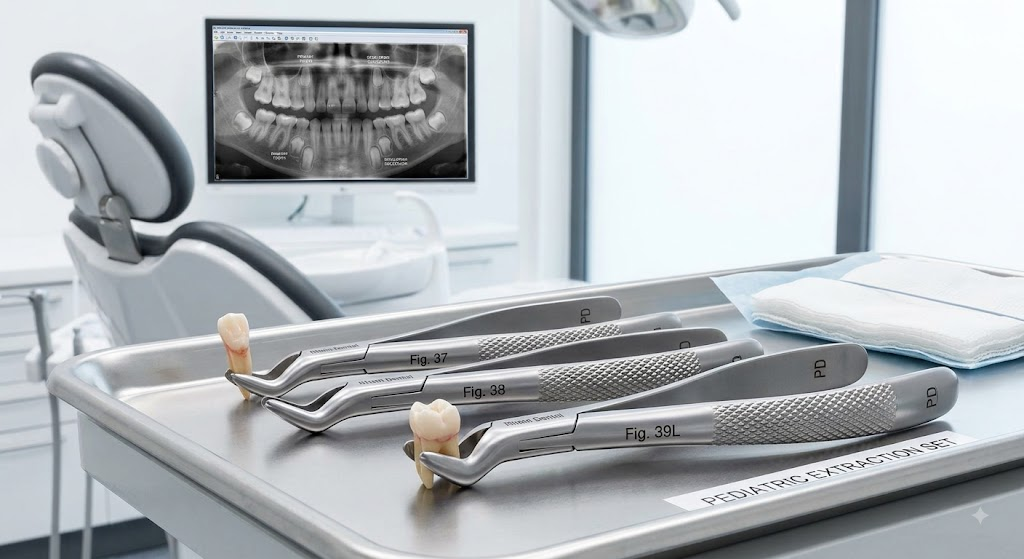
Pediatric extraction forceps are specialized dental instruments designed to help dentists remove primary teeth with controlled handling. Their smaller working ends and compact designs provide better access to children’s mouths. Therefore, choosing the correct forceps can support precise tooth engagement while helping clinicians protect surrounding tissues and developing permanent teeth.
What Are Pediatric Extraction Forceps?
Pediatric extraction forceps help dental professionals remove primary or deciduous teeth when extraction becomes necessary.
Unlike many adult forceps, pediatric designs usually provide:
- Smaller working ends
- Compact profiles
- Tooth-specific beak designs
- Comfortable handling
- Stainless-steel construction in professional reusable instruments
However, dentists should not choose a forceps simply because it has a smaller size. Instead, they should consider the tooth type, anatomy, crown condition and clinical access.
When Do Children Need Tooth Extraction?
A dentist may recommend extraction when a primary tooth:
- Has severe, non-restorable decay
- Develops an infection
- Becomes significantly damaged
- Remains in place longer than expected
- Interferes with eruption
- Suffers certain traumatic injuries
- Requires removal as part of a planned treatment
However, extraction does not always provide the best treatment. Therefore, the dentist should assess whether restoration, pulp therapy, monitoring or extraction offers the most appropriate option.
According to the American Academy of Pediatric Dentistry (AAPD), pediatric oral surgery requires careful consideration of developing anatomy, dentition and the permanent successors.
Types of Pediatric Extraction Forceps
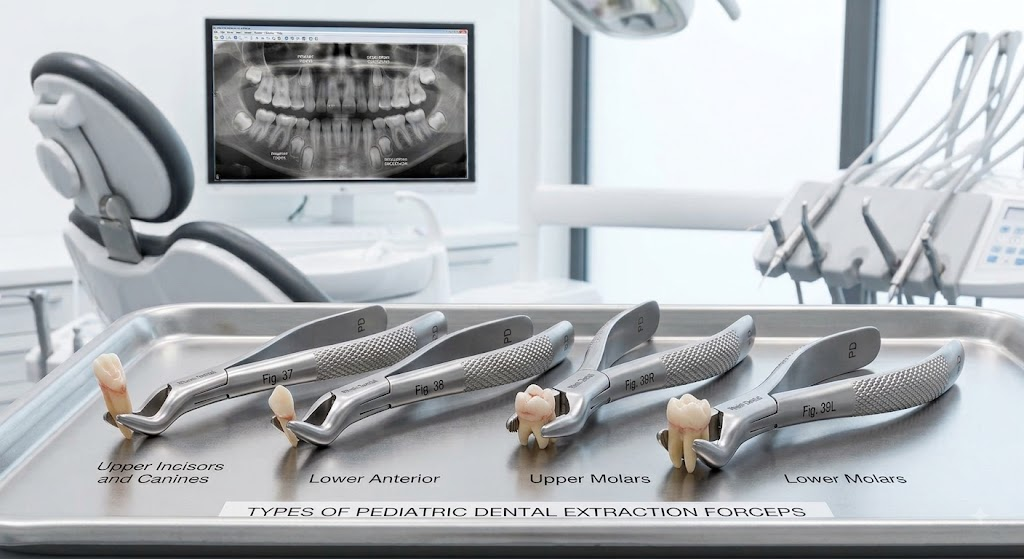
Different teeth require different instrument designs. Therefore, pediatric extraction forceps come in several patterns.
| Forceps Type | Common Application |
|---|---|
| Upper incisor forceps | Primary upper incisors |
| Lower anterior forceps | Lower incisors and canines |
| Upper molar forceps | Primary upper molars |
| Lower tooth forceps | Primary lower teeth |
| Serrated-tip forceps | Improved engagement for selected teeth |
For example, Rhein Dental offers pediatric extraction patterns for upper incisors, lower incisors and canines, as well as upper and lower teeth.
Pediatric vs Adult Extraction Forceps
| Pediatric Forceps | Adult Forceps |
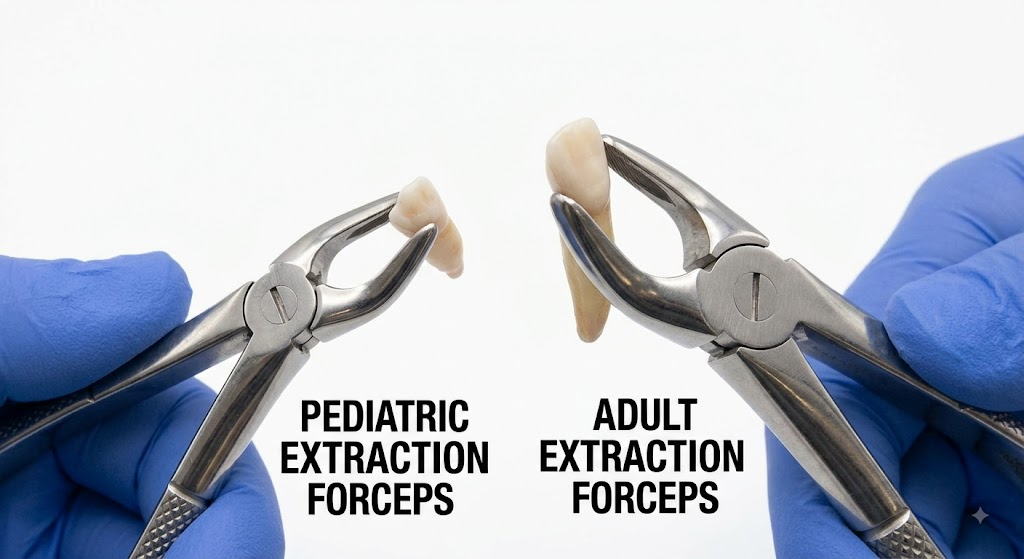
| Designed for children’s anatomy | Designed mainly for adult anatomy |
| Smaller working ends | Generally larger working ends |
| Compact profile | Larger overall profile |
| Suitable for primary teeth | Mainly used for permanent teeth |
| Better suited to limited oral access | Designed for adult oral access |
Therefore, pediatric forceps are not simply smaller versions of adult instruments. Instead, their design considers the anatomy and access requirements of younger patients.
How to Choose the Right Pediatric Forceps
Choosing the correct instrument becomes easier when you follow a simple process.
1. Identify the Tooth
First, determine whether you are treating an incisor, canine or molar. Then identify whether the tooth sits in the upper or lower arch.
2. Check the Crown
Next, examine the remaining tooth structure. If extensive decay or fracture has damaged the crown, conventional forceps engagement may become difficult.
3. Consider Root Anatomy
Primary teeth can have resorbing or anatomically complex roots. Therefore, clinicians should consider the developing permanent tooth before planning extraction.
4. Check Clinical Access
Children have smaller oral cavities. Consequently, a compact pediatric forceps can provide better access and handling than a larger adult instrument.
5. Inspect the Instrument
Finally, check the beaks, hinge and handles. The forceps should open smoothly and provide stable, controlled engagement.
Important Safety Considerations
Pediatric tooth extraction requires appropriate professional training and patient assessment.
Before treatment, the clinician should consider:
- Medical and dental history
- Clinical examination
- Radiographs when indicated
- Pain control
- Informed consent
- Child behavior and anxiety
- Developing permanent teeth
- Postoperative care
In addition, the AAPD recommends individualized behavior guidance based on the child’s needs, treatment requirements and previous dental experiences.
For that reason, techniques such as communication, positive reinforcement and tell-show-do can help create a more comfortable dental experience when appropriate.
How to Reduce Unnecessary Trauma
The key principle is simple: use the right instrument and controlled technique rather than excessive force.
Therefore, clinicians should:
- Choose the correct pediatric forceps.
- Maintain clear visibility.
- Ensure adequate pain control.
- Avoid unnecessary soft-tissue contact.
- Consider the developing permanent tooth.
- Reassess the instrument if the forceps slips.
- Inspect the extracted tooth after removal.
- Provide suitable postoperative instructions.
The AAPD specifically highlights the importance of avoiding injury to permanent successors and nearby tissues during pediatric oral surgery.
Pediatric Extraction Forceps Quality Checklist
Before purchasing pediatric dental forceps, check the following:
- Appropriate pediatric size
- Correct tooth-specific design
- Proper beak alignment
- Smooth hinge movement
- Comfortable handles
- Quality stainless-steel construction
- Good surface finish
- Cleaning and sterilization instructions
- Reliable manufacturer documentation
Moreover, regular inspection helps dental teams identify damaged or poorly functioning instruments before clinical use.
Why Instrument Quality Matters
A well-made pediatric extraction forceps should provide consistent handling and reliable tooth engagement.
For example, a properly aligned hinge allows smooth movement, while accurately manufactured beaks can improve control. As a result, dentists can select and handle instruments with greater confidence.
Furthermore, reusable instruments require appropriate cleaning, sterilization and maintenance according to the manufacturer’s instructions.
Pediatric Extraction Forceps vs Elevators
Forceps and elevators have different purposes.
| Instrument | Main Purpose |
| Pediatric extraction forceps | Grasp and remove the tooth |
| Dental elevator | Mobilize or luxate the tooth or root |
| Periosteal elevator | Manage soft tissue when indicated |
| Surgical curette | Manage the extraction socket when indicated |
Therefore, a pediatric extraction setup may contain several instruments rather than forceps alone.
Rhein Dental Pediatric Extraction Forceps
Rhein Dental offers professional dental extraction instruments for different clinical applications, including pediatric tooth extraction.
The pediatric range includes designs for:
- Upper incisors
- Lower incisors and canines
- Upper molars
- Lower teeth
- Selected pediatric extraction procedures
For example, Rhein Dental’s Fig. 38 extracting forceps for children features serrated tips and is designed for lower incisors and canines.
Consequently, dental practices can select instruments according to the tooth and clinical requirements rather than relying on a single universal pattern.
Final Takeaway
Choosing the right pediatric extraction forceps involves more than selecting a small instrument.
Instead, dentists should consider:
Tooth anatomy + clinical access + crown condition + developing dentition + appropriate technique.
When clinicians match the forceps to the tooth, they can support better access, handling and procedural control.
Therefore, dental practices should invest in reliable pediatric extraction instruments that meet their clinical requirements and maintenance standards.
Explore Rhein Dental Pediatric Extraction Forceps
Looking for pediatric extraction forceps for your dental practice, clinic or distribution business?
Explore Rhein Dental’s pediatric dental instruments, request the latest catalogue, or contact our team for product information and professional purchasing support.
Explore Rhein Dental’s pediatric extraction instruments today and find the right forceps for your clinical requirements.
Frequently Asked Questions
What are pediatric extraction forceps?
Pediatric extraction forceps are dental instruments designed for controlled removal of primary teeth. Their compact designs suit children’s smaller oral anatomy.
Why use pediatric forceps instead of adult forceps?
Pediatric forceps generally provide better access and handling for primary teeth. However, the dentist should always select the instrument according to the specific tooth and clinical situation.
What forceps are used for primary teeth?
Common options include forceps for upper incisors, lower incisors and canines, upper molars and lower teeth. Therefore, practices should maintain several appropriate patterns.
Are pediatric extraction forceps reusable?
Many professional stainless-steel forceps are reusable. However, dental teams must follow the manufacturer’s cleaning and sterilization instructions.
Are serrated pediatric forceps better?
Not necessarily. Serrated tips can improve engagement for certain teeth. However, the best forceps depends on tooth anatomy, crown condition and clinical technique.
Can extracting a baby tooth affect the permanent tooth?
The developing permanent successor requires careful consideration during treatment planning. Therefore, clinicians should assess the relationship between the primary tooth and permanent successor before extraction.
Are antibiotics always needed after pediatric extraction?
No. Antibiotics do not automatically follow every pediatric extraction. Instead, clinicians should prescribe them according to the patient’s clinical condition and current professional guidance. The AAPD recommends antibiotic therapy for selected situations, particularly when systemic involvement requires it.