
Endodontic instruments are specialized dental tools used to diagnose, access, clean, shape, disinfect, and fill root canals during endodontic treatment. An essential endodontic instruments list includes hand files, rotary files, explorers, access burs, apex locators, irrigation instruments, paper points, gutta-percha, spreaders, and pluggers.
Essential Endodontic Instruments List
A practical endodontic setup should cover every major stage of root canal treatment. Therefore, clinicians need instruments for diagnosis, isolation, access, canal preparation, irrigation, drying, and obturation.
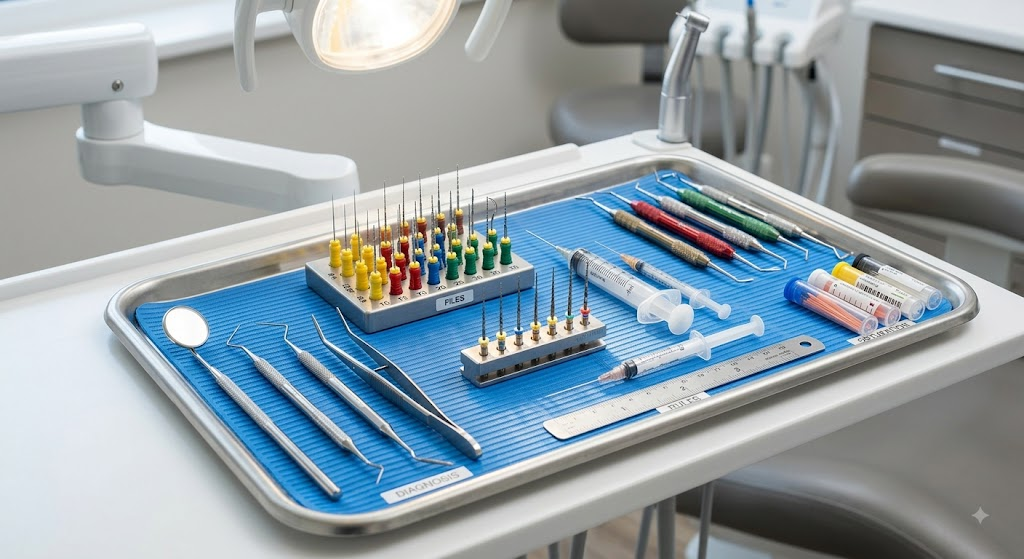
| Treatment Stage | Essential Instruments |
|---|---|
| Diagnosis | Dental mirror, explorer, periodontal probe |
| Isolation | Rubber dam, clamps, forceps, punch |
| Access | Round burs, diamond burs, endodontic burs |
| Canal location | Endodontic explorer, ultrasonic tips |
| Canal negotiation | K-files, C-files, small hand files |
| Working length | Apex locator, endodontic ruler, silicone stops |
| Shaping | Hand files, rotary NiTi files, reciprocating files |
| Irrigation | Syringes, irrigation needles, aspiration tips |
| Drying | Absorbent paper points, tweezers |
| Obturation | Gutta-percha, spreaders, pluggers |
| Retreatment | Retreatment files, ultrasonic tips, retrieval instruments |
1. Diagnostic Endodontic Instruments
Accurate diagnosis is the first step in endodontic treatment. For this reason, clinicians commonly use a dental mirror, explorer, periodontal probe, and cotton pliers before starting treatment.
An endodontic explorer has a fine tip that helps identify canal orifices and examine the pulp chamber floor. In addition, it can assist with locating difficult or calcified canal entrances.
Common diagnostic instruments
- Dental mouth mirror
- Dental explorer
- Endodontic explorer
- Periodontal probe
- Cotton pliers
2. Rubber Dam Instruments
Rubber dam isolation helps maintain a controlled working field and protects the patient during endodontic treatment. The American Association of Endodontists includes dental dam use in its endodontic clinical guidance.
Essentially, a basic isolation setup includes:
- Rubber dam sheets
- Rubber dam frame
- Rubber dam punch
- Rubber dam clamps
- Clamp forceps
- Dental floss
As a result, rubber dam equipment should be considered an essential part of an endodontic setup rather than an optional accessory.
3. Endodontic Access Instruments
Access preparation provides entry to the pulp chamber and root canals. At this stage, the clinician needs instruments that provide adequate visibility while preserving appropriate tooth structure.
Common access instruments include:
- Round burs
- Diamond burs
- Endodontic access burs
- Safe-ended burs
- Long-shank burs
- Ultrasonic endodontic tips
In particular, ultrasonic tips can help refine access cavities and locate difficult canal orifices.
4. K-Files and Other Hand Files
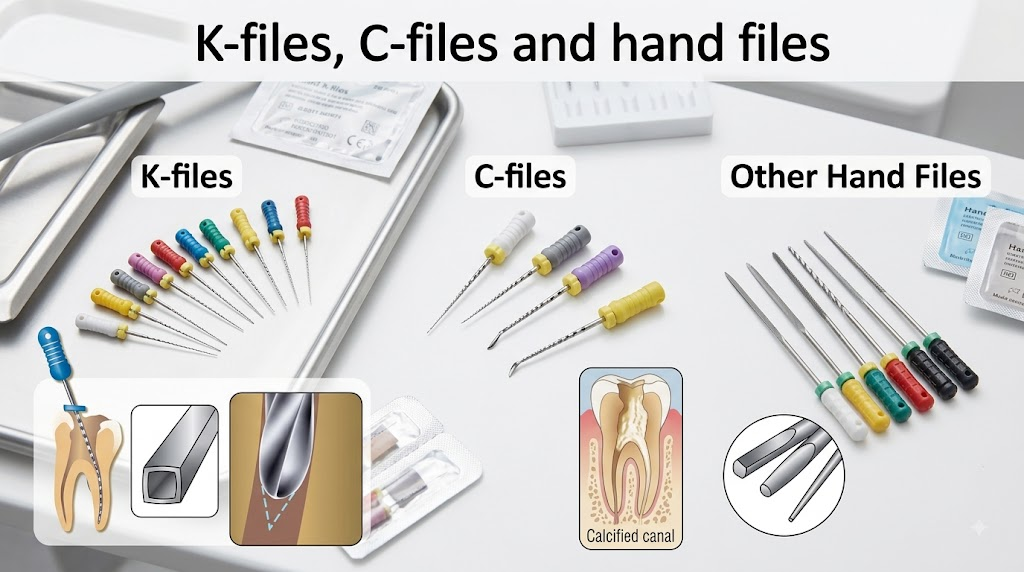
Hand files remain important even when rotary or reciprocating systems are used. For example, K-files, H-files, C-files, reamers, and pathfinder files can support different stages of canal preparation.
K-Files
K-files are widely used for:
- Canal scouting
- Canal negotiation
- Working-length procedures
- Glide-path preparation
- Manual shaping
Meanwhile, C-files can be useful for narrow or calcified canals because of their resistance to buckling.
H-files have a more aggressive cutting design and are mainly used for controlled filing and dentin removal.
K-Files vs H-Files
| Feature | K-File | H-File |
| Main use | Negotiation and shaping | Dentin removal |
| Cutting action | Moderate and versatile | More aggressive |
| Common application | Initial canal preparation | Filing and enlargement |
| Technique | Controlled filing/reaming | Controlled filing |
5. Rotary and Reciprocating NiTi Files
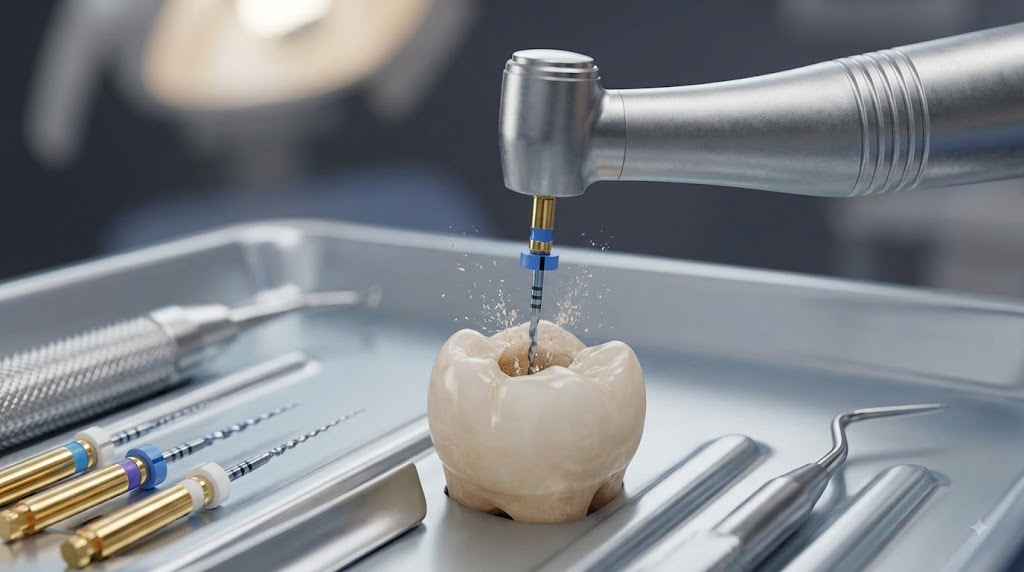
Nickel-titanium (NiTi) instruments are widely used for mechanical root canal preparation. Because of their flexibility, they are particularly useful for shaping curved canals.
Rotary files
Rotary files use continuous rotation and are available in different sizes, tapers, and designs.
Reciprocating files
In contrast, reciprocating systems use alternating rotational movements. Depending on the system, this approach can simplify the instrumentation sequence.
Modern NiTi designs and heat treatments can improve flexibility and resistance to cyclic fatigue. However, no file system eliminates the need for correct technique, case selection, and careful instrument use.
Always follow the manufacturer’s recommended speed, torque, motion, and reuse instructions.
6. Glide-Path Instruments
A glide path creates a smooth and reproducible pathway for subsequent shaping instruments. Typically, clinicians use small hand files such as #06, #08, #10, and #15 files, C-files, or dedicated mechanical glide-path files.
Once established, a controlled glide path can help engine-driven files follow the canal and reduce unnecessary mechanical stress.
Common glide-path instruments
- Small K-files
- C-files
- Pathfinder files
- Mechanical glide-path files
7. Working-Length Instruments
Working length helps control the extent of canal preparation and obturation. To determine it, clinicians may use an electronic apex locator, endodontic ruler, measuring block, silicone stops, and hand files.
Radiographic imaging may also be used when clinically indicated. Together, these methods help the clinician assess the working length within the context of the patient’s anatomy.
Essential working-length tools
- Electronic apex locator
- Endodontic ruler
- Measuring block
- Silicone stops
- Hand files
- Radiographic imaging where indicated
8. Endodontic Irrigation Instruments
Irrigation is an essential part of root canal treatment because mechanical files cannot contact every area of the complex canal system. Therefore, appropriate irrigation equipment should be included in every endodontic setup.
Common options include:
- Luer-lock syringes
- Endodontic irrigation needles
- Side-vented needles
- Irrigation tips
- Aspiration equipment
- Irrigation activation devices
For safe irrigation, clinicians should use controlled pressure and avoid binding the needle inside the canal.
9. Canal-Drying Instruments
After cleaning and irrigation, the canal must be dried before obturation. For this purpose, clinicians commonly use absorbent paper points and endodontic tweezers.
Paper points should match the prepared canal size. In addition, they should be handled carefully to maintain a clean working field.
Common canal-drying supplies
- Absorbent paper points
- Sterile paper points
- Endodontic tweezers
10. Endodontic Obturation Instruments
Obturation fills the prepared root canal space after cleaning and shaping. At this stage, clinicians may use gutta-percha points, spreaders, pluggers, heated instruments, and gutta-percha cutters.
Essential obturation instruments
- Gutta-percha points
- Master cones
- Accessory cones
- Finger spreaders
- Pluggers
- Heated pluggers
- Gutta-percha cutters
- Sealer application accessories
Spreader vs Plugger
| Instrument | Main Purpose |
| Spreader | Creates space for accessory gutta-percha during lateral compaction |
| Plugger | Compacts filling material |
| Heated plugger | Softens and compacts gutta-percha |
| Gutta-percha cutter | Removes excess filling material |
In simple terms, spreaders are mainly associated with lateral compaction, whereas pluggers are commonly used for compaction techniques.
11. Endodontic Retreatment Instruments
Retreatment may require additional instruments to remove existing gutta-percha, sealers, posts, or other obstructions. Depending on the case, clinicians may use:
- Retreatment rotary files
- H-files
- Ultrasonic tips
- Heat instruments
- Post-removal instruments
- Instrument-retrieval tools
- Micro forceps
However, the exact instrument selection depends on the cause of treatment failure and the anatomy of the tooth.
12. Ultrasonic Endodontic Instruments
Ultrasonic tips are useful adjuncts during difficult endodontic procedures. For example, they can assist with:
- Locating calcified canals
- Troughing around canal orifices
- Access refinement
- Post removal
- Instrument retrieval
- Irrigation activation
Nevertheless, ultrasonic instruments should be used carefully because excessive use can remove unnecessary dentin.
Basic Endodontic Instrument Checklist
For a practical starting point, use the following checklist:
- Dental mirror
- Explorer
- Endodontic explorer
- Rubber dam kit
- Rubber dam clamps and forceps
- Access burs
- K-files
- C-files
- Small hand files
- Rotary or reciprocating NiTi files
- Apex locator
- Endodontic ruler
- Irrigation syringes
- Side-vented irrigation needles
- Paper points
- Gutta-percha points
- Finger spreaders
- Pluggers
- Gutta-percha cutter
- Endodontic tweezers
For complex retreatment cases, additional retreatment files, ultrasonic tips, retrieval instruments, and magnification may be required.
Hand Files vs Rotary NiTi Files
| Feature | Hand Files | Rotary NiTi Files |
| Main advantage | Tactile control | Efficient mechanical shaping |
| Common material | Stainless steel or NiTi | NiTi |
| Canal negotiation | Excellent | Usually not the primary role |
| Curved canals | Depends on size and design | Particularly useful |
| Speed | Slower | Faster |
| Equipment | No motor required | Endodontic motor required |
Overall, rotary NiTi files can make canal shaping more efficient, while hand files remain valuable for negotiation and tactile control. Therefore, many endodontic workflows use both rather than relying exclusively on one type.
How to Choose an Endodontic Instrument Set
Before purchasing an endodontic instrument set, consider several factors. First, check the material and dimensions. Next, confirm that the instruments match your clinical technique.
Also consider:
- Material – Choose materials suitable for the intended application.
- Size and taper – Ensure the available sizes match your treatment protocol.
- Intended use – Confirm whether each instrument is designed for negotiation, shaping, irrigation, or obturation.
- Ergonomics – Look for comfortable and controlled handling.
- Sterilization – Follow the manufacturer’s cleaning and sterilization instructions.
- Quality – Check dimensional consistency, surface finish, and manufacturing quality.
- Supplier support – Reliable availability and product documentation are important for professional practices.
Why Endodontic Instrument Quality Matters
Endodontic instruments operate in a highly controlled environment where size, flexibility, cutting efficiency, and design affect handling. For this reason, professional buyers should look beyond price when selecting instruments.
Important factors include:
- Material quality
- Precision manufacturing
- Surface finish
- Dimensional consistency
- Corrosion resistance
- Ergonomic design
- Sterilization compatibility
- Product documentation
Ultimately, the best endodontic instrument set is one that matches the clinician’s technique and provides the right instrument for each stage of treatment.
Final Endodontic Instrument Checklist
In summary, a practical endodontic setup should cover five core stages:
Diagnose → Isolate → Shape → Disinfect → Obturate
The most commonly required instruments include K-files, C-files, NiTi rotary or reciprocating files, an apex locator, irrigation instruments, paper points, gutta-percha, spreaders, and pluggers.
Ultimately, the ideal endodontic instrument set depends on the clinician’s technique, equipment, and case complexity.
Explore Rhein Dental Instruments
Looking for professional dental instruments for your practice, clinic, hospital, or distribution business?
Explore Rhein Dental’s range of professional dental instruments or contact the team for product information and catalogue support.
Frequently Asked Questions
What are the essential endodontic instruments?
The essential endodontic instruments include diagnostic tools, rubber dam equipment, access burs, K-files, C-files, NiTi files, an apex locator, irrigation equipment, paper points, gutta-percha, spreaders, and pluggers.
What instruments are used for root canal treatment?
Root canal treatment uses instruments for diagnosis, isolation, access, canal negotiation, working-length measurement, cleaning and shaping, irrigation, drying, and obturation.
What are K-files used for in endodontics?
K-files are commonly used for canal scouting, negotiation, working-length procedures, glide-path preparation, and manual canal shaping.
What is the difference between K-files and H-files?
K-files are versatile instruments used for canal negotiation and shaping. In comparison, H-files have a more aggressive cutting design and are primarily used for filing and dentin removal.
Are rotary files better than hand files?
They serve different purposes. Rotary NiTi files can make canal shaping more efficient. However, hand files remain important for canal negotiation and tactile control.
What is an apex locator used for?
An electronic apex locator helps estimate the position of the apical terminus and assists with working-length determination.
What instruments are used for root canal obturation?
Common obturation instruments include gutta-percha points, spreaders, pluggers, heated pluggers, and gutta-percha cutters.
Can endodontic instruments be reused?
Some instruments are designed for reuse, while others are intended for single use. Therefore, always follow the manufacturer’s instructions for cleaning, sterilization, inspection, and reuse.