Types of Endodontic Files: Complete Guide (K-File, H-File, NiTi) | Rhein Dental

The types of endodontic files include K-files, H-files, reamers, C-files, hand NiTi files, rotary NiTi files and reciprocating NiTi files. Each type has a specific design, material, cutting action and clinical purpose. K-files commonly support canal negotiation, while H-files provide cutting during withdrawal and NiTi instruments offer flexibility for mechanical shaping.


What Are Endodontic Files?

Endodontic files are precision dental instruments that dentists and endodontists use to negotiate, clean and shape root canals during root canal treatment.

Understanding the types of endodontic files is important because each instrument behaves differently inside the canal. For example, stainless-steel K-files provide excellent tactile feedback, while flexible NiTi files can follow curved canal anatomy more effectively.

Tip size

Taper

Working length

Cross-sectional design

Cutting geometry

Material

Therefore, clinicians should select an instrument according to the canal anatomy, treatment stage and manufacturer’s instructions.

ISO 3630-1 specifies general requirements for endodontic instruments, including dimensions, marking and identification. Consequently, standardized sizing helps dental professionals identify and compare conventional instruments.


Types of Endodontic Files at a Glance

The types of endodontic files can be grouped according to their design, material and movement.

Endodontic file typeCommon materialMain actionTypical application
K-fileStainless steel or NiTiFiling and negotiationCanal scouting and glide path
H-fileUsually stainless steelCutting on withdrawalDentin removal
ReamerStainless steel or NiTiReamingCanal enlargement
C-fileStainless steelNegotiationNarrow or calcified canals
Hand NiTi fileNiTiManual instrumentationFlexible canal preparation
Rotary NiTi fileNiTiContinuous rotationMechanical canal shaping
Reciprocating NiTi fileNiTiAlternating movementMechanical canal shaping
Glide-path fileStainless steel or NiTiPathway preparationPreparation before larger instruments

Although these instruments belong to the same broad category, their geometry and intended applications differ considerably.


1. K-Files: A Fundamental Type of Endodontic File

K-files, also called Kerr files, remain one of the most widely recognized types of endodontic files.

Manufacturers traditionally create K-files by twisting a metal blank into a helical cutting instrument. As a result, K-files provide useful tactile feedback during manual canal negotiation.

What Are K-Files Used For?

Dentists commonly use K-files for:

  • Initial canal negotiation
  • Canal scouting
  • Working-length procedures
  • Glide-path preparation
  • Manual canal enlargement
  • Canal patency procedures where clinically appropriate
  • Controlled manual shaping

Small K-files are particularly useful when the clinician needs tactile information about the canal pathway.

Advantages of K-Files

Pros

  • Excellent tactile feedback
  • Useful for initial canal negotiation
  • Available in multiple sizes
  • Available in different working lengths
  • Suitable for manual instrumentation
  • Useful for glide-path preparation

Cons

  • Stainless-steel versions are less flexible than many NiTi instruments
  • Larger sizes can become relatively stiff
  • Improper manipulation can cause procedural errors
  • Manual preparation can take longer than mechanical shaping

How Are K-Files Used?

Depending on the file size and clinical technique, clinicians may use K-files with controlled movements such as:

  • Filing
  • Watch-winding
  • Controlled rotation
  • Balanced-force techniques

However, clinicians should always use the movement recommended by their training and the instrument manufacturer.


2. H-Files: Another Important Type of Endodontic File

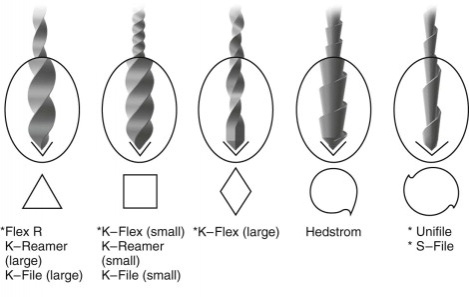
H-files, or Hedström files, have a different cutting geometry from K-files.

Manufacturers create H-files by machining or grinding a metal blank to produce prominent cutting flutes. Consequently, H-files can provide strong cutting action during a controlled withdrawal stroke.

What Are H-Files Used For?

H-files may support:

  • Canal enlargement
  • Controlled dentin removal
  • Canal-wall cleaning
  • Selected retreatment procedures
  • Refinement of manually prepared canals

Why Should H-Files Not Be Aggressively Rotated?

H-files primarily cut during withdrawal. Therefore, clinicians should avoid aggressive rotation inside the canal.

Instead, controlled withdrawal helps the instrument perform its intended cutting action. Because H-files can engage dentin strongly, excessive force or inappropriate movement can increase the risk of instrument separation.

H-File Pros and Cons

Pros

  • Strong cutting action
  • Useful for controlled dentin removal
  • Good tactile feedback
  • Helpful during selected manual procedures

Cons

  • Can engage dentin aggressively
  • Requires careful handling
  • Not designed for aggressive continuous rotation
  • Requires particular care in curved canals

3. K-File vs H-File: Which Type of Endodontic File Should You Use?

One of the most common questions about the types of endodontic files is whether a K-file or H-file is better.

In reality, neither instrument is universally better. Instead, each serves a different purpose.

FeatureK-FileH-File
Primary roleCanal negotiation and filingCutting on withdrawal
Basic designTwisted blankMachined/ground cutting flutes
Tactile feedbackHighHigh
Cutting actionControlledMore aggressive
Canal negotiationExcellentLess typical
Glide-path preparationCommonLess typical
Manual useCommonCommon
Aggressive rotationTechnique dependentAvoid

Simple Rule for K-Files and H-Files

Use a K-file when you need controlled canal negotiation and tactile feedback.

Use an H-file when controlled cutting during withdrawal is the intended action.

Therefore, choosing between these two types of endodontic files depends on the clinical objective.


4. Reamers in Endodontic Treatment

Reamers are another traditional category among the types of endodontic files.

Endodontic reamers resemble K-files, but they generally have fewer spirals per unit length. As a result, their geometry favors a reaming action rather than the filing action commonly associated with K-files.

Clinicians may use reamers for:

  • Canal enlargement
  • Controlled rotational preparation
  • Manual shaping
  • Selected instrumentation techniques

However, the clinician should always match the movement to the instrument design and intended application.


5. C-Files for Narrow and Calcified Canals

C-files are specialized stainless-steel hand instruments with greater stiffness than many conventional small K-files.

Therefore, C-files can be useful when clinicians encounter:

  • Very narrow canals
  • Calcified canals
  • Difficult canal entrances
  • Restricted canal pathways

The additional stiffness can help the clinician negotiate challenging anatomy. Nevertheless, greater stiffness does not mean the clinician should apply excessive apical force.

Instead, controlled pressure, appropriate irrigation and careful technique remain essential.


6. NiTi Files: Flexible Types of Endodontic Files

Nickel-titanium, commonly abbreviated NiTi, significantly changed modern endodontic instrumentation.

Importantly, NiTi describes the material, not one specific file design. Therefore, several types of endodontic files can use NiTi alloy.

Manufacturers can produce NiTi instruments as:

  • Hand files
  • Rotary files
  • Reciprocating files
  • Glide-path instruments
  • Shaping files
  • Finishing instruments

NiTi’s flexibility can help appropriately designed instruments follow curved canal anatomy more effectively than many conventional stainless-steel instruments.

Modern manufacturers also use different heat treatments and metallurgical processes to modify the mechanical properties of NiTi instruments.


Why Are NiTi Endodontic Files Used?

NiTi provides a useful combination of flexibility and mechanical performance.

For example, a flexible NiTi instrument can follow a curved canal while rotating or reciprocating. Consequently, clinicians can mechanically shape complex canal anatomy with an appropriately selected system.

Potential advantages include:

  • Greater flexibility
  • Better adaptation to curved canals
  • Efficient mechanical shaping
  • Compatibility with rotary systems
  • Compatibility with reciprocating systems
  • Different metallurgical options

However, NiTi does not eliminate the risk of instrument fracture. Instead, clinicians need to understand the file’s design, operating parameters and limitations.


Rotary NiTi Files

Rotary NiTi files are among the most widely discussed modern types of endodontic files.

These instruments continuously rotate around their axis according to the manufacturer’s recommended settings.

Therefore, rotary NiTi systems can provide efficient mechanical canal shaping.

Their performance depends on several factors, including:

  • Alloy
  • Heat treatment
  • Taper
  • Cross-sectional design
  • Tip design
  • Rotation speed
  • Torque
  • Canal anatomy
  • Operator technique

Consequently, dentists should never judge a rotary file only by its brand or material. The entire system influences its behavior.


Reciprocating NiTi Files

Reciprocating NiTi files use alternating clockwise and counterclockwise movements rather than continuous rotation.

This movement pattern can influence the stresses placed on the instrument. Some laboratory studies have reported differences in cyclic fatigue behavior between rotary and reciprocating systems.

However, laboratory results do not automatically predict clinical performance.

Therefore, clinicians should use reciprocating systems according to the specific manufacturer’s instructions for motion, speed, torque and file sequence.


Rotary vs Reciprocating Endodontic Files

FeatureRotary NiTiReciprocating NiTi
MovementContinuous rotationAlternating movement
Typical applicationCanal shapingCanal shaping
MotorCompatible endodontic motorCompatible reciprocating motor
FlexibilityDepends on alloy and designDepends on alloy and design
Fatigue behaviorSystem dependentSystem dependent
TechniqueManufacturer specificManufacturer specific

Neither movement is automatically superior in every clinical situation. Instead, clinicians should choose the system according to anatomy, treatment requirements, training and manufacturer guidance.


Understanding Endodontic File Sizes

Understanding file sizes is essential when learning the types of endodontic files.

Under the conventional ISO sizing system, the number generally represents the nominal tip diameter in hundredths of a millimetre.

For example:

  • #10 = approximately 0.10 mm
  • #15 = approximately 0.15 mm
  • #20 = approximately 0.20 mm
  • #25 = approximately 0.25 mm
  • #30 = approximately 0.30 mm
  • #40 = approximately 0.40 mm

Therefore, a higher number generally indicates a larger nominal tip diameter.

However, file size does not describe the complete geometry. Taper also significantly influences the instrument’s dimensions and behavior.


What Is Taper in an Endodontic File?

Taper describes how quickly an instrument’s diameter increases along its working portion.

For example, a .02 taper increases the diameter by approximately 0.02 mm for every millimetre along the relevant portion.

Common taper values include:

  • .02
  • .04
  • .06
  • .08

Some modern systems also use larger tapers.

As taper increases, the instrument generally contains more metal along its working portion. Consequently, taper can affect:

  • Flexibility
  • Stiffness
  • Dentin removal
  • Canal enlargement
  • Instrument stress

Therefore, a larger taper does not automatically mean a better endodontic file. Instead, the clinician should select taper according to canal anatomy and the chosen instrumentation system.


Endodontic File Color Coding

Many conventional hand files use standardized color coding to help clinicians identify sizes quickly.

A commonly encountered ISO sequence is:

SizeCommon ISO color
#06Pink
#08Grey
#10Purple
#15White
#20Yellow
#25Red
#30Blue
#35Green
#40Black

Consequently, color coding can make instrument identification faster during clinical procedures.

However, clinicians should verify the manufacturer’s product information because specialized systems may use different identification methods.


How to Choose the Right Type of Endodontic File

There is no single best type of endodontic file for every tooth.

Instead, clinicians should consider:

  • Canal anatomy
  • Canal curvature
  • Canal width
  • Calcification
  • Working length
  • Root morphology
  • Previous treatment
  • File geometry
  • Material
  • Taper
  • Instrument movement
  • Manufacturer instructions

Step 1: Assess Canal Anatomy

First, evaluate the canal’s curvature, width, length and morphology.

This assessment helps determine which instruments are appropriate for the case.

Step 2: Establish a Reproducible Path

Next, negotiate the canal and establish an appropriate glide path when required.

Small hand files can provide valuable tactile information during this stage. Consequently, they remain important even when clinicians plan to use rotary NiTi instruments later.

Step 3: Select the File System

Depending on the case, clinicians may choose:

  • Stainless-steel K-files
  • H-files
  • C-files
  • Hand NiTi files
  • Rotary NiTi files
  • Reciprocating NiTi files
  • Dedicated glide-path instruments

Step 4: Verify the Manufacturer’s Protocol

For engine-driven systems, check:

  • Recommended speed
  • Torque
  • Movement
  • File sequence
  • Motor compatibility
  • Usage limitations
  • Sterilization instructions
  • Single-use or reuse requirements

Step 5: Inspect the Instrument

Finally, inspect each file for:

  • Unwinding
  • Distorted flutes
  • Corrosion
  • Surface damage
  • Deformation
  • Signs of fatigue

If the instrument shows damage, discontinue its use according to the relevant clinical protocol.


Endodontic File Selection Checklist

Before instrumentation, clinicians should consider:

  • Confirm the diagnosis and treatment plan
  • Prepare appropriate access
  • Locate canal orifices
  • Determine working length
  • Negotiate the canal
  • Establish a glide path when required
  • Select the appropriate file size
  • Select the appropriate taper
  • Verify motor settings
  • Maintain an appropriate irrigation protocol
  • Inspect instruments
  • Follow manufacturer instructions

Why Do Endodontic Files Break?

Instrument separation remains an important concern when using different types of endodontic files, particularly engine-driven NiTi instruments.

Two major mechanisms associated with NiTi fracture are torsional fatigue and cyclic fatigue.

Torsional Fatigue

Torsional stress can occur when the file tip binds against dentin while the rest of the instrument continues to rotate.

As a result, the instrument can experience stress beyond its mechanical limit.

Cyclic Fatigue

Cyclic fatigue develops when an instrument repeatedly flexes inside a curved canal.

With repeated tension and compression, the metal can eventually develop fatigue and fracture.

Therefore, canal curvature, instrument design, movement, usage and clinical technique can all influence fracture risk.

How Can Clinicians Reduce File Separation Risk?

Clinicians can reduce risk by:

  1. Creating appropriate access.
  2. Establishing a reproducible glide path.
  3. Avoiding excessive apical pressure.
  4. Using recommended motor settings.
  5. Maintaining adequate irrigation.
  6. Inspecting instruments during use.
  7. Respecting recommended usage limits.
  8. Avoiding unnecessary reuse.
  9. Considering canal anatomy before selecting an instrumentation system.

Most importantly, no endodontic file is completely fracture-proof.


Manual vs Rotary Endodontic Files

Understanding the difference between manual and rotary types of endodontic files helps clinicians select instruments more effectively.

FeatureManual FilesRotary/Engine-Driven Files
ControlDirect hand controlMotor controlled
Tactile feedbackExcellentLower than manual
Common materialsStainless steel and NiTiPrimarily NiTi
FlexibilityDepends on material and sizeOften high in modern NiTi designs
SpeedGenerally slowerGenerally faster
Canal negotiationExcellentUsually follows an established pathway
Curved canalsTechnique dependentNiTi flexibility can help
Learning curveFundamentalRequires system-specific training
Motor requiredNoYes

Which Is Better?

Neither approach is universally better.

Instead, many clinicians combine both approaches. For example, a dentist may use small hand files to negotiate the canal and establish a pathway. Then, the dentist may use a NiTi system for mechanical shaping.

Therefore, manual and rotary files often complement rather than replace one another.


Common Mistakes When Choosing Endodontic Files

1. Choosing Only by Price

Price alone does not indicate instrument quality or clinical suitability.

Instead, consider:

  • Manufacturing consistency
  • Material
  • Geometry
  • Documentation
  • Intended application
  • Supplier support

2. Assuming All NiTi Files Are the Same

They are not.

NiTi files can differ in:

  • Alloy
  • Heat treatment
  • Cross-section
  • Taper
  • Tip design
  • Helical angle
  • Cutting efficiency
  • Movement
  • Speed
  • Torque

Therefore, clinicians should follow the instructions for the specific file system.

3. Ignoring Canal Anatomy

A popular file system may not suit every canal.

Instead, clinicians should consider curvature, calcification, canal size and root morphology before selecting an instrumentation strategy.

4. Using Rotary Files Without an Appropriate Pathway

Rotary systems require appropriate clinical preparation.

Consequently, establishing a reproducible pathway can improve control before larger engine-driven instruments enter the canal.

5. Assuming File Fracture Cannot Happen

Modern NiTi technology has improved instrument performance. Nevertheless, fracture remains possible.

Therefore, careful technique, proper inspection and adherence to manufacturer recommendations remain essential.


How Endodontic Files Have Evolved

The development of modern types of endodontic files reflects major advances in materials science and instrument design.

Initially, clinicians relied heavily on stainless-steel hand instrumentation. Later, manufacturers introduced NiTi instruments because of their favorable flexibility.

As a result, engine-driven rotary systems became increasingly common. More recently, manufacturers have developed heat-treated alloys, modified cross-sections and reciprocating systems.

Today, endodontic file development focuses on:

  • Metallurgy
  • Heat treatment
  • Cross-sectional geometry
  • Taper
  • Cutting efficiency
  • Flexibility
  • Cyclic fatigue resistance
  • Torsional resistance
  • Reciprocating motion
  • Conservative shaping

Consequently, modern file selection requires more than simply choosing stainless steel or NiTi.


Which Endodontic Files Should Beginners Learn First?

For students and clinicians developing fundamental endodontic skills, small stainless-steel K-files provide an important starting point.

They help clinicians develop tactile awareness and understand basic canal negotiation.

A practical learning sequence is:

  1. First, learn file sizes and color coding.
  2. Next, understand K-file geometry.
  3. Then, learn controlled manual canal negotiation.
  4. After that, study working length and glide-path principles.
  5. Next, learn H-file geometry and safe use.
  6. Then, study NiTi metallurgy.
  7. Finally, learn rotary and reciprocating systems.

This progression provides fundamental knowledge before introducing more complex engine-driven instrumentation.


How to Select Endodontic Files for a Dental Practice

Dental practices should evaluate more than purchase price when sourcing types of endodontic files.

Consider Product Quality

Look for:

  • Consistent dimensions
  • Reliable manufacturing
  • Appropriate material specifications
  • Clear size identification
  • Secure packaging
  • Traceability
  • Regulatory documentation

Consider Clinical Requirements

Determine whether the practice needs:

  • K-file sets
  • H-files
  • C-files
  • Hand NiTi files
  • Rotary NiTi files
  • Reciprocating systems
  • Glide-path instruments
  • Endodontic accessories

Consider Workflow Compatibility

For rotary and reciprocating systems, confirm compatibility with the practice’s endodontic motor.

In addition, verify the manufacturer’s recommended speed, torque and movement.

Consider Supplier Support

A reliable dental instrument supplier should provide clear product information, documentation, catalogue support and responsive communication.


Types of Endodontic Files: Quick Reference Guide

If you need to…Consider…
Scout a canalSmall K-file
Establish a glide pathSmall K-files or glide-path instruments
Negotiate a difficult narrow canalC-file or suitable small hand file
Manually enlarge a canalK-files or reamers
Cut dentin during withdrawalH-file
Shape curved canals mechanicallyAppropriate NiTi system
Use continuous rotationRotary NiTi
Use alternating movementReciprocating NiTi
Maintain tactile feedbackManual hand files
Improve mechanical shaping efficiencyEngine-driven NiTi

This table provides general guidance. However, clinicians should always make case-specific decisions according to training, canal anatomy and manufacturer instructions.


Practical Tips for Dentists and Dental Students

Tip 1: Learn the File, Not Just the Name

Understand the instrument’s geometry, material, taper and intended movement.

Tip 2: Handle Small Files Carefully

Small files can deform easily. Therefore, inspect them carefully during use.

Tip 3: Never Force a File

If a file stops progressing, reassess the canal instead of applying excessive apical pressure.

Tip 4: Understand Size and Taper

File size tells you the nominal tip diameter. Taper, however, tells you how the diameter changes along the working portion.

Tip 5: Keep Rotary Systems Organized

Separate files by sequence, size and clinical stage. This approach can reduce selection errors.

Tip 6: Follow Manufacturer Instructions

This point matters particularly for rotary and reciprocating NiTi systems because motor settings and file sequences vary between systems.

Tip 7: Remember That Instrumentation Is Only One Part of Treatment

Mechanical shaping supports cleaning and obturation. However, successful endodontic treatment also requires appropriate irrigation, disinfection, sealing and restoration.


Frequently Asked Questions About Types of Endodontic Files

What are the main types of endodontic files?

The main types of endodontic files include K-files, H-files, reamers, C-files, hand NiTi files, rotary NiTi files, reciprocating NiTi files and glide-path instruments.

What is a K-file used for in endodontics?

K-files help clinicians negotiate canals, scout canal anatomy, establish glide paths and perform manual cleaning and shaping.

What is an H-file used for?

H-files provide cutting action mainly during withdrawal. Therefore, clinicians can use them for controlled dentin removal and selected canal enlargement procedures.

What is the difference between a K-file and an H-file?

K-files commonly support canal negotiation and filing, whereas H-files have a more aggressive cutting geometry that works primarily during withdrawal.

What are NiTi endodontic files?

NiTi endodontic files use nickel-titanium alloy. Manufacturers can design these instruments for manual, rotary or reciprocating use.

What does endodontic file size mean?

Under the conventional ISO system, file size generally indicates the nominal tip diameter in hundredths of a millimetre.

What is a #25 endodontic file?

A #25 endodontic file has a nominal tip diameter of approximately 0.25 mm under the conventional ISO sizing system.

Why do dentists use NiTi files in curved canals?

NiTi offers useful flexibility. Therefore, appropriately designed NiTi instruments can follow curved canal anatomy more effectively than many conventional stainless-steel instruments.

Why do endodontic files fracture?

Endodontic files can fracture because of torsional stress, cyclic fatigue and other factors related to canal anatomy, instrument design, usage and clinical technique.

Are rotary endodontic files better than manual K-files?

Neither option is universally better. Manual K-files provide tactile control and support canal negotiation, while rotary NiTi systems can improve mechanical shaping efficiency.

Can endodontic files be reused?

Reuse depends on the specific instrument, manufacturer instructions, regulatory requirements and clinical setting. Therefore, clinicians should follow the manufacturer’s validated instructions for use.

Are rotary endodontic files safe?

Clinicians can use rotary files safely when they have appropriate training and follow the manufacturer’s protocol. However, every instrumentation system carries potential risks.

Which endodontic files work well for curved canals?

Appropriately designed NiTi instruments can provide useful flexibility in curved canals. Nevertheless, clinicians should select the system according to canal anatomy, clinical technique and manufacturer recommendations.


Endodontic File Purchasing Checklist

When sourcing types of endodontic files for a dental practice, distributor or OEM requirement, consider:

  • File design
  • Material
  • Available sizes
  • Available tapers
  • Working lengths
  • Manual, rotary or reciprocating operation
  • Motor compatibility
  • Manufacturer instructions
  • Product identification
  • Traceability
  • Packaging
  • Regulatory documentation
  • Quality consistency
  • Supplier support

Why Quality Matters in Endodontic Instruments

Endodontic files are precision instruments. Therefore, manufacturing consistency matters when dental professionals select an instrument supplier.

Small differences in geometry, dimensions or material properties can influence how an instrument behaves.

For dental professionals, distributors and OEM buyers, a reliable supplier can provide value beyond the individual instrument. In addition to product quality, buyers should consider traceability, documentation, regulatory compliance and technical support.

Rhein Dental is part of the Rhein Group and provides dental instruments for professional applications. Therefore, dental practices, distributors and OEM buyers can explore the company’s product portfolio and discuss their specific requirements.


Explore Endodontic Instruments From Rhein Dental

Choosing the right types of endodontic files starts with understanding the clinical application, instrument design and required specifications.

Rhein Dental offers a broad range of dental instruments for professional applications. If you are sourcing endodontic instruments for a dental practice, distributor or OEM requirement, contact Rhein Dental to discuss product specifications, available sizes, catalogue options and sourcing requirements.

Explore Rhein Dental’s dental instrument range and find the instruments that fit your professional requirements.

Request the Rhein Dental catalogue or contact our team today to discuss your requirements.