
NiTi Files vs Stainless Steel: Which Is Better? – NiTi vs Stainless Steel Endodontic Instruments
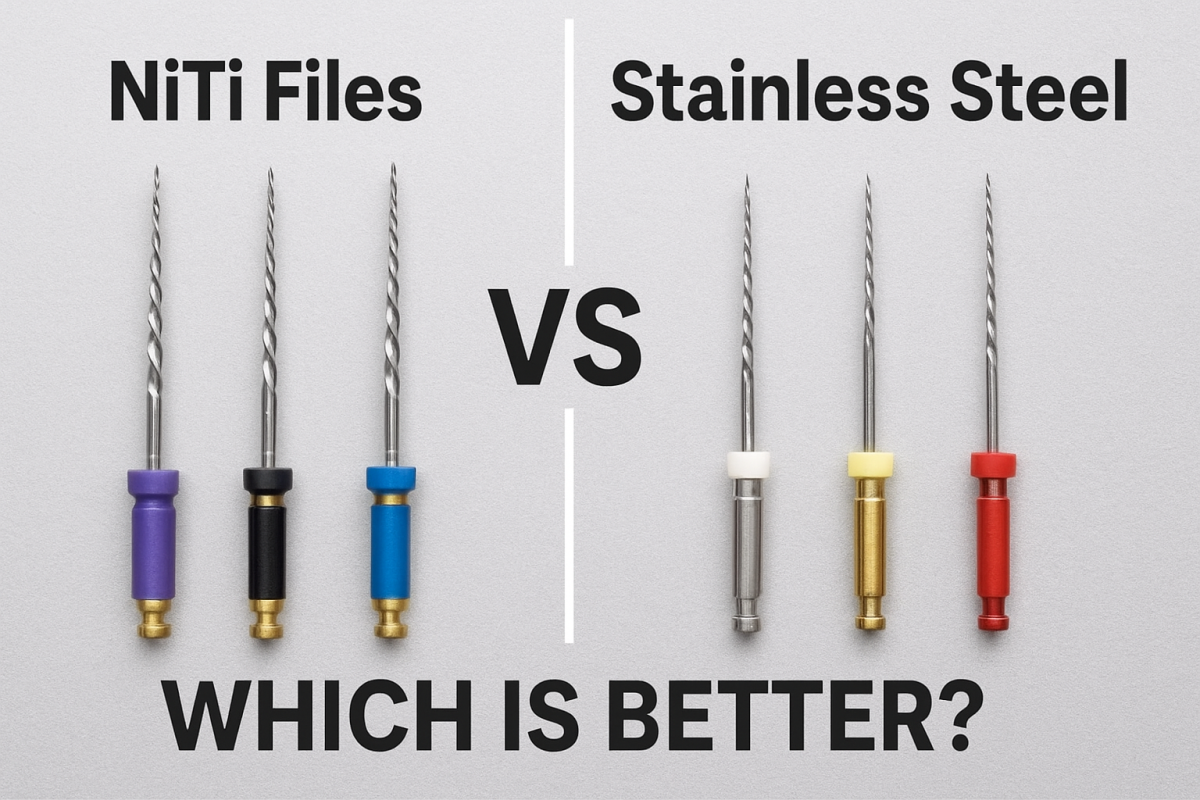
When it comes to successful root canal treatment, the choice of endodontic instruments plays a vital role in shaping, cleaning, and preserving the integrity of the tooth. Two of the most commonly used materials for endodontic files are Nickel-Titanium (NiTi) and Stainless Steel (SS).
Both materials have their strengths and limitations — and understanding these differences can help dental professionals choose the most appropriate instrument for each clinical situation.
In this article, we’ll compare NiTi vs Stainless Steel endodontic files in terms of flexibility, cutting efficiency, durability, safety, and clinical applications.
1. Composition and Properties
Stainless Steel Files
Stainless steel endodontic files have been used for decades and remain a staple in many practices. They are made from an alloy of iron, carbon, and chromium, which makes them strong, corrosion-resistant, and cost-effective.
Key properties:
- High rigidity and strength
- Resistant to corrosion
- Affordable and easily available
- Limited flexibility, especially in curved canals
NiTi Files (Nickel-Titanium)
NiTi files are made from a unique alloy of approximately 56% nickel and 44% titanium. The most remarkable feature of NiTi is its shape memory and superelasticity, which allow the files to return to their original shape after deformation.
Key properties:
- Superior flexibility
- Excellent shape memory
- High resistance to cyclic fatigue
- More expensive than stainless steel files
2. Flexibility and Canal Adaptation
One of the major differences between NiTi and stainless steel files lies in flexibility.
- NiTi Files: Extremely flexible, making them ideal for curved or narrow root canals. They can follow the natural anatomy of the canal with minimal transportation or ledging.
- Stainless Steel Files: Stiffer and tend to straighten within the canal, which increases the risk of canal transportation, ledging, or even perforation in curved canals.
✅ Winner: NiTi Files
NiTi’s flexibility offers better shaping ability with less risk of procedural errors.
3. Cutting Efficiency and Tactile Feedback
- Stainless Steel: Offers strong tactile feedback and is easier to control manually. Many clinicians prefer stainless steel files for initial canal negotiation and glide path creation.
- NiTi Files: Provide smoother cutting and remove dentin more efficiently, especially when used in rotary or reciprocating systems. However, they may give less tactile feedback due to their elasticity.
✅ Winner: Tie
Stainless steel is better for manual control; NiTi excels in efficient shaping during rotary procedures.
4. Resistance to Fatigue and Instrument Separation
Instrument separation is one of the most concerning issues in endodontics.
- Stainless Steel: Although strong, they are more prone to torsional stress because they do not flex easily.
- NiTi: Highly resistant to cyclic fatigue, allowing them to rotate in curved canals with a lower risk of breakage. However, they can still fracture if used improperly or beyond their fatigue limit.
✅ Winner: NiTi Files
NiTi instruments demonstrate greater durability and resistance to cyclic fatigue.
5. Cost and Accessibility
- Stainless Steel: Much more affordable, making them a practical choice for educational settings or basic procedures.
- NiTi Files: More expensive due to advanced manufacturing processes and material properties. However, their efficiency and reduced risk of complications can offset the cost in the long term.
✅ Winner: Depends on clinical need
Stainless steel for cost efficiency; NiTi for performance and safety.
6. Clinical Applications
| Application | Preferred Material | Reason |
|---|---|---|
| Initial canal negotiation | Stainless Steel | Better tactile sense and control |
| Curved/narrow canals | NiTi | Superior flexibility and adaptability |
| Straight canals | Stainless Steel | Sufficient rigidity and lower cost |
| Rotary instrumentation | NiTi | Designed for mechanical systems |
| Retreatment cases | NiTi (heat-treated types) | Enhanced fatigue resistance and cutting ability |
7. Technological Advancements in NiTi Files
Modern NiTi instruments are continuously evolving. Heat-treated NiTi alloys such as M-Wire, CM-Wire, and Gold/Blue NiTi offer enhanced flexibility, fatigue resistance, and cutting performance compared to traditional NiTi.
These innovations make NiTi files even more reliable and safer for a variety of clinical situations.
Conclusion: NiTi vs Stainless Steel – Which Is Better?
Both NiTi and Stainless Steel endodontic files have important roles in root canal therapy. The choice depends on case complexity, canal anatomy, and clinician preference.
- For curved canals and advanced rotary procedures, NiTi files are clearly superior due to their flexibility and fatigue resistance.
- For straight canals, initial negotiation, or cost-sensitive environments, stainless steel files remain a dependable choice.
Ultimately, the most effective approach often involves using both materials strategically — stainless steel for initial shaping and NiTi for final canal preparation.