
Tungsten Carbide Jaws & Spring-Tension Handles: Rhein’s Arruga Micro Needle Holder for Precision Procedures
Introduction
In microsurgery, the margin for error is practically nonexistent. Surgeons performing delicate corneal repairs or vitreoretinal procedures need instruments that deliver uncompromising accuracy, control, and durability. Naturally, not all micro needle holders meet this standard.
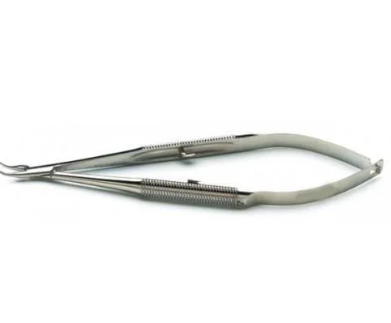
Rhein Medical’s Arruga Micro Needle Holder has earned its reputation as a gold standard in ophthalmic surgery. So, what sets it apart? The answer lies in two defining structural features: tungsten carbide-tipped jaws and spring-tension handles. Together, these elements transform a simple instrument into an extension of the surgeon’s hand — one that performs with confidence where precision matters most.
Understanding the Arruga Micro Needle Holder
First, it helps to understand what the Arruga Micro Needle Holder is and where it fits in surgical practice.
Named after the Spanish ophthalmologist Hermenegildo Arruga, this instrument targets ophthalmic and microsurgical suturing. Surgeons use it to grasp, position, and drive fine suture needles through delicate ocular tissue. These needles often measure just fractions of a millimeter in diameter, demanding both precision and control.
Furthermore, the Arruga design excels in procedures like strabismus surgery, corneal transplants, cataract repair, and retinal detachment surgery. In these cases, every movement counts. A quality instrument can mean the difference between a clean outcome and a costly complication.
Feature #1: Tungsten Carbide Jaws — The Foundation of Grip Precision
What Is Tungsten Carbide?
Tungsten carbide is an exceptionally hard compound of tungsten and carbon atoms. It ranks among the hardest materials in medical instrument manufacturing — second only to diamond. Consequently, instrument makers use tungsten carbide inserts to create gripping surfaces that far outperform standard stainless steel in durability and holding power.
Why Tungsten Carbide Jaws Matter
During microsurgery, the jaw surface must do two things simultaneously. It must hold the needle firmly enough to prevent slippage, yet gently enough to avoid deformation. This balance is difficult to achieve. However, tungsten carbide jaws make it possible.
The crosshatched diamond-pattern surface texture of the Arruga’s carbide inserts creates an exceptionally high coefficient of friction. As a result, the jaws maintain a secure, non-slip grip even under light closing pressures. Surgeons avoid applying excessive force to stay in control. In turn, this reduces hand fatigue and sharpens fine motor accuracy during long procedures.
Beyond grip quality, tungsten carbide jaws also deliver significant longevity advantages. Standard stainless steel surfaces wear down through repeated sterilization and clinical use. Over time, they lose their grip texture and need more frequent replacement. Tungsten carbide, by contrast, resists wear at a substantially higher rate. Therefore, surgical facilities that perform high procedure volumes benefit from meaningful cost savings and consistent instrument performance.
Additionally, the Arruga’s jaws undergo precision machining to achieve perfect jaw alignment. Misaligned jaws — a common failure in lower-quality needle holders — cause the needle to rotate or slip during suturing passes. This leads to inaccurate placement and potential tissue trauma. The Arruga eliminates that risk. When the instrument closes, the jaws grip the needle with centered, consistent force every time.
Clinical Impact
For the operating surgeon, tungsten carbide jaws deliver confidence. There is no reason to second-guess needle position through a pass. There is no need to compensate for drift with exaggerated hand movements. Instead, the instrument simply performs, allowing the surgeon to focus entirely on the procedure and patient outcome.
Feature #2: Spring-Tension Handles — Control Without Compromise
The Design Philosophy Behind Spring Tension
Traditional needle holders rely on a locking ratchet mechanism. Surgeons must actively engage and disengage the lock with each needle pass. While this works, the design introduces mechanical interruptions into the surgical workflow. The surgeon must consciously release the lock before repositioning the needle. This adds extra steps and creates micro-movements that can disturb the operative field.
The Arruga Micro Needle Holder takes a smarter approach with its spring-tension handle design. Rather than a locking ratchet, the spring mechanism delivers continuous, calibrated resistance. It naturally keeps the jaws closed when the surgeon releases the handles. To open the jaws, the surgeon simply squeezes the handles against the spring tension. Upon release, the spring closes the jaws securely around the needle once again.
Why Spring Tension Elevates Surgical Performance
This mechanism offers several clear advantages for precision procedures.
Smooth, Uninterrupted Workflow. Without a ratchet to engage and disengage, surgeons experience fluid, seamless interaction with the instrument. Opening and closing the jaws becomes a continuous, intuitive motion. As a result, this fluidity can noticeably reduce operative time in fast-paced surgical settings.
Reduced Tissue Disturbance. Every mechanical action in microsurgery risks disturbing delicate tissue or shifting the operative view. The spring-tension mechanism lets surgeons control jaw grip and release with a single smooth motion. Consequently, it cuts down on discrete movements and minimizes the risk of inadvertent tissue contact.
Tactile Feedback. The spring-tension system also provides excellent proprioceptive feedback. As surgeons close the handles, they feel the progressive resistance of the spring. This gives them intuitive awareness of how firmly the needle sits in the jaws. Moreover, this tactile responsiveness proves especially valuable when handling needles of varying gauges.
Reduced Hand Fatigue. Sustained gripping and locking forces during lengthy microsurgical procedures build up hand and finger fatigue. Over time, this can subtly degrade fine motor control. The spring-tension design requires only light, consistent pressure to operate. Thus, it preserves the surgeon’s neuromuscular precision throughout the procedure.
Precise Needle Repositioning. Finally, because there is no ratchet to release, surgeons make micro-adjustments to needle position with greater ease and speed. This proves especially valuable when suturing angles shift between passes.
The Arruga Advantage: When Both Features Work Together
Individually, tungsten carbide jaws and spring-tension handles each represent a significant upgrade over conventional micro needle holder designs. Together, however, they create a synergy that elevates the Arruga to a class of its own.
The firm, wear-resistant grip of the carbide jaws keeps the needle precisely positioned regardless of suturing angle or tissue resistance. Meanwhile, the spring-tension handles let surgeons open, adjust, and close their grip in one smooth, uninterrupted motion. Consequently, the instrument responds to surgical intention with minimal lag and maximum tactile clarity.
In ophthalmic procedures, suture needles can measure as little as 50 to 100 microns in diameter. Suture threads run finer than human hair. At this scale, precision is not a luxury — it is a necessity. Thankfully, the Arruga delivers exactly that.
Who Should Consider the Arruga Micro Needle Holder?
The Arruga Micro Needle Holder suits a wide range of surgical professionals, including:
- Ophthalmologists performing corneal, retinal, glaucoma, or strabismus procedures requiring fine suturing
- Microsurgeons working in disciplines where suture gauge 8-0 and finer is routine
- Surgical training programs where consistent instrument quality supports skill development
- Outpatient surgical centers seeking durable, high-performing instruments with long service lives
Whether suturing a corneal wound after cataract surgery or completing a complex retinal repair, surgeons find that the Arruga keeps pace with their skill — not the other way aroun
Conclusion
In microsurgery, instrument choice matters as much as technique. Rhein’s Arruga Micro Needle Holder combines the grip durability of tungsten carbide jaws with the smooth responsiveness of spring-tension handles. Together, these structural features produce an instrument surgeons can trust in their most demanding cases.
Ultimately, for any ophthalmic or microsurgical practice that prioritizes patient care, the Arruga is more than a tool. It is a precision instrument built to help great surgeons do their best work.