
Introduction
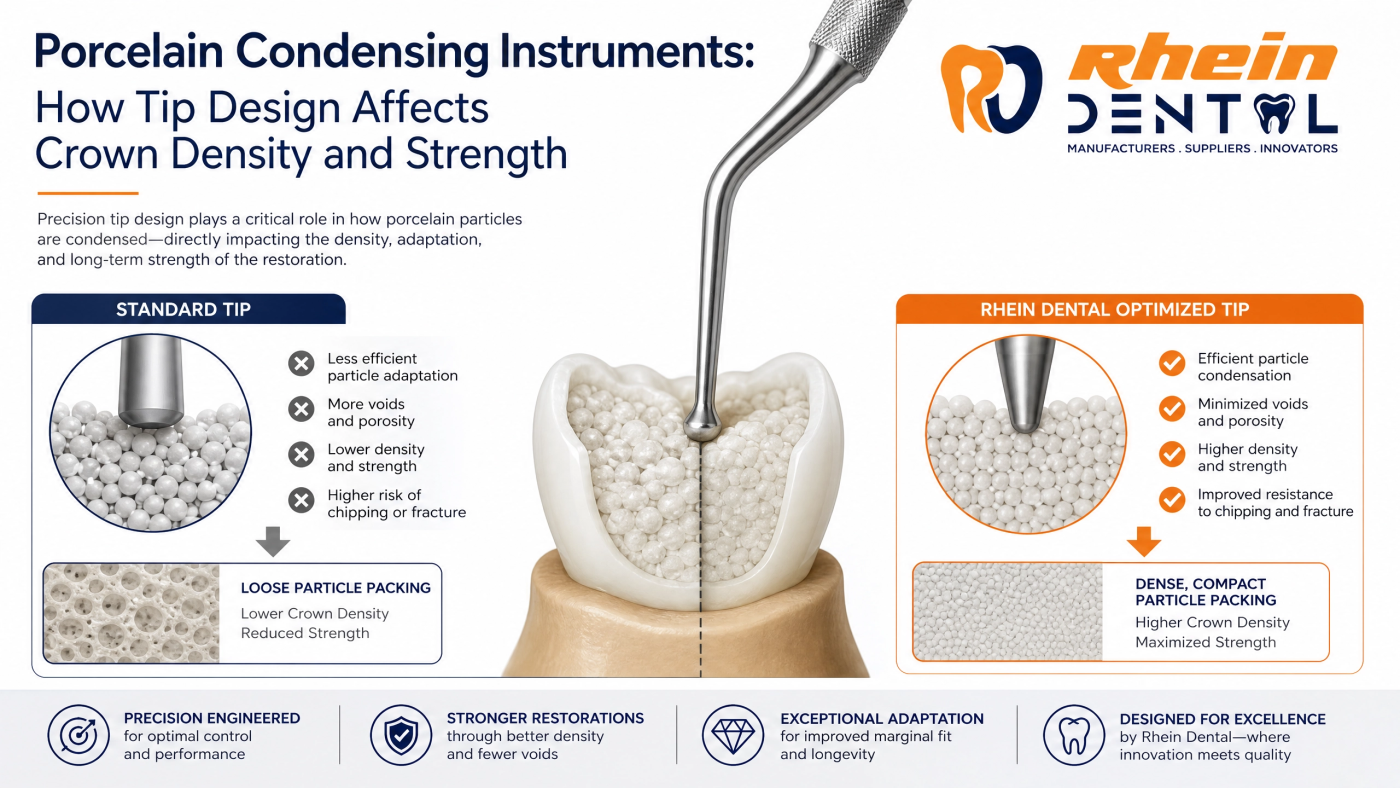
In modern restorative dentistry, achieving durable, aesthetic, and accurately fitting ceramic restorations depends on more than just porcelain quality. The instruments used during porcelain build-up play a critical role in determining the final density, strength, and appearance of a crown. Among these essential tools, porcelain condensing instruments are specifically designed to remove excess moisture, compact ceramic particles, and create a more homogeneous porcelain structure (Porcelain Condensing Instruments).
While many clinicians and dental technicians focus on porcelain materials and firing protocols, the design of the condensing instrument tip can significantly influence restoration outcomes. Understanding how different tip configurations affect porcelain compaction helps practitioners produce stronger crowns with fewer defects and improved aesthetics (Porcelain Condensing Instruments).
This article explores the relationship between porcelain condensing instrument tip design and the resulting density and strength of ceramic crowns.
What Are Porcelain Condensing Instruments?
Porcelain condensing instruments are specialized dental laboratory and restorative tools used during the layering and shaping of ceramic materials (Porcelain Condensing Instruments). Their primary purpose is to:
- Remove excess liquid from porcelain slurry
- Compact ceramic particles
- Reduce internal porosity
- Improve marginal adaptation
- Enhance crown strength and longevity
Proper condensation creates a denser porcelain structure, reducing shrinkage during firing and minimizing the risk of fractures or weak spots.
Why Porcelain Density Matters
Dental porcelain consists of microscopic ceramic particles suspended in liquid. Before firing, these particles must be packed as closely together as possible.
Benefits of higher porcelain density include:
Increased Mechanical Strength
Densely packed porcelain contains fewer voids and microscopic defects, improving resistance to cracking and chipping.
Reduced Shrinkage
Well-condensed porcelain experiences more predictable shrinkage during firing, resulting in better-fitting restorations.
Improved Aesthetics
Uniform particle distribution produces consistent translucency, color stability, and natural-looking results.
Enhanced Longevity
Crowns with fewer internal defects are more likely to withstand years of functional loading without failure.
How Tip Design Influences Condensation Efficiency
The effectiveness of a porcelain condensing instrument depends largely on its tip geometry. Different tip designs distribute pressure differently and interact uniquely with porcelain materials (Porcelain Condensing Instruments).
1. Flat-Tip Condensers
Flat-tip instruments feature broad, smooth working surfaces designed to apply even pressure across larger porcelain areas.
Advantages
- Uniform particle compaction
- Efficient moisture removal
- Excellent for broad crown surfaces
- Reduced risk of creating surface irregularities
Best Applications
- Buccal and lingual crown surfaces
- Veneer layering
- Initial porcelain build-up
Because pressure is evenly distributed, flat tips often help create consistent density throughout larger restorations.
2. Pointed-Tip Condensers
Pointed or tapered tips concentrate force into smaller areas.
Advantages
- Precise condensation in restricted spaces
- Improved access to detailed anatomy
- Effective around margins and cusps
Best Applications
- Occlusal anatomy refinement
- Interproximal areas
- Marginal adaptation
However, excessive pressure with pointed tips may create localized density variations if not used carefully.
3. Serrated-Tip Condensers
Some condensing instruments feature textured or serrated surfaces designed to improve grip and vibration transfer.
Advantages
- Enhanced moisture displacement
- Increased particle movement
- Faster condensation process
Best Applications
- Dense ceramic build-up
- Multi-layer porcelain restorations
- Laboratory crown fabrication
The textured surface helps ceramic particles settle more effectively, often resulting in improved overall density.
4. Ball-Tip Condensers
Ball-shaped tips provide controlled pressure from multiple angles.
Advantages
- Smooth compaction
- Reduced risk of gouging porcelain
- Excellent for contour development
Best Applications
- Final anatomical shaping
- Delicate porcelain layers
- Cosmetic restorations
Ball tips allow technicians to maintain consistent density while preserving detailed morphology.
Moisture Removal and Crown Strength
One of the most important functions of a condensing instrument is moisture control.
Excess water trapped within porcelain can create:
- Internal voids
- Uneven firing shrinkage
- Porosity
- Reduced fracture resistance
Tip designs that efficiently absorb or displace liquid help produce a denser ceramic matrix. This reduction in porosity directly contributes to stronger and more predictable restorations.
The Relationship Between Porosity and Fracture Resistance
Porosity is a major factor affecting ceramic failure.
Microscopic pores can:
- Act as crack initiation points
- Weaken structural integrity
- Increase susceptibility to chipping
- Reduce load-bearing capacity
Well-designed porcelain condensing instruments minimize pore formation by improving particle packing efficiency.
As density increases, fracture resistance generally improves, allowing crowns to better withstand occlusal forces over time.
Selecting the Right Tip Design
No single tip design is ideal for every procedure. Many clinicians and laboratory technicians use multiple condenser styles throughout the porcelain build-up process.
Consider the Following Factors
Restoration Type
- Full ceramic crowns
- Veneers
- Inlays
- Onlays
- Implant-supported restorations
Working Area Size
Large surfaces often benefit from flat tips, while detailed anatomy may require pointed or ball tips.
Porcelain Consistency
Different ceramic systems vary in viscosity and particle size, affecting how they respond to condensation.
Operator Technique
Experience and personal preference often influence instrument selection and condensation success.
Instrument Material Considerations
Tip design is important, but material quality also impacts performance.
High-quality stainless steel porcelain condensers offer:
- Corrosion resistance
- Long-lasting precision
- Easy sterilization
- Consistent performance
Premium instruments maintain their shape and surface finish, ensuring predictable condensation results throughout repeated clinical and laboratory use.
Maintenance Tips for Porcelain Condensing Instruments
Proper care preserves instrument efficiency and prolongs service life.
Best Practices
- Clean immediately after use
- Remove residual ceramic material carefully
- Avoid abrasive cleaning methods
- Inspect working tips regularly
- Sterilize according to manufacturer recommendations
- Replace damaged or worn instruments promptly
Maintaining smooth and undamaged tips helps ensure optimal condensation performance.
Future Trends in Porcelain Condensation Technology
As digital dentistry continues to evolve, traditional layering techniques remain essential for highly aesthetic restorations. Manufacturers are developing:
- Ergonomically optimized handles
- Precision-machined condenser tips
- Enhanced moisture-control surfaces
- Specialized instruments for advanced ceramics
These innovations aim to improve operator comfort while maximizing porcelain density and restoration strength.
Conclusion
Porcelain condensing instruments play a crucial role in the success of ceramic restorations. The design of the working tip directly influences moisture removal, particle compaction, porcelain density, and ultimately crown strength.
Flat tips provide uniform condensation across broad surfaces, pointed tips excel in detailed areas, serrated designs enhance moisture displacement, and ball tips offer controlled shaping with consistent density. By selecting the appropriate tip design and applying proper condensation techniques, dental professionals can produce stronger, more durable, and aesthetically superior crowns.
Investing in high-quality porcelain condensing instruments is not merely a matter of convenience—it is an important step toward achieving predictable restorative outcomes and long-term patient satisfaction.