
Bone removal and reshaping are essential components of many oral and maxillofacial surgical procedures. Whether performing a surgical tooth extraction, preparing a dental implant site, conducting alveoloplasty, or removing pathological bone, selecting the correct bone instrument directly impacts surgical precision, patient safety, healing, and overall treatment outcomes(Bone Instruments in Oral Surgery).
Among the most commonly used oral surgery instruments, the bone chisel, bone file, and bone rongeur each serve a distinct purpose. Although they all interact with bone tissue, they are designed for different stages of surgery and different clinical objectives(Bone Instruments in Oral Surgery).
This guide explains exactly when to use a bone chisel, bone file, or bone rongeur, how each instrument functions, their advantages, limitations, and best practices for safe and controlled bone removal.
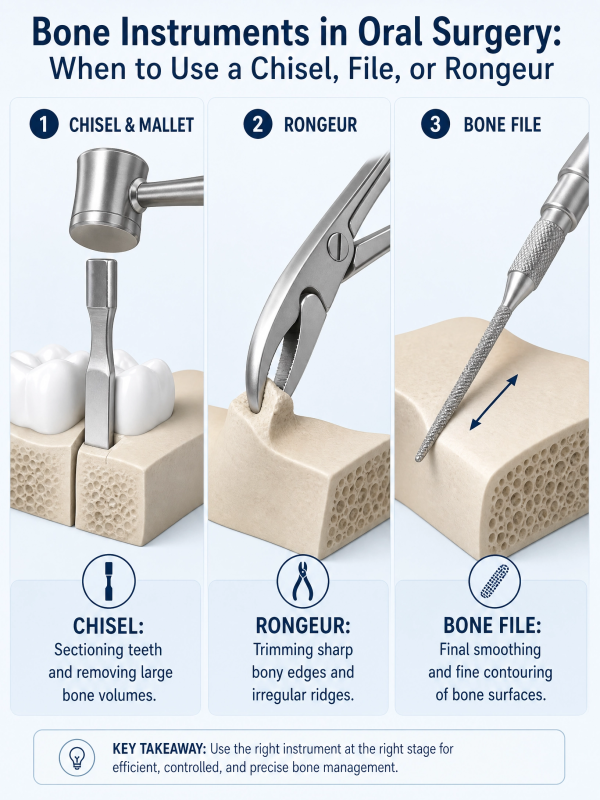
Why Bone Instruments Matter in Oral Surgery
Bone management is a critical aspect of modern dentistry and oral surgery. Excessive bone removal can compromise anatomical structures, while inadequate bone contouring may affect prosthetic fit, implant placement, or wound healing.
Using the appropriate bone surgical instrument helps clinicians:
- Preserve healthy bone
- Improve surgical visibility
- Minimize trauma to surrounding tissues
- Reduce operative time
- Enhance healing outcomes
- Achieve smoother bone contours
- Improve patient comfort during recovery
Each instrument is specifically engineered to perform one phase of bone management effectively.
Understanding Bone Instruments in Oral Surgery
Bone instruments are specialized surgical tools designed to cut, trim, shape, remove, or smooth bone during oral surgical procedures.
Common applications include:
- Surgical tooth extraction
- Impacted wisdom tooth removal
- Alveoloplasty
- Dental implant surgery
- Ridge contouring
- Bone graft preparation
- Removal of bony exostoses
- Tori reduction
- Periodontal osseous surgery
- Oral pathology procedures
Among these instruments, bone chisels, bone files, and bone rongeurs are considered indispensable in nearly every oral surgery setup.
What Is a Bone Chisel?
A bone chisel is a precision cutting instrument used to divide, split, or shape cortical bone using controlled mallet force or hand pressure.
Unlike powered rotary instruments, bone chisels provide tactile feedback, allowing surgeons to make accurate bone cuts while preserving adjacent structures.
Primary Functions of a Bone Chisel
- Cutting cortical bone
- Splitting bone plates
- Removing sections of bone
- Bone contouring
- Osteotomy procedures
- Ridge modification
When to Use a Bone Chisel
Bone chisels are commonly used when:
Surgical Tooth Extractions
Dense bone surrounding impacted teeth may require controlled removal before elevation.
Alveoloplasty
Bone chisels help reshape irregular alveolar ridges before denture fabrication.
Bone Splitting Procedures
Used during ridge expansion techniques for implant placement.
Removal of Exostoses and Tori
Provides controlled bone sectioning before removal.
Osteotomy Procedures
Creates accurate bone cuts while preserving nearby anatomical structures.
Advantages of Bone Chisels
- Excellent cutting precision
- Minimal heat generation
- Strong tactile control
- Reduced reliance on rotary handpieces
- Ideal for dense cortical bone
- Highly durable stainless steel construction
Limitations of Bone Chisels
- Requires advanced surgical skill
- Often requires a surgical mallet
- Less effective for rapid bulk bone removal
- Improper technique may create uncontrolled fractures
What Is a Bone Rongeur?
A bone rongeur is a heavy-duty cutting instrument featuring sharp scoop-shaped jaws that bite and remove small sections of bone.
Rather than cutting through bone like a chisel, a rongeur nibbles away unwanted bone in controlled increments.
Bone rongeurs are among the most frequently used oral surgery instruments because they enable quick removal of irregular bone without powered equipment.
Primary Functions of a Bone Rongeur
- Removing sharp bone edges
- Trimming alveolar bone
- Removing bony projections
- Bone contouring
- Preparing extraction sockets
- Removing loose bone fragments
When to Use a Bone Rongeur
Following Tooth Extractions
After surgical extraction, irregular bone can be removed to create smooth socket margins.
Alveoloplasty
Quickly trims excess alveolar bone before final smoothing.
Implant Site Preparation
Removes minor bony irregularities prior to implant placement.
Bone Grafting Procedures
Shapes recipient sites for improved graft adaptation.
Removal of Bone Spicules
Ideal for eliminating loose or sharp bone fragments after surgery.
Advantages of Bone Rongeurs
- Fast bone removal
- Easy to control
- Excellent visibility
- Reduces surgical time
- Ideal for removing bulk bone
- Minimal operator fatigue
Limitations of Bone Rongeurs
- Not intended for precision cutting
- Less effective on very dense cortical bone
- May require additional smoothing afterward
What Is a Bone File?
A bone file is a finishing instrument designed to smooth rough bone surfaces after cutting or trimming.
Unlike chisels and rongeurs, a bone file removes only small amounts of bone, making it ideal for the final stage of bone contouring.
Primary Functions of a Bone File
- Smoothing sharp bone edges
- Refining bone contours
- Removing small irregularities
- Preparing bone for flap closure
- Improving soft tissue adaptation
When to Use a Bone File
After Rongeur Use
Smooths rough areas left after bulk bone removal.
Following Osteotomy
Refines surgical bone cuts.
Before Suturing
Creates smooth bone surfaces that reduce soft tissue irritation.
Alveoloplasty
Final finishing before wound closure.
Implant Surgery
Refines bone contours surrounding the implant site.
Advantages of Bone Files
- Produces smooth bone surfaces
- Reduces postoperative irritation
- Improves tissue healing
- Excellent tactile feedback
- Simple to control
- Enhances surgical precision
Limitations of Bone Files
- Slow bone removal
- Not suitable for large bone reduction
- Requires repeated strokes for significant contouring
Bone Chisel vs Bone Rongeur vs Bone File
| Feature | Bone Chisel | Bone Rongeur | Bone File |
|---|---|---|---|
| Primary Purpose | Bone cutting | Bone removal | Bone smoothing |
| Precision | Excellent | Moderate | Excellent |
| Speed | Moderate | Fast | Slow |
| Best For | Osteotomy | Bulk bone trimming | Final finishing |
| Requires Mallet | Often | No | No |
| Bone Removal Capacity | Moderate | High | Low |
| Surgical Stage | Initial | Intermediate | Final |
Typical Sequence of Bone Removal During Oral Surgery
Most oral surgical procedures follow a logical progression:
Step 1: Bone Chisel
Creates controlled cuts through dense cortical bone.
Step 2: Bone Rongeur
Removes excess bone and contours the surgical site.
Step 3: Bone File
Smooths remaining irregularities before wound closure.
This sequence minimizes trauma while producing optimal surgical contours.
Best Practices for Safe and Controlled Bone Removal
Successful bone management requires more than selecting the right instrument.
Surgeons should:
- Evaluate bone density before surgery.
- Maintain clear visualization of the surgical field.
- Remove bone conservatively.
- Protect adjacent nerves and teeth.
- Irrigate frequently when using rotary instruments.
- Use sharp, well-maintained instruments.
- Apply controlled force rather than excessive pressure.
- Finish with a bone file to eliminate sharp edges.
Instrument Maintenance and Sterilization
Proper maintenance ensures long-term performance and patient safety.
Recommended practices include:
- Clean immediately after surgery.
- Remove biological debris thoroughly.
- Inspect cutting edges regularly.
- Lubricate hinged instruments when appropriate.
- Sterilize according to validated protocols.
- Replace damaged or dull instruments promptly.
- Store instruments in protective surgical cassettes.
High-quality stainless steel bone instruments provide superior corrosion resistance and maintain cutting efficiency through repeated sterilization cycles.
Choosing the Right Bone Instrument
Selection depends on several clinical factors:
- Bone density
- Surgical objective
- Procedure complexity
- Access limitations
- Desired precision
- Amount of bone removal required
- Surgeon preference
- Patient anatomy
Using the appropriate instrument at the correct stage improves efficiency while minimizing unnecessary trauma.
Final Thoughts
Safe and predictable bone management is fundamental to successful oral surgery. Understanding the unique roles of the bone chisel, bone rongeur, and bone file enables clinicians to perform procedures with greater precision, efficiency, and confidence.
Rather than viewing these instruments as interchangeable, experienced surgeons use them as complementary tools throughout the surgical workflow. The chisel provides controlled bone cutting, the rongeur efficiently removes and contours excess bone, and the bone file delivers the smooth finish necessary for optimal soft tissue healing.
Selecting the right instrument at the right time not only improves surgical accuracy but also minimizes patient trauma, shortens recovery, and contributes to consistently successful clinical outcomes.
Frequently Asked Questions (FAQs)
What is the difference between a bone chisel and a bone rongeur?
A bone chisel cuts through dense cortical bone using controlled force, while a bone rongeur removes bone by nibbling away small sections. Chisels are used for precise cutting, whereas rongeurs are preferred for bulk bone removal and contouring.
When should a bone file be used during oral surgery?
A bone file is used after bone cutting or trimming to smooth rough bone surfaces before suturing. It helps reduce soft tissue irritation and supports better healing.
Which bone instrument is best for alveoloplasty?
Alveoloplasty often involves all three instruments. A chisel may be used for initial bone cutting, a rongeur for trimming excess bone, and a bone file for final smoothing.
Can a bone rongeur replace a bone chisel?
No. A bone rongeur is designed for removing and contouring bone, while a bone chisel is intended for controlled cutting and osteotomy procedures. Each serves a different surgical purpose.
Why is bone smoothing important after surgery?
Smoothing bone eliminates sharp edges that may irritate soft tissues, improves flap adaptation, reduces postoperative discomfort, and promotes better wound healing.