
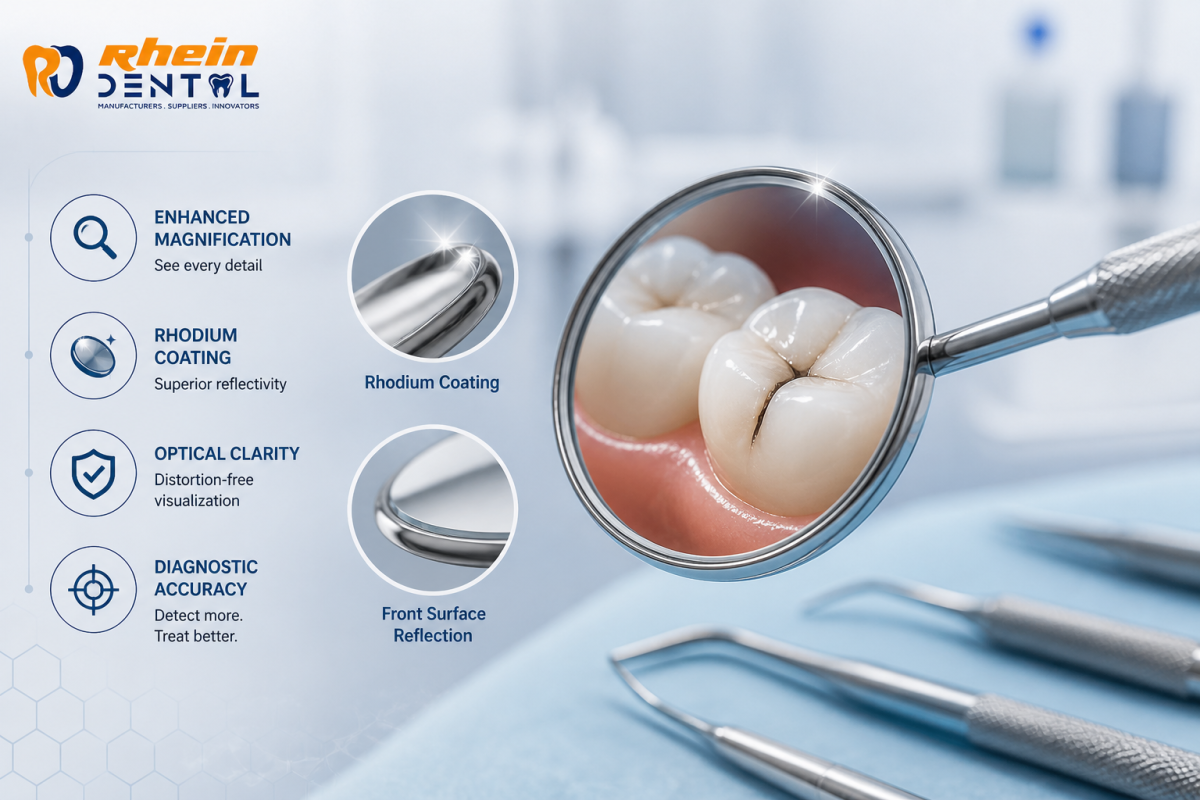
In modern dentistry, precision begins with what the clinician can clearly see. Among all diagnostic tools, the humble dental mirror plays a surprisingly powerful role. Its design—particularly magnification capability and rhodium coating—directly affects optical clarity, and therefore, diagnostic accuracy. When visibility improves, decision-making becomes more reliable, treatment outcomes improve, and patient care reaches a higher standard (Dental Mirror Magnification and rhodium coating).
The Role of the Dental Mirror in Clinical Practice
A dental mirror is more than just a reflective surface. It serves multiple essential purposes:
- Indirect vision in hard-to-reach areas
- Retraction of soft tissues
- Illumination by reflecting light
- Magnification of oral structures
Because many areas of the oral cavity are not directly visible, dentists rely heavily on mirrors to assess tooth surfaces, margins of restorations, and early signs of pathology. Even a slight distortion or lack of clarity can lead to missed details(Dental Mirror Magnification and rhodium coating).
Understanding Magnification in Dental Mirrors
Magnification enhances the clinician’s ability to detect subtle abnormalities such as microfractures, early caries, or marginal discrepancies. Dental mirrors are typically available in two types:
- Plane (front surface) mirrors – Provide a true image without magnification
- Concave mirrors – Offer magnification but may introduce image distortion if not precisely engineered
High-quality mirrors use front-surface reflection technology, where the reflective coating is applied on top of the glass rather than behind it. This eliminates the “double image” effect and ensures sharper visualization.
Magnification is especially beneficial in:
- Detecting incipient caries
- Evaluating crown margins
- Identifying calculus deposits
- Assessing endodontic access
However, excessive or poorly calibrated magnification can mislead perception, so balance and optical precision are key.
What is Rhodium Coating?
Rhodium is a rare, highly reflective metal belonging to the platinum family. When applied as a coating on dental mirrors, it significantly enhances their optical performance.
Key properties of rhodium coating include:
- High reflectivity – Produces bright, crisp images
- Corrosion resistance – Maintains clarity over time
- Scratch resistance – Improves durability
- Anti-tarnish properties – Prevents image degradation
Unlike traditional chrome or aluminum coatings, rhodium offers superior reflectance and longevity, making it the preferred choice for high-end dental instruments.
How Rhodium Coating Improves Optical Clarity
Optical clarity is essential for accurate diagnosis. Rhodium-coated mirrors minimize common visual disturbances such as:
- Light scattering
- Image distortion
- Surface dullness
- Reflection loss over time
Because rhodium reflects a higher percentage of light, it enhances illumination inside the oral cavity. This is particularly important when working in posterior regions where light access is limited.
Additionally, rhodium-coated mirrors are less prone to micro-scratches, which can otherwise blur the image and reduce diagnostic precision.
The Link Between Optical Clarity and Diagnostic Accuracy
Clear visualization directly impacts clinical outcomes. When a dentist can see more clearly, they can:
- Detect diseases at an earlier stage
- Make more accurate treatment plans
- Reduce the risk of procedural errors
- Improve patient communication through better visual explanation
For example, identifying early enamel demineralization requires excellent contrast and lighting. A low-quality mirror may fail to reveal such subtle changes, delaying intervention.
Similarly, evaluating the integrity of restorations demands sharp, undistorted reflection. Any compromise in mirror quality can lead to misjudgment.
Practical Considerations When Choosing a Dental Mirror
To maximize diagnostic efficiency, clinicians should consider the following factors:
- Type of mirror surface (front surface vs. back surface)
- Quality of coating (rhodium vs. standard coatings)
- Resistance to fogging
- Ease of sterilization
- Durability and scratch resistance
Investing in high-quality mirrors may seem minor, but it has a significant impact on everyday clinical performance.
The Future of Optical Enhancements in Dentistry
As dental technology evolves, optical tools continue to improve. Innovations such as anti-fog coatings, enhanced magnification systems, and integration with digital imaging are shaping the future of diagnostics.
However, even with advanced tools like intraoral cameras and microscopes, the dental mirror remains indispensable. Its simplicity, versatility, and immediate feedback make it a cornerstone of clinical examination.
Conclusion
Dental mirror magnification and rhodium coating are not just technical features—they are critical components that influence how accurately a clinician can diagnose and treat patients. Superior optical clarity leads to better visibility, which in turn enhances diagnostic confidence and clinical outcomes.
In a field where millimeters matter, the clarity of reflection can make all the difference. Investing in high-quality, rhodium-coated dental mirrors is a small step that delivers significant benefits in precision dentistry.