
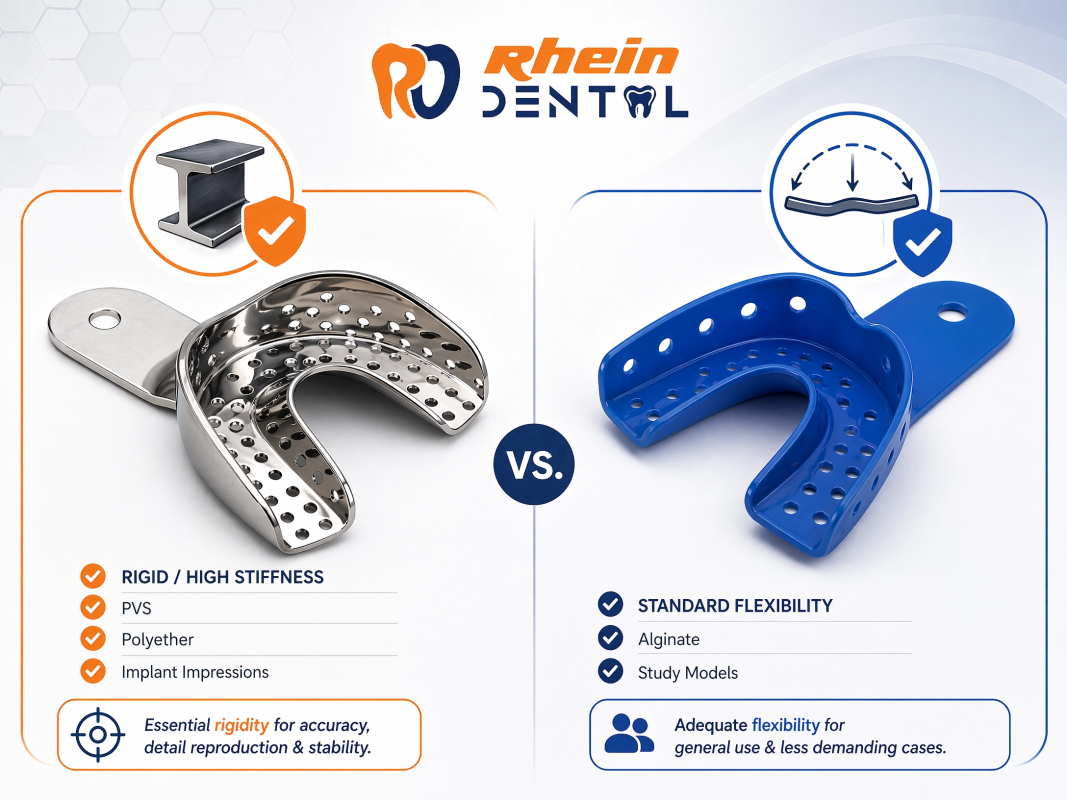
Accurate dental impressions are the foundation of successful restorations, crowns, bridges, dentures, and implant-supported prosthetics. While clinicians often focus on impression materials, the impression tray itself plays an equally important role in ensuring dimensional accuracy. One of the most critical factors in tray selection is rigidity (Metal vs. Plastic Impression Trays).
The choice between metal and plastic impression trays can significantly affect impression quality, especially when using different impression materials. Understanding how tray rigidity influences material performance helps clinicians achieve more predictable results and reduce costly remakes (Metal vs. Plastic Impression Trays).
Why Tray Rigidity Matters
An impression tray serves as the support structure that holds the impression material during placement, setting, and removal from the patient’s mouth. If the tray flexes during any stage of the procedure, distortion can occur (Metal vs. Plastic Impression Trays).
Even minor tray deformation may lead to:
- Inaccurate margins
- Poor crown fit
- Occlusal discrepancies
- Distorted implant impressions
- Increased chairside adjustments
- Laboratory remakes
The rigidity requirements of a tray become even more important when working with highly accurate elastomeric impression materials.
Understanding Impression Tray Materials
Metal Impression Trays
Metal trays are typically manufactured from stainless steel or aluminum and are designed for repeated sterilization and long-term use.
Advantages
- Superior rigidity
- Minimal flexing under load
- Excellent dimensional stability
- Reusable and cost-effective over time
- Ideal for precision impressions
Limitations
- Higher initial cost
- Require cleaning and sterilization
- Slightly heavier than plastic alternatives
Plastic Impression Trays
Plastic trays are commonly used as disposable options and are available in perforated and non-perforated designs.
Advantages
- Lightweight
- Economical for single-use applications
- Convenient and readily available
- No sterilization required
Limitations
- Greater risk of flexure
- Reduced dimensional stability
- Potential distortion during removal
- Less suitable for highly precise restorative work
How Different Impression Materials Affect Tray Selection
Not all impression materials exert the same forces on trays. Some materials require significantly more support than others.
Alginate Impressions
Alginate remains one of the most commonly used materials for:
- Preliminary impressions
- Study models
- Orthodontic records
- Opposing arch impressions
Because alginate has relatively low stiffness after setting, tray flexure is generally less critical compared to elastomeric materials.
Recommended Tray Options
Both metal and high-quality plastic trays can provide acceptable results for alginate impressions.
However, metal trays may still offer advantages when:
- Taking full-arch impressions
- Working with patients who have strong musculature
- Managing complex anatomical variations
Polyvinyl Siloxane (PVS) Impressions
PVS materials are known for exceptional accuracy and dimensional stability. They are widely used for:
- Crown and bridge impressions
- Implant restorations
- Fixed prosthodontics
- Precision laboratory work
Because PVS materials are highly accurate, any tray distortion can compromise the final result.
Recommended Tray Options
Metal trays are strongly preferred for PVS impressions because they:
- Resist flexing during insertion and removal
- Maintain impression accuracy
- Support detailed reproduction of preparation margins
Plastic trays may deform under removal forces, introducing errors that become evident during restoration fabrication.
Polyether Impressions
Polyether materials are among the stiffest dental impression materials available.
Their rigidity creates greater stress during impression removal, placing substantial demands on the tray.
Recommended Tray Options
Metal trays are considered the gold standard for polyether impressions because they provide:
- Maximum resistance to deformation
- Superior support during removal
- Consistent dimensional accuracy
Using flexible plastic trays with polyether materials increases the risk of distortion and inaccurate casts.
Impression Materials for Implant Cases
Implant restorations demand extremely precise transfer of implant positions.
Even microscopic inaccuracies can lead to:
- Framework misfit
- Screw loosening
- Prosthetic complications
- Increased laboratory adjustments
Recommended Tray Options
Rigid metal trays are generally preferred for implant impressions, particularly in:
- Multiple implant cases
- Full-arch restorations
- Immediate loading protocols
The stability provided by metal trays helps preserve the exact spatial relationship between implants.
Factors Influencing Tray Rigidity Requirements
Arch Size
Larger arches place greater stress on impression trays. Full-arch impressions are more susceptible to tray flexure than quadrant impressions.
Impression Material Stiffness
The stiffer the material after setting, the greater the forces applied to the tray during removal.
Patient Anatomy
Patients with:
- Deep undercuts
- Prominent tori
- Crowded dentition
- Extensive restorations
often generate higher removal forces, increasing the need for rigid trays.
Procedure Type
Diagnostic impressions may tolerate slight inaccuracies, whereas implant and crown impressions require maximum precision.
When Plastic Trays May Be Appropriate
Plastic trays remain useful in many clinical situations, including:
- Preliminary impressions
- Orthodontic records
- Opposing arch impressions
- Diagnostic casts
- Temporary prosthetic planning
High-quality reinforced plastic trays can perform adequately when used with less demanding materials and procedures.
When Metal Trays Are the Better Choice
Metal trays are generally recommended for:
- Crown and bridge work
- Implant impressions
- Polyether impressions
- High-precision PVS impressions
- Full-arch restorative cases
- Laboratory-sensitive procedures
The improved rigidity reduces distortion risk and contributes to more accurate restorations.
Cost vs. Accuracy Considerations
While disposable plastic trays may appear more economical initially, inaccuracies leading to remakes, additional appointments, and laboratory costs can quickly outweigh their savings.
For precision restorative dentistry, investing in rigid metal trays often provides greater long-term value by improving clinical outcomes and reducing errors.
Best Practices for Maximizing Impression Accuracy
Regardless of tray material, clinicians should:
- Select the correct tray size
- Ensure adequate material thickness
- Use tray adhesive when indicated
- Avoid overloading the tray
- Verify tray stability before insertion
- Inspect impressions for distortion before sending to the laboratory
Following these practices helps maximize the performance of both impression materials and trays.
Conclusion
The debate between metal and plastic impression trays ultimately comes down to rigidity requirements and clinical objectives. While plastic trays can be suitable for preliminary and diagnostic impressions, metal trays provide the stability needed for high-accuracy restorative and implant procedures.
When using precision materials such as PVS and polyether, tray rigidity becomes a critical factor in maintaining dimensional accuracy. By matching tray selection to the impression material and clinical situation, dental professionals can improve restoration fit, reduce remakes, and achieve more predictable patient outcomes.