
Introduction
Composite resin restorations have become the preferred choice for treating both anterior and posterior dental defects due to their excellent aesthetics, durability, and conservative preparation requirements. However, successful composite restorations depend not only on material selection but also on the instruments used during placement.
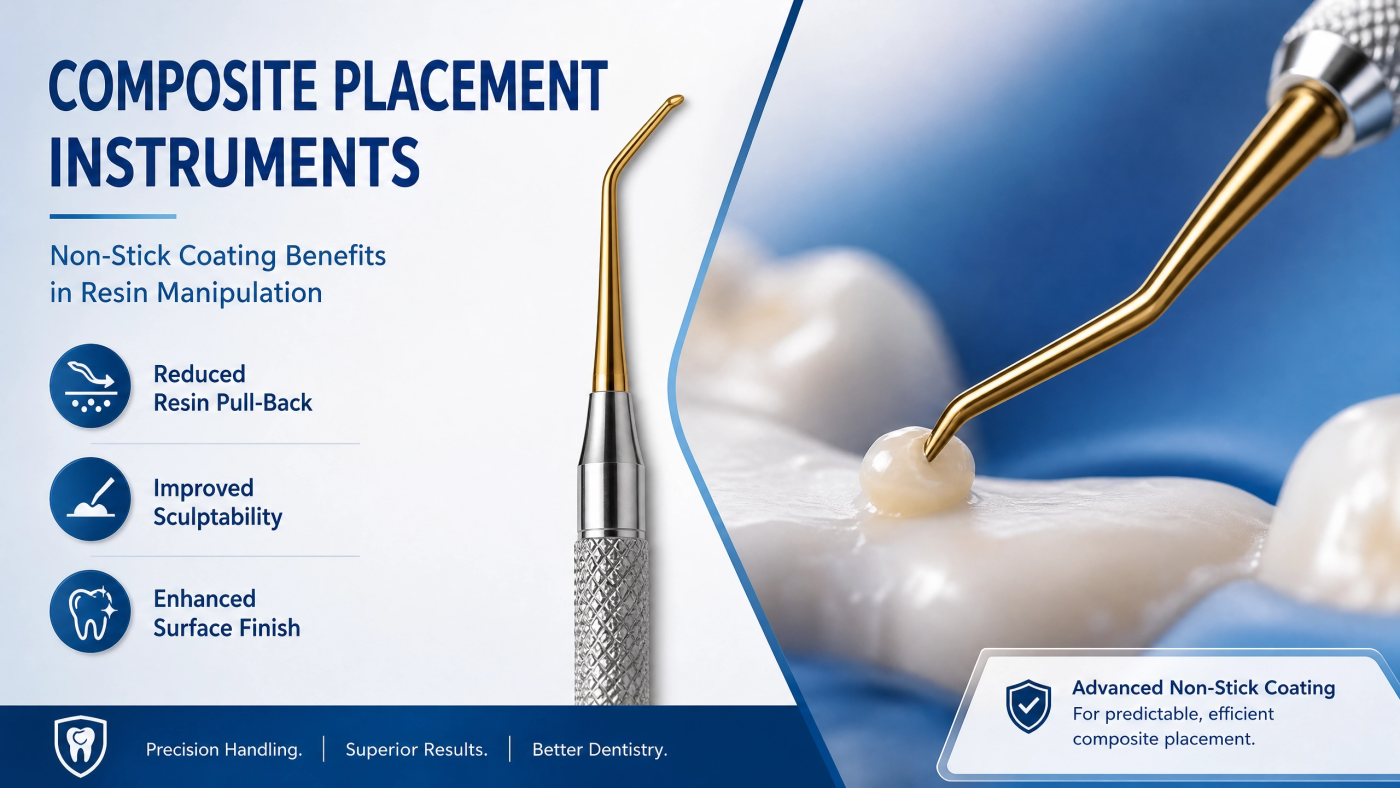
Traditional stainless steel instruments often cause composite resin to stick to their surfaces, making adaptation difficult and potentially compromising restoration quality. To address this challenge, manufacturers have developed composite placement instruments with specialized non-stick coatings. These coatings significantly improve resin handling, allowing dental professionals to achieve smoother, more precise restorations while reducing procedure time.
This article explores the importance of composite placement instruments, the science behind non-stick coatings, and the benefits they provide during resin manipulation.
What Are Composite Placement Instruments?
Composite placement instruments are specialized dental tools designed to carry, place, contour, sculpt, and adapt composite resin materials during restorative procedures. They are available in various shapes and tip designs to accommodate different restoration types and clinical situations.
Common applications include:
- Class I, II, III, IV, and V restorations
- Direct composite veneers
- Diastema closures
- Composite bonding procedures
- Cosmetic contouring and reshaping
- Core build-ups
These instruments enable clinicians to precisely manipulate resin materials while maintaining proper anatomy and marginal integrity.
The Challenge of Composite Resin Stickiness
Composite resins contain a matrix of organic polymers combined with inorganic filler particles. During placement, these materials exhibit a natural tendency to adhere to metal surfaces.
This stickiness can create several clinical challenges:
- Difficulty transferring material accurately
- Pulling or dragging of composite during contouring
- Formation of voids and air bubbles
- Loss of anatomical detail
- Increased finishing and polishing time
- Operator frustration during complex restorations
Traditional solutions included lubricating instruments with bonding agents or resin wetting agents. While effective to some extent, these methods may alter material properties or introduce unnecessary complexity.
Understanding Non-Stick Coating Technology
Non-stick composite instruments utilize specialized surface treatments or coatings designed to reduce resin adhesion.
Common coating materials include:
Titanium Nitride (TiN)
Titanium nitride coatings create an ultra-smooth, hard surface that minimizes composite sticking while enhancing instrument durability.
Benefits include:
- Increased hardness
- Improved wear resistance
- Reduced surface friction
- Enhanced corrosion resistance
Titanium Carbon Nitride (TiCN)
This advanced coating offers even greater hardness and smoother surface characteristics.
Advantages include:
- Superior scratch resistance
- Excellent non-stick performance
- Extended instrument lifespan
Diamond-Like Carbon (DLC) Coatings
DLC coatings provide an exceptionally smooth surface with very low friction coefficients.
Key features:
- Exceptional non-stick properties
- High durability
- Resistance to staining and corrosion
Polytetrafluoroethylene (PTFE) Coatings
Often referred to as Teflon-type coatings, PTFE surfaces significantly reduce resin adhesion.
Benefits include:
- Extremely low friction
- Smooth resin handling
- Comfortable manipulation
Major Benefits of Non-Stick Composite Placement Instruments
Improved Resin Handling
The primary advantage of non-stick coatings is smoother resin manipulation.
Clinicians can:
- Transfer composite more accurately
- Adapt material without dragging
- Sculpt anatomy with greater precision
- Maintain intended contours during placement
This improved control contributes directly to better restorative outcomes.
Enhanced Anatomical Sculpting
Creating natural tooth anatomy requires precise shaping of composite layers.
Non-stick instruments allow clinicians to:
- Develop realistic cusps and fissures
- Reproduce natural marginal ridges
- Maintain detailed surface morphology
- Achieve superior aesthetic results
The resin remains where it is placed rather than adhering to the instrument.
Reduced Risk of Voids and Defects
When composite sticks to an instrument, material may unintentionally lift away from the cavity preparation, creating gaps or voids.
Non-stick coatings help ensure:
- Uniform material adaptation
- Improved cavity wall contact
- Reduced air entrapment
- Better marginal integrity
These factors contribute to restoration longevity and clinical success.
Faster Clinical Procedures
Efficient resin handling reduces the need for repeated repositioning and correction.
This results in:
- Shorter treatment times
- Improved workflow efficiency
- Greater patient comfort
- Increased productivity for dental practices
Even small time savings per restoration can significantly impact daily clinical operations.
Reduced Need for Instrument Lubrication
Many clinicians traditionally use bonding agents to prevent sticking.
Non-stick instruments reduce dependence on:
- Adhesive lubricants
- Resin wetting agents
- Additional procedural steps
This simplifies restorative protocols while maintaining material integrity.
Better Surface Finish
Proper resin adaptation during placement often leads to smoother restoration surfaces before finishing.
Benefits include:
- Less finishing time
- Easier polishing
- Improved aesthetics
- Enhanced patient satisfaction
A well-contoured restoration requires fewer adjustments after curing.
Advantages for Layering Techniques
Modern composite restorations frequently utilize incremental layering techniques to improve aesthetics and reduce polymerization shrinkage.
Non-stick instruments facilitate:
- Thin layer placement
- Controlled material adaptation
- Accurate shade transitions
- Natural translucency effects
For cosmetic restorations, this level of control is particularly valuable.
Durability and Instrument Longevity
High-quality non-stick coatings not only improve resin handling but also enhance instrument durability.
These coatings provide:
- Wear resistance
- Scratch resistance
- Corrosion protection
- Long-term performance
As a result, practices often experience reduced instrument replacement costs over time.
Ideal Clinical Applications
Non-stick composite placement instruments are especially beneficial for:
Anterior Restorations
Where aesthetics and surface detail are critical.
Posterior Composite Fillings
Where efficient adaptation and contouring improve occlusal accuracy.
Direct Veneers
Where precise layering and sculpting determine final appearance.
Cosmetic Bonding Procedures
Where smooth manipulation contributes to natural-looking results.
Pediatric Restorations
Where reduced chair time benefits patient cooperation.
Selecting the Right Non-Stick Composite Instrument
When choosing composite placement instruments, dental professionals should consider:
Coating Quality
Premium coatings generally provide superior durability and performance.
Tip Configuration
Different restoration types require varying tip shapes and sizes.
Ergonomic Design
Comfortable handles improve control and reduce operator fatigue.
Sterilization Compatibility
Ensure coatings withstand repeated autoclave cycles without degradation.
Manufacturer Reputation
Reliable manufacturers provide consistent coating quality and long-term performance.
Maintenance Tips
To maximize instrument lifespan:
- Clean immediately after use
- Avoid abrasive cleaning materials
- Follow manufacturer sterilization guidelines
- Inspect coatings regularly for wear
- Store instruments properly to prevent damage
Proper maintenance preserves both coating effectiveness and instrument performance.
Future Trends in Composite Placement Instruments
As restorative dentistry continues to evolve, manufacturers are developing increasingly advanced coating technologies.
Emerging innovations include:
- Nanotechnology-based surface treatments
- Ultra-low friction coatings
- Enhanced wear-resistant materials
- Improved ergonomic designs
- Smart instrument surface engineering
These advancements will continue improving resin manipulation precision and restorative outcomes.
Conclusion
Non-stick composite placement instruments have transformed modern restorative dentistry by simplifying resin manipulation and improving clinical efficiency. Their specialized coatings minimize material adhesion, allowing dentists to place, contour, and sculpt composite resins with exceptional precision.
Benefits such as improved handling, enhanced anatomical accuracy, reduced procedure times, fewer defects, and superior aesthetic results make these instruments an essential component of contemporary dental practice. As composite materials and restorative techniques continue to advance, high-quality non-stick placement instruments will remain vital tools for achieving predictable, long-lasting restorations.
For dental professionals seeking greater control, efficiency, and restorative excellence, investing in premium non-stick composite placement instruments is a practical step toward delivering superior patient outcomes.