
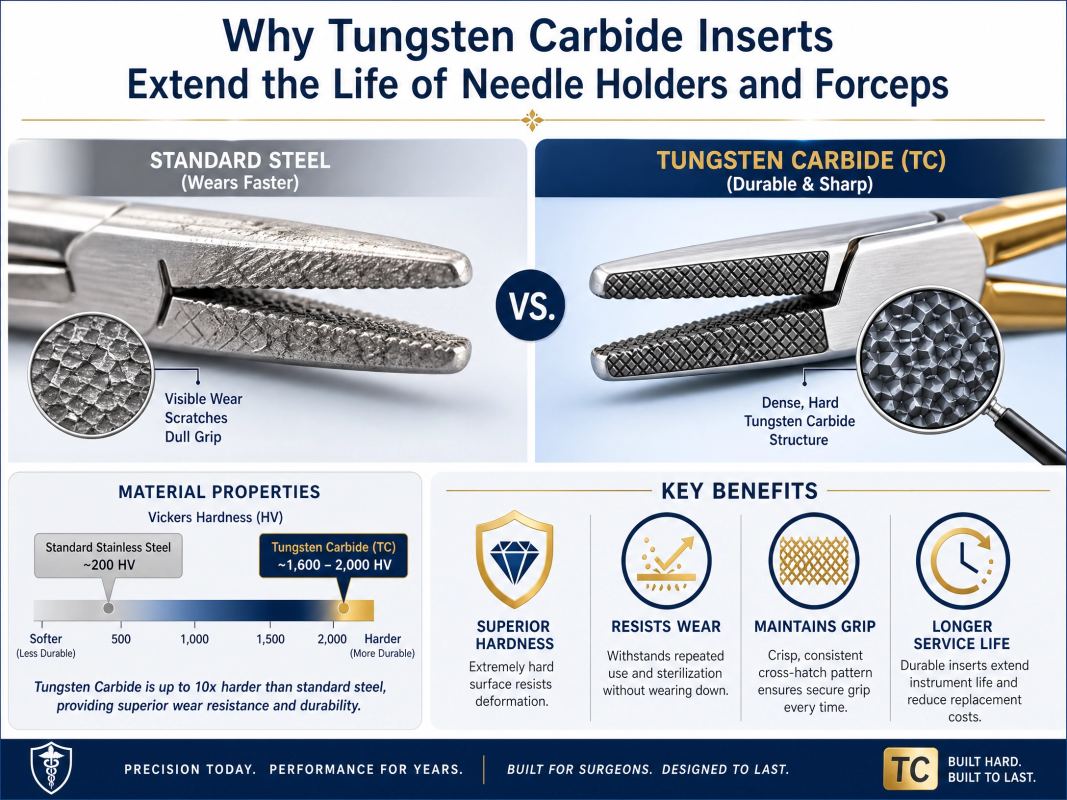
Surgical and dental instruments are a significant investment for any healthcare practice. Among these instruments, needle holders and forceps are used repeatedly during procedures that demand precision, reliability, and durability. Because these instruments experience constant gripping, pressure, and sterilization cycles, wear and tear can quickly affect their performance.

To address this challenge, many premium surgical instruments incorporate Tungsten Carbide (TC) inserts into their working jaws. These inserts provide superior strength, enhanced grip, and exceptional wear resistance compared to standard stainless steel jaws. As a result, instruments with TC inserts often deliver longer service life and more consistent performance.
This guide explains why Tungsten Carbide inserts are widely regarded as one of the most valuable upgrades for needle holders and forceps.
What Are Tungsten Carbide Inserts?
Tungsten Carbide inserts are small sections of an extremely hard metal compound that are permanently bonded to the working surfaces of surgical instruments. These inserts are commonly found in:
- Needle holders
- Tissue forceps
- Surgical clamps
- Orthodontic pliers
- Specialized surgical instruments
Manufacturers place these inserts on the jaw surfaces where the greatest amount of contact, friction, and pressure occurs.
Because Tungsten Carbide is significantly harder than stainless steel, it provides enhanced durability and gripping performance throughout the instrument’s lifespan.
Understanding Instrument Wear
Every time a needle holder grasps a surgical needle or forceps grip tissue, friction occurs between the working surfaces and the object being held.
Over time, this repeated contact can cause:
- Jaw wear
- Reduced gripping strength
- Surface smoothing
- Needle slippage
- Loss of precision
- Premature instrument replacement
Although stainless steel is durable, constant use eventually causes the gripping surfaces to wear down. Consequently, instrument performance gradually declines.
TC inserts help prevent this deterioration by providing a much harder and more wear-resistant gripping surface.
Why Tungsten Carbide Is So Durable
One of the primary reasons Tungsten Carbide extends instrument life is its exceptional hardness.
Superior Hardness
Tungsten Carbide is substantially harder than medical-grade stainless steel. This increased hardness allows it to withstand repeated pressure without deforming or wearing away quickly.
As a result, the instrument maintains its gripping effectiveness for significantly longer periods.
Outstanding Wear Resistance
Unlike standard steel jaws, TC inserts resist abrasion caused by repeated contact with surgical needles and instruments.
Therefore, clinicians experience:
- Less jaw deterioration
- More consistent gripping performance
- Reduced maintenance requirements
This resistance to wear is especially valuable in busy practices where instruments are used multiple times every day.
Enhanced Grip Means Less Damage
A strong grip is essential for both precision and instrument longevity.
Reduced Needle Slippage
Needle holders with TC inserts provide superior traction on surgical needles. The textured insert surface helps maintain a secure hold during suturing procedures.
Because the needle remains firmly positioned, clinicians are less likely to repeatedly reposition or squeeze the instrument excessively.
Lower Jaw Stress
When standard steel jaws begin to wear, users often compensate by applying additional pressure to maintain a secure grip.
However, excessive force can accelerate jaw wear and increase stress on locking mechanisms.
TC inserts minimize this issue by maintaining reliable gripping performance with less applied pressure.
Longer Service Life for Needle Holders
Needle holders are among the most frequently used instruments in surgical and dental settings. Their jaws endure constant contact with hard surgical needles.
Benefits of TC Needle Holders
- Improved needle retention
- Greater resistance to jaw wear
- Consistent performance over time
- Reduced need for replacement
- Better procedural efficiency
Because the gripping surfaces remain effective for longer periods, practices can maximize the value of their instrument investment.
How TC Inserts Improve Forceps Durability
Forceps are commonly used to manipulate tissue, hold materials, and assist during various surgical procedures.
Repeated gripping can gradually wear down standard forceps tips, reducing precision and effectiveness.
Advantages for Forceps
TC inserts help forceps maintain:
- Secure tissue handling
- Accurate tip alignment
- Enhanced gripping capability
- Long-term reliability
As a result, clinicians experience more predictable performance throughout the instrument’s lifespan.
Cost Savings Through Extended Instrument Life
TC instruments generally have a higher initial purchase price than standard stainless steel alternatives.
However, the long-term financial benefits often outweigh the higher upfront cost.
Reduced Replacement Frequency
Since TC inserts resist wear more effectively, instruments typically remain functional for longer periods.
This means practices can:
- Purchase replacements less frequently
- Reduce instrument inventory costs
- Lower maintenance expenses
Better Return on Investment
For clinics that perform frequent surgical or dental procedures, the extended lifespan of TC instruments often results in substantial cost savings over time.
Therefore, many healthcare professionals view TC inserts as a smart long-term investment rather than an added expense.
Improved Performance Throughout the Instrument’s Life
One significant advantage of Tungsten Carbide inserts is their ability to maintain consistent performance over extended periods.
Standard steel jaws often lose effectiveness gradually, sometimes without immediate notice.
In contrast, TC inserts continue to provide:
- Reliable gripping power
- Precise needle control
- Consistent tactile feedback
- Enhanced procedural confidence
Consequently, clinicians can perform delicate tasks with greater accuracy and efficiency.
Ideal Applications for TC Instruments
Although TC inserts offer advantages in virtually every clinical environment, they are particularly beneficial for:
Dental Practices
- Oral surgery
- Implant procedures
- Periodontal surgery
- Routine suturing
Surgical Centers
- General surgery
- Plastic surgery
- Orthopedic procedures
- Microsurgery
Veterinary Clinics
- Soft tissue surgery
- Orthopedic procedures
- Routine wound closure
In high-use environments, the durability benefits become even more noticeable.
Maintenance Tips for TC Instruments
Proper maintenance helps maximize the lifespan of Tungsten Carbide instruments.
Recommended Practices
- Clean instruments immediately after use
- Remove debris before sterilization
- Lubricate hinges and box locks regularly
- Inspect inserts for damage
- Avoid dropping instruments
- Store instruments properly between uses
Although TC inserts are highly durable, careful handling ensures optimal performance for many years.
Common Misconceptions About TC Inserts
“TC Inserts Make Instruments Indestructible”
While Tungsten Carbide is extremely durable, proper maintenance remains essential. Excessive force, improper handling, or accidental damage can still affect instrument performance.
“TC Instruments Are Too Expensive”
Although the initial investment is higher, many clinicians find that reduced replacement costs and longer service life make TC instruments more economical in the long run.
“Only Surgeons Need TC Instruments”
Dental professionals, veterinarians, and other healthcare providers who perform suturing or precision gripping procedures can also benefit significantly from TC technology.
Final Thoughts
Tungsten Carbide inserts have become the preferred choice for premium needle holders and forceps because they offer exceptional durability, superior grip, and outstanding wear resistance. By protecting the working surfaces from premature deterioration, TC inserts help instruments maintain their performance through countless procedures and sterilization cycles.
For healthcare professionals seeking reliable, long-lasting instruments, investing in Tungsten Carbide technology can improve clinical efficiency, reduce replacement costs, and provide consistent precision for years to come. Whether used in dentistry, surgery, or veterinary medicine, TC-insert instruments continue to deliver value far beyond their initial purchase price.