
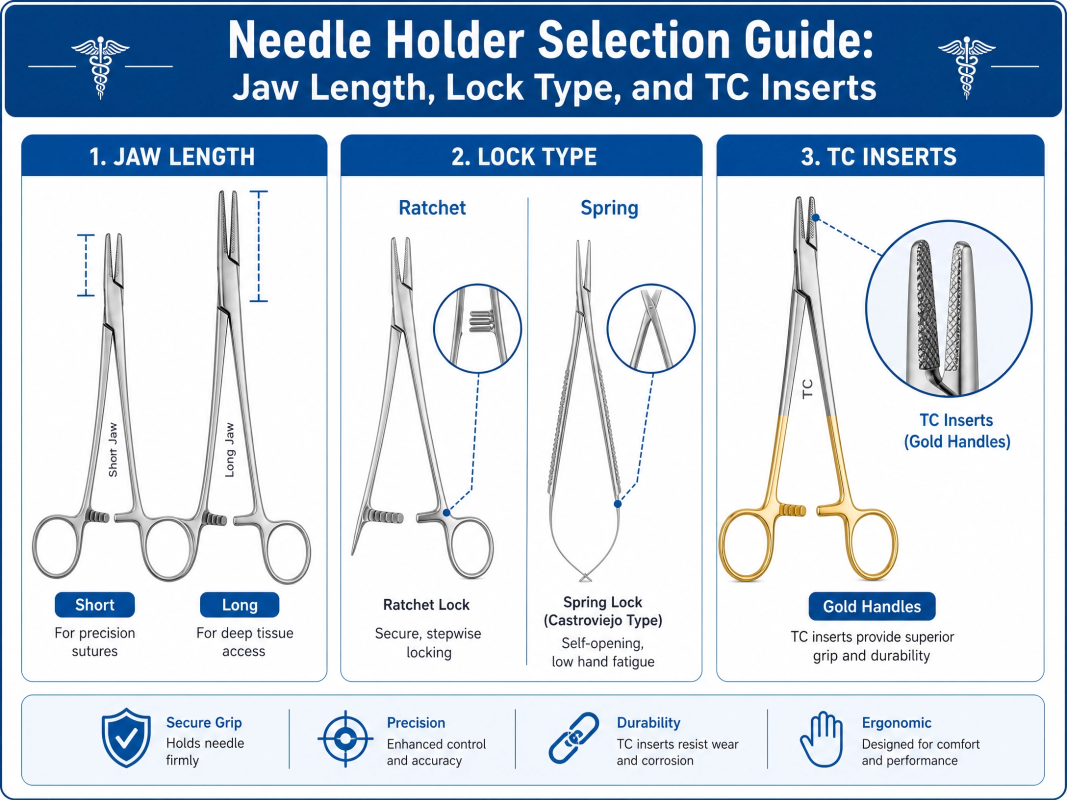
Suturing is a fundamental skill in dental, surgical, and veterinary procedures. While suture material often receives considerable attention, the needle holder used during the procedure plays an equally important role. The right needle holder improves precision, reduces hand fatigue, and helps maintain needle integrity throughout the procedure (Needle holders Selection Guide).
However, selecting the ideal instrument can be challenging because needle holders are available in various jaw lengths, locking mechanisms, and insert materials. Understanding these features allows clinicians to choose an instrument that matches their suturing technique and clinical requirements.
Why Needle Holder Selection Matters
A needle holder is designed to securely grasp and control surgical needles during suturing. Choosing an unsuitable instrument can lead to several problems, including:
- Reduced needle control
- Increased hand fatigue
- Needle slippage
- Damage to suture needles
- Longer procedure times
- Decreased suturing precision
Therefore, selecting the correct needle holder contributes to better clinical outcomes, improved efficiency, and greater operator comfort.
Understanding Needle Holder Jaw Length
Jaw length significantly affects how the instrument handles different needle sizes and surgical environments.
Short Jaw Needle Holders
Short jaws provide excellent control and precision. They are particularly useful when working in confined surgical fields where delicate movements are required.
Advantages:
- Greater needle stability
- Improved tactile feedback
- Enhanced precision for fine suturing
- Better control in restricted spaces
Common Applications:
- Periodontal surgery
- Microsurgical procedures
- Oral surgery
- Delicate tissue approximation
Long Jaw Needle Holders
Longer jaws offer increased reach and are suitable for deeper surgical sites.
Advantages:
- Extended access to difficult areas
- Better visibility in deeper wounds
- Improved reach during complex procedures
Common Applications:
- General surgery
- Veterinary procedures
- Deep tissue suturing
- Large wound closure
How to Choose the Right Jaw Length
When selecting jaw length, consider:
- Surgical site accessibility
- Needle size
- Tissue depth
- Required precision level
For delicate dental and periodontal procedures, shorter jaws generally provide superior control. Conversely, deeper surgical fields often benefit from longer jaws.
Comparing Lock Types
The locking mechanism determines how securely the needle is held and how easily the instrument can be manipulated during suturing.
Standard Ratchet Lock
The ratchet lock is the most common locking system found on needle holders.
Benefits:
- Secure needle retention
- Familiar operation
- Reliable performance
- Cost-effective design
Potential Drawbacks:
- Requires finger pressure to release
- May contribute to hand fatigue during lengthy procedures
Smooth Release Lock Systems
Some modern needle holders feature modified locking mechanisms designed for easier release.
Benefits:
- Faster instrument handling
- Reduced hand strain
- Improved workflow efficiency
Best For:
- High-volume surgical environments
- Repetitive suturing procedures
- Extended surgical sessions
Non-Locking Needle Holders
Certain specialized procedures may use non-locking designs.
Benefits:
- Faster needle repositioning
- Enhanced tactile sensation
- Greater maneuverability
Common Uses:
- Microsurgery
- Delicate tissue work
- Precision suturing applications
What Are Tungsten Carbide (TC) Inserts?
Tungsten Carbide inserts are hardened gripping surfaces integrated into the jaws of premium needle holders. These inserts provide superior durability and gripping performance compared to standard stainless steel jaws.
Many clinicians prefer TC needle holders because they maintain their effectiveness over extended periods of use.
Advantages of TC Inserts
Enhanced Needle Grip
Tungsten Carbide provides exceptional traction, helping prevent needle slippage during suturing.
Increased Durability
TC inserts are significantly harder than stainless steel, allowing them to resist wear and maintain performance longer.
Improved Precision
A secure grip enables more accurate needle placement and consistent suture spacing.
Cost Efficiency Over Time
Although TC needle holders typically cost more initially, their extended lifespan often makes them a cost-effective investment.
TC Inserts vs Standard Stainless Steel Jaws
| Feature | TC Inserts | Stainless Steel Jaws |
|---|---|---|
| Grip Strength | Excellent | Moderate |
| Wear Resistance | High | Moderate |
| Needle Control | Superior | Good |
| Longevity | Extended | Standard |
| Initial Cost | Higher | Lower |
Clinicians who perform frequent suturing often find that TC inserts provide better long-term value due to their durability and reliability.
Matching Needle Holders to Your Suturing Technique
For Fine Precision Suturing
Recommended Features:
- Short jaws
- TC inserts
- Smooth locking mechanism
- Lightweight design
Ideal for:
- Periodontal procedures
- Microsurgery
- Soft tissue grafting
For Routine Clinical Suturing
Recommended Features:
- Medium jaw length
- Standard ratchet lock
- TC inserts preferred
Ideal for:
- General dental procedures
- Minor oral surgery
- Routine wound closure
For Deep Surgical Access
Recommended Features:
- Long jaws
- Secure ratchet lock
- Durable TC inserts
Ideal for:
- Deep tissue procedures
- Complex surgical closures
- Veterinary surgery
For High-Volume Clinical Use
Recommended Features:
- TC inserts
- Ergonomic handle design
- Smooth-release locking system
Ideal for:
- Busy surgical practices
- Hospital environments
- Repetitive suturing procedures
Maintenance Tips for Needle Holders
Proper care extends instrument life and preserves gripping performance.
Best Practices
- Clean immediately after use
- Remove biological debris thoroughly
- Lubricate locking joints regularly
- Inspect TC inserts for wear
- Avoid excessive force during needle gripping
- Follow manufacturer sterilization guidelines
Routine maintenance helps maintain precise needle control and prolongs instrument lifespan.
Common Mistakes When Choosing a Needle Holder
Many clinicians select needle holders based solely on availability rather than procedure requirements.
Avoid these common errors:
- Using oversized jaws for delicate procedures
- Choosing short jaws for deep surgical access
- Ignoring locking mechanism preferences
- Overlooking TC insert benefits
- Selecting instruments incompatible with needle size
Careful evaluation of clinical needs ensures better instrument performance and procedural efficiency.
Final Thoughts
Choosing the right needle holder involves more than selecting a familiar instrument. Jaw length affects accessibility and control, lock type influences handling comfort, and Tungsten Carbide inserts enhance grip and durability.
By matching these features to your suturing technique, procedure type, and personal preferences, you can improve precision, reduce fatigue, and achieve more predictable clinical outcomes. Whether performing delicate periodontal surgery or routine wound closure, investing in the appropriate needle holder is a small decision that can make a significant difference in surgical performance.