
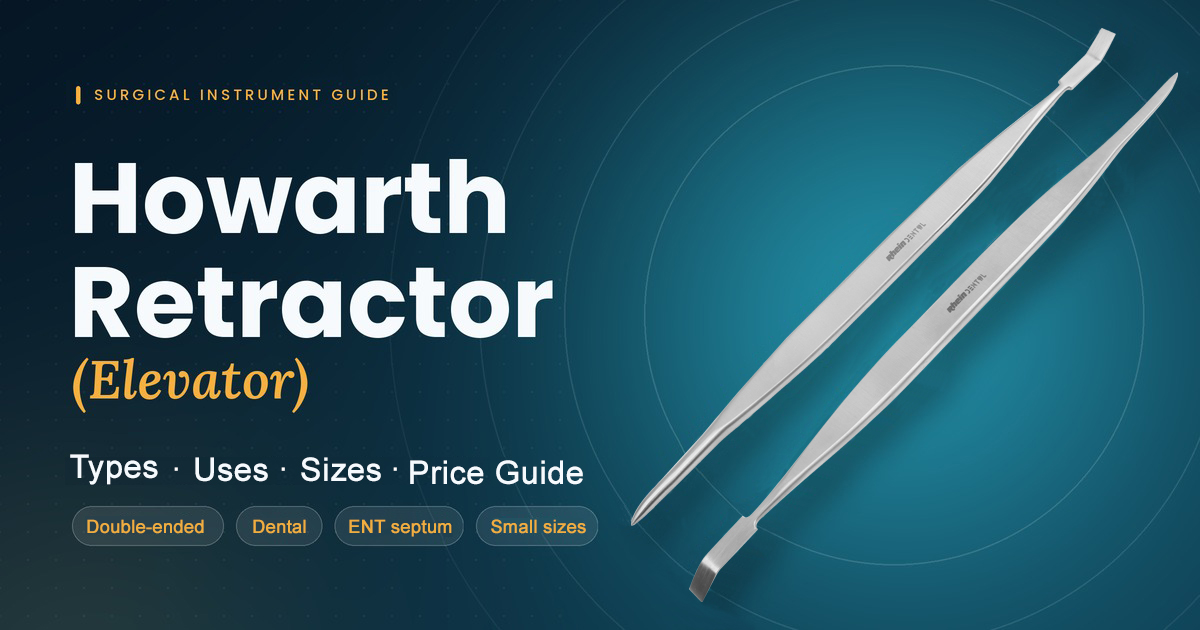
The Howarth retractor , more often sold as the Howarth elevator or Howarth periosteal elevator, is a slim, double-ended surgical instrument used to lift and hold back soft tissue and periosteum so the surgeon can see bone. Dentists and oral surgeons use it to reflect gum flaps, and ENT surgeons use a longer version to lift tissue from the nasal septum. This guide covers the types, how each is used, what it costs and what to check before you buy.
Howarth Elevator Double Ended: One Instrument, Two Working Ends
The classic Howarth retractor is double ended: a flat central handle with a long shaft and a small curved blade at each end. Because both ends are the same width, one instrument can work on either side of the mouth or nose without being swapped for a second tool.
A widely stocked version has a 6 mm blade on each end, stainless steel shafts and a flat handle for a balanced grip. Variants also exist with one sharper, one blunter end, and a shorter handle for dental work versus a longer one for ENT work.
Why surgeons like the double-ended design:
- The long shafts reach deep or narrow spaces, such as the area between tooth roots or high along the nasal septum.
- The thin blade slides under tissue with little trauma when used with gentle pressure.
- The second end gives a fresh working edge and a different angle in one sterile pack.
The same shape is the reason it is also called a retractor. Once the tissue is lifted, the blade holds it back so the surgeon can see and work.
Howarth Retractor Dental Uses
In dentistry, the Howarth retractor is a flap instrument. Suppliers describe it as made for reflecting and retracting the mucoperiosteum after the gum has been incised, which gives a clear view during extractions, especially when several teeth are removed at once.
Typical dental uses:
- Reflecting a gum flap before removing an impacted third molar or doing apical surgery.
- Working along the buccal (cheek-side) bone and into tight spaces between roots.
- Holding a flap back during implant placement, bone grafting or sinus access.
- Releasing the soft tissue attachment around a tooth before luxating it.
It is one of several flap elevators. The Molt No. 9 is shorter, with a pointed end for papillae and a spoon-shaped end for the flap. The Glickman has a small curved tip for periodontal flaps, and the Freer is slim and suited to sinus and nasal floor work. The Howarth stands out for its long shafts and small flat blades, which suit narrow access.
Howarth Mucoperiosteal Elevator: How a Flap Is Reflected
Mucoperiosteum is the layer of gum (mucosa) fused to the bone covering (periosteum). A mucoperiosteal elevator separates that layer from the bone so it can be lifted as a single flap without tearing.
- The surgeon makes the incision through gum and periosteum down to bone.
- The blade is placed at the edge of the cut, flat against the bone, with the tip under the periosteum.
- With light, controlled strokes, the blade peels the tissue away from the bone, working along the incision.
- Once the flap is lifted, the instrument or a separate retractor holds it back while the procedure is done.
- At the end, the flap is repositioned and sutured.
Two practical points. Keep the blade on bone, not in the soft tissue, because a blade that skids can cut the flap. And a pulling stroke can tear tissue if used carelessly, so a pushing or levering motion with a fulcrum on bone is safer. Training and the surgeon’s judgment decide the exact technique; this is an overview, not clinical instruction.
Howarth Septum Elevator (ENT)
The same design has a second life in ear, nose and throat surgery. A Howarth septum elevator is a double-ended instrument with blunt blades used to lift the mucosal lining off the nasal septum, for example in septoplasty.
A listed US device record describes one as double ended with a 5 mm blade and an overall length of 8-1/2 inches (216 mm). Another catalogue entry lists a Howarth nasal raspatory at 22 cm. Regulatory databases classify this kind of tool as an ENT elevator: a hand-held, reusable instrument with no cutting edge at the working end, used to lift or position tissue.
| Dental Howarth | ENT septum Howarth | |
|---|---|---|
| Main job | Reflect gum flaps | Lift septal mucosa |
| Typical blade | About 6 mm | About 5 mm |
| Typical length | Shorter | About 21.5 to 22 cm |
| Setting | Oral surgery | Nasal surgery |
The lengths and blade widths vary by maker, so always check the product specification rather than the name alone.
Choosing a Howarth retractor Instrument: Small Sizes, Materials and Care
When buyers search for an elevator Howarth small, they usually mean the narrow-blade version. Blades around 5 to 6 mm suit tight tooth sockets and nasal work, while broader blades cover more tissue but need more room. If you work in small spaces, go narrow.
What to check before buying:
- Material: surgical stainless steel that can be autoclaved repeatedly. Cheap steel may stain, dull or bend.
- Blade finish: smooth, with no burrs that could snag tissue. The edge should be rounded or blunt unless a sharp end is intended.
- Handle and balance: a flat, solid handle gives a firm grip; hollow or thin handles can flex.
- Dimensions: blade width at each end and total length, matched to your procedure.
- Certification: for clinical use, buy from a supplier that can show quality marks such as CE or FDA registration.
Care is straightforward. Clean off tissue right after use, run the instrument through an ultrasonic bath or washer, dry it fully, then sterilise it in an autoclave. Inspect the blade each time and replace it if it is bent, pitted or rough.
Howarth Elevator Price: What to Expect
A single stainless steel Howarth elevator generally costs a few hundred rupees or a few tens of pounds or dollars, depending on the brand, size and market. These are listing prices seen in search results around 26 October 2026; stock and prices change, so confirm at checkout.
| Supplier | Product | Listed price |
|---|---|---|
| Swallow Dental (UK) | Howarth Periosteal Elevator 6 mm / 6 mm | £25.25 (struck from £30.30) |
| Medikabazaar (India) | Oracraft Howarth Periosteal #6 | ₹457 (struck from ₹577) |
| Dentalkart (India) | GDC Periosteal Elevator Howarth (PH) | ₹588 (struck from ₹840) |
| Instrumentarium | Howarth periosteal elevator, 21.5 cm (HB.3610) | Account required to see price |
Why prices differ:
- Brand and origin: German-made OR-grade instruments cost noticeably more than generic stainless steel.
- Size and length: ENT septum versions are longer and usually cost more than dental ones.
- Pack size: single pieces, pairs and kits are priced differently.
- Supplier type: dental depots, surgical wholesalers and marketplaces all set different margins.
A very low price is not automatically a bargain. For clinical use, a well-finished instrument that survives hundreds of sterilisation cycles is cheaper per use than one that has to be replaced soon.