
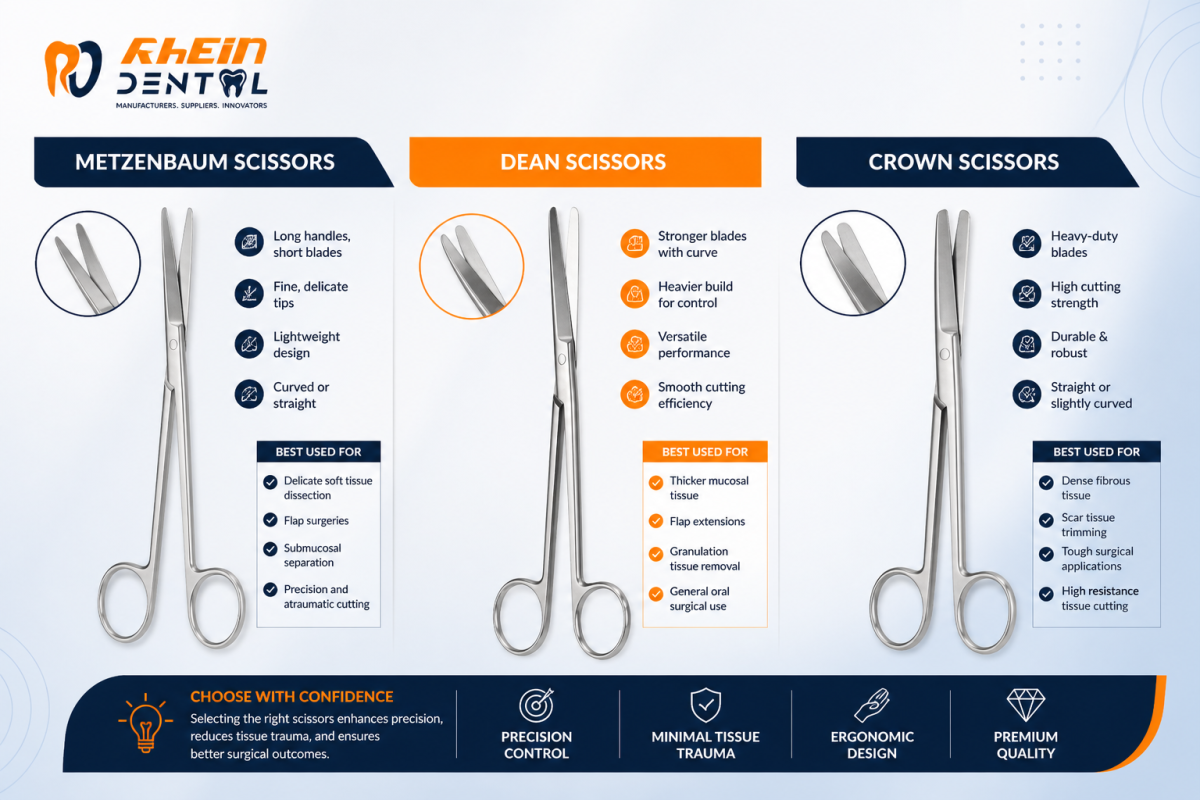
Every surgical scissor in a dental tray looks similar at first glance. Two blades, a pivot, a pair of rings. But compare a Metzenbaum against a Dean or a crown-and-collar scissor, and the differences stop being cosmetic. Blade length, tip shape, curvature, and shank design each solve a different problem. As a result, choosing the wrong scissor doesn’t just slow you down. It can tear tissue you meant to preserve, or dull a blade meant for something else entirely.
Metzenbaum Scissors: Built for Delicate Dissection
Surgeons use Metzenbaum scissors for blunt and sharp dissection of soft tissue. This includes periodontal flaps, mucosal undermining, and careful separation of fascial planes. The defining feature is a long, thin shank paired with short, blunt-tipped blades. Most versions curve gently.
This shank-to-blade ratio matters more than it looks. The long handle gives you reach and leverage into confined spaces, such as a narrow field around an impacted molar. You don’t need to force your wrist into an awkward angle. Meanwhile, the blunt tips lower the risk of accidentally perforating tissue you want to protect. That risk becomes real when you work near a mucoperiosteal flap or close to a nerve bundle.
Metzenbaum blades come in fine, medium, and heavy variants. Fine-blade versions flex more, so surgeons reserve them for delicate mucosal work. Heavier variants hold up better against thick connective tissue, but they sacrifice some precision. Most oral surgeons prefer curved Metzenbaums over straight ones. The curve follows the natural contour of the surgical site and improves visibility around the blade tip.
Where Metzenbaum outperforms: blunt dissection, undermining flaps, and separating tissue planes where control matters more than raw cutting force.
Where it struggles: dense fibrous tissue, or any task that needs a sharp, decisive cut. The blunt tips aren’t built for that. Forcing them through resistant tissue also wears down the pivot joint faster.
Dean Scissors: Precision in Tight Pediatric and Anterior Fields
Dean scissors are shorter and more angled than Metzenbaums. A distinct bend near the blade tip lets you cut tissue without the handle blocking your line of sight. This detail matters enormously in pediatric dentistry and anterior oral surgery, where the field is small and every millimeter of visibility counts.
The angled tip is the whole point of a Dean scissor. In a Metzenbaum, the blade sits roughly in line with the shank. In a Dean, the blade angles downward relative to the handle. So your hand stays clear of the operative site instead of hovering directly over it. That’s why Dean scissors show up so often in pediatric extractions, frenectomies, and any procedure where you work close to the midline with limited access.
However, Dean scissors aren’t a workhorse instrument. Because the blades are shorter and the tips finer, they’re the wrong choice for bulk tissue removal or dissecting through thicker planes.
Where Dean outperforms: frenectomies, pediatric soft-tissue procedures, and anterior surgical sites where visibility matters most.
Where it struggles: procedures that need extended reach, or cutting through resistant, fibrous tissue.
Crown-and-Collar Scissors: A Different Job Entirely
Here, the comparison shifts. Crown-and-collar scissors aren’t soft-tissue instruments at all. Surgeons and technicians use them to cut stainless steel crowns, orthodontic bands, and matrix material. As a result, their blade geometry has almost nothing in common with the other two. The blades are shorter, thicker, and often serrated or notched near the pivot to grip metal instead of tissue. One blade typically carries a slight curve or hook, so it can slide under the margin of a stainless steel crown without gouging the tooth structure underneath.
Including crown-and-collar scissors in this comparison serves a purpose: it clarifies what the other two instruments are not for. If you reach for a Metzenbaum to trim a stainless steel crown, you’ll blunt an expensive soft-tissue instrument almost immediately. The blade angle and thin edge simply aren’t tempered for metal. Crown-and-collar scissors solve a completely different mechanical problem instead shearing rigid metal cleanly at a defined margin, not separating soft tissue planes.
Where crown-and-collar outperforms: trimming stainless steel crowns, and cutting orthodontic bands and matrix bands.
Where it has no place: any soft-tissue dissection. Using it there risks crushing tissue instead of cutting it.
Side-by-Side: Matching the Scissor to the Task
| Feature | Metzenbaum | Dean | Crown-and-Collar |
|---|---|---|---|
| Primary use | Blunt/sharp soft-tissue dissection | Precision cuts in tight anterior/pediatric fields | Cutting stainless steel crowns, bands |
| Blade tip | Blunt, rounded | Fine, angled | Short, notched/curved for metal |
| Shank length | Long | Short to medium | Short |
| Best for tissue type | Fascia, mucosa, connective tissue | Fine mucosal tissue, frenum | Not for tissue — rigid metal only |
| Typical setting | General oral/periodontal surgery | Pediatric dentistry, frenectomy | Restorative/pediatric crown adjustment |
A Practical Rule of Thumb
If you’re separating or undermining tissue and need reach and control, choose Metzenbaum first. If you’re working in a small pediatric or anterior field where visibility limits you, pick Dean instead. And if metal — not tissue sits on the table, only crown-and-collar scissors from this list belong in your hand.
Maintenance Note
All three instrument types lose precision the same way: through use outside their intended purpose. For example, tissue scissors dull faster when you cut suture material with them than when you cut actual tissue. Similarly, even brief contact with metal can misalign the pivot. So keep dedicated scissors for dedicated jobs. Sharpen or replace them based on the resistance you feel during use, not just visible wear.